Passenger Van and Worker Transport in Singapore: Vehicle Choices, LTA Rules and Compliance
For workforce transport in Singapore you’re choosing between 13/18-seater minibuses, full-size private buses, or lorries fitted with a canopy — each with different licence classes, capacity limits and compliance loads. Lorry-based worker transport remains legal but is under active tightening: canopies, side railings and rain covers are already mandatory, and from 1 January 2027 caged lorry decks specifically will be banned. Most fleets moving 10+ workers regularly are better served by a minibus or private bus once you weight in compliance risk and reputational exposure.
Key Takeaways
- Four real options exist: 13-seater passenger vans, 18-seater minibuses, full-size private buses/omnibuses, and canopy-fitted lorries — each sits at a different point on the capacity-versus-compliance curve.
- Lorry worker transport is still permitted, but heavily conditioned: rain covers, side railings of at least 700mm, seating height capped at 1.1m, and a minimum 0.372m² (4 sq ft) per seated worker are already required by law.
- Caged lorry decks are being banned from 1 January 2027. Operators using cage-style rear decks must retrofit to canopy-plus-railings before that date or stop using the lorry for passengers.
- Licence classes differ sharply by vehicle: a 13-seat-and-under car-derived vehicle can run on Class 3/3A, but anything carrying more than 7 passengers — minibus, bus, or omnibus — needs a Class 4 licence plus a vocational licence, and Class 4A is reserved for public transport bus captains only.
- Speed limiters are a lorry-specific mandate, not a bus one — the phased 2024–2027 Traffic Police requirement targets lorries with MLW between 3,501kg and 12,000kg, capping them at 60km/h, with a compliance label on the front windscreen. Bus-specific speed limiter mandates are governed by separate, older rules not fully detailed in current public guidance.
- The safest choice isn’t always the cheapest per head. Lorries move the most workers per dollar but carry the highest compliance and reputational burden; minibuses and buses cost more per seat but offload most of that burden onto a professional PSV operator.
Table of Contents
- Worker Transport Modes Compared
- LTA and MOM Rules for Lorries Carrying Workers
- The 2027 Caged Lorry Deck Ban
- Licence Classes Required by Vehicle Type
- Speed Limiters and Mandatory Signage
- Choosing the Right Mode for Your Operation
- Compliance Checklist
- FAQ
- Sources
Worker Transport Modes Compared
Most fleet managers moving workers to worksites in Singapore — construction, marine, landscaping, cleaning contractors — default to whatever mode the company has always used, usually because a lorry was already on the books for materials. That’s worth revisiting, because the four realistic modes sit at genuinely different points on capacity, cost, comfort and compliance.
13-seater passenger vans/minibuses. These are the smallest dedicated passenger option beyond a car, typically built on a light commercial van chassis (Toyota HiAce-class vehicles and similar). They’re comfortable, air-conditioned, and familiar to drivers who already hold a Class 3 licence for other duties — though as covered below, once seating exceeds 7 passengers the licensing picture changes. Good for site supervisors, small crews, or feeder runs between dormitories and a larger vehicle pickup point.
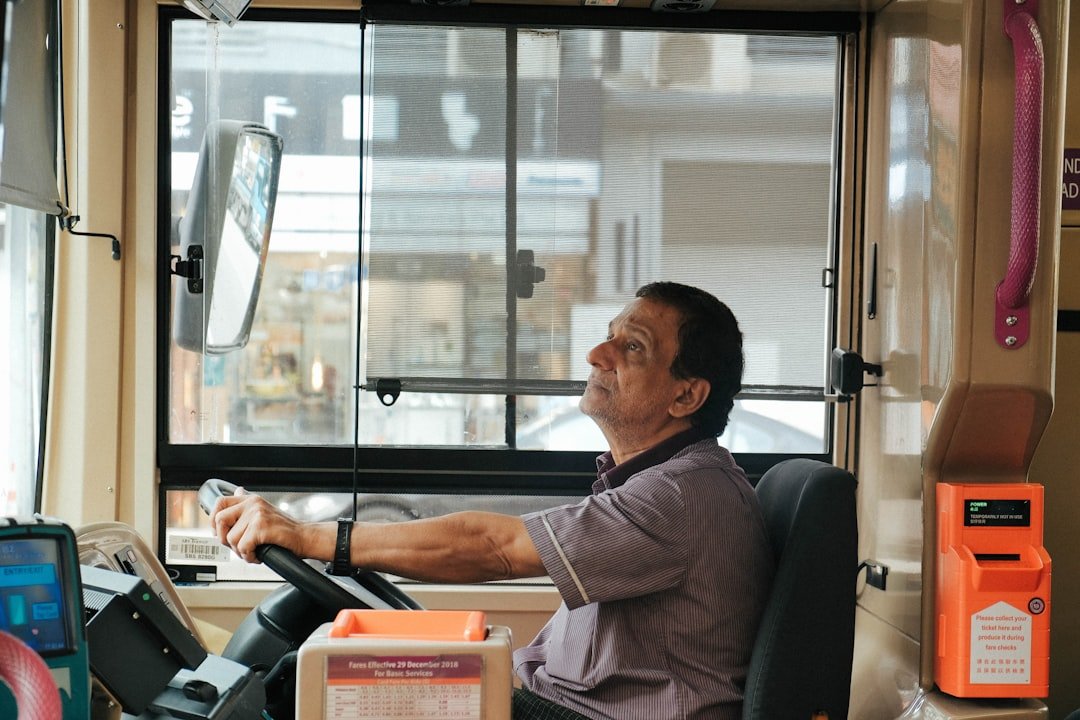
18-seater minibuses. The step up in capacity brings a step up in vehicle classification — these are omnibuses under LTA’s definitions, not cars, which means Class 4 licensing and vocational licensing requirements kick in regardless of how light the vehicle itself is. Comfort is broadly similar to the 13-seater tier (forward-facing seats, seatbelts, air-conditioning), but the driver pool is smaller because not every Class 3 holder has upgraded to Class 4.
Full-size private buses/omnibuses. These are the buses you see contracted to move large construction crews or dormitory populations in one run — typically 40 to 60 seats. They’re registered as private buses (as distinct from public-service omnibuses run by SBS Transit/SMRT) and are usually operated by a dedicated private bus company rather than owned in-house, because the vocational licensing, maintenance and insurance overhead rarely makes sense for a single fleet to carry alone. Comfort and safety compliance is the highest of any road-based option — proper seatbelts, professional PSV drivers, scheduled maintenance under a bus operator’s certificate.
Lorries fitted with canopies. This is the option most associated with Singapore’s construction and marine sectors, and it is the most regulated of the four by a wide margin — precisely because it repurposes a goods vehicle for passenger transport rather than using a vehicle purpose-built for people. It is also, per seat, usually the cheapest option since the same lorry can carry materials on one run and workers on the next. That flexibility is exactly why it remains in wide use despite the compliance load — but as covered in the next two sections, that load has been increasing steadily since 2022 and is about to increase again.
On driver behaviour and hours across all four modes, the same fatigue and conduct issues that apply to goods-vehicle drivers apply here — our guide to fatigue management for commercial drivers in Singapore is directly relevant if your drivers double up between goods runs and worker transport shifts, which MOM’s rules specifically address (see below).
Where a driver has been working onsite for six or more hours before being asked to drive workers home (“dual-role” driving), MOM’s advisory requires employers to give that driver a rest period of at least 30 minutes before they get behind the wheel. This is a genuine, cited requirement from the joint LTA-MOM-SPF safety measures, not a general best-practice suggestion — build it into your shift roster, not just your safety poster.
LTA and MOM Rules for Lorries Carrying Workers
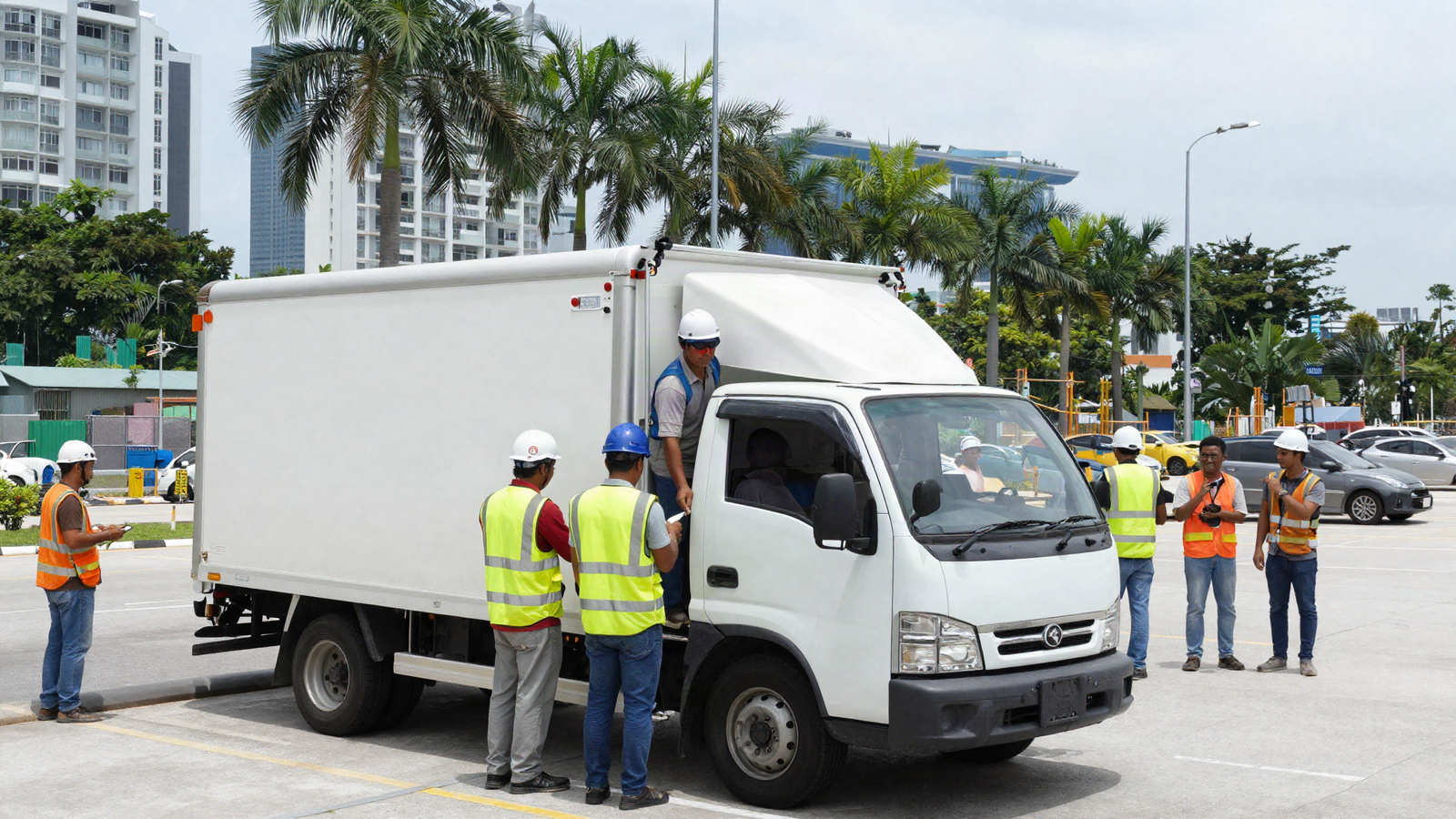
Using a lorry to transport workers on the open rear deck is a long-standing and heavily regulated practice in Singapore, tightened significantly following past fatal accidents involving lorries carrying workers. Following a series of incidents, LTA, MOM and the Singapore Police Force jointly rolled out a package of measures from 2022, with staged effective dates running into 2024. The current baseline rules for lorries carrying workers on the rear deck include:
- Canopy and side railings: the rear deck must be fitted with a canopy and protective side railings of at least 700mm from the deck floor.
- Rain covers: waterproof canvas tarps must cover all non-enclosed sections of the deck, including partially open gaps, with at least one side made of transparent material so workers aren’t riding in the dark. This was phased in — newly registered lorries from 1 January 2023, existing light lorries from 1 July 2023, and existing heavy lorries from 1 January 2024.
- Seating height and space: seating on the rear deck may not exceed 1.1m above the deck floor, and each seated worker must have a minimum of 0.372m² (roughly 4 sq ft) of space.
- Maximum Passenger Capacity label: the rear tailboard must display a label stating the maximum number of workers the deck may carry, calculated from the deck’s dimensions against the per-worker space rule above — so the actual headcount cap varies by lorry size rather than being a single fixed national number. We could not find a single universal maximum-worker figure published by LTA/MOM; the cap is deck-area-dependent per vehicle.
- Seating order: all seats in the front cabin must be filled before any worker is carried on the rear deck.
- No projecting body parts: workers must be seated properly and may not have limbs or any body part extending beyond the sides of the vehicle.
- Speed cap while carrying workers: the posted speed limit or 60km/h, whichever is lower.
- Vehicle person-in-charge (V-PIC): every lorry ferrying workers on the rear deck must have a designated person seated beside the driver, empowered to intervene — including halting the journey — if the driver appears unfit to continue.
- No handheld mobile device use by the driver while the vehicle is in motion.
- Driver working hours: drivers may not work more than 12 hours a day inclusive of overtime, and dual-role drivers need the 30-minute rest period noted in the callout above.
One area regulators deliberately did not mandate is seatbelts on the rear deck. In a parliamentary reply, the government explained that consultations with industry and academia found that retrofitting seatbelts onto existing lorries could compromise the vehicle’s structural integrity and introduce new safety risks — and that lorry manufacturers won’t fit seatbelts to a rear deck on new vehicles or vouch for their safety if fitted. That’s a genuine, documented finding — not an oversight — and it’s part of why the newer 2026 measures (below) focus on structural changes to the deck enclosure itself rather than occupant restraint.
If your lorry’s rear deck is enclosed by a cage-style structure with a gate that latches or locks from the outside, treat this as an active compliance deadline, not a future concern. Regulators have specifically flagged that a locked or latched cage gate can trap workers inside during an emergency — this is the direct rationale for the ban covered in the next section.
The 2027 Caged Lorry Deck Ban
In March 2026, LTA and the Ministry of Transport announced a further, more decisive measure: the ferrying of workers in caged lorry decks will be banned outright from 1 January 2027. The safety rationale cited is specific — a caged deck with a gate latched or locked from the outside creates a real risk of trapping workers in an accident, fire, or other emergency where fast egress matters.
What this means in practice for fleet operators:
- Lorries may continue to use cage structures for goods and equipment — the ban applies specifically to using a caged deck to carry workers.
- If you want to keep using a lorry for worker transport past 1 January 2027, the cage must be retrofitted to a canopy-and-side-railings configuration (the same configuration already required under the 2022–2024 measures above), plus rain covers.
- Penalties for non-compliance had not been finalised at the time of the March 2026 announcement — government has said specifics will be communicated ahead of the ban date, following further engagement with industry and NGO stakeholders.
- Until the ban takes effect, firms are still required to maintain safe worker access to and from the lorry deck under existing rules.
For fleet managers, the practical takeaway is to audit your rear-deck lorries now rather than waiting for the deadline. If any of your fleet still uses cage-style enclosures, budget for the retrofit (or for switching those routes to a minibus or private bus) well before late 2026, since retrofit slots at authorised workshops are likely to compress as the deadline approaches. This is an expectation based on typical compliance-deadline behaviour in Singapore’s commercial vehicle sector; no official capacity warning has been issued yet.
Licence Classes Required by Vehicle Type
Licensing is where a lot of fleet managers get tripped up, because the class boundary isn’t just about vehicle weight — it’s about how many passengers the vehicle is built to carry.
- Class 3 / 3A: covers motor cars constructed to carry up to 7 passengers (excluding the driver) with an unladen weight not exceeding 3,000kg. Class 3A is the automatic-transmission equivalent. This covers a standard car-derived people-mover but not a proper 13-seat minibus.
- Class 4: covers heavy motor vehicles and heavy motor tractors, generally with unladen weight exceeding 2,500kg — and this is the class that captures minibuses, private buses and omnibuses used for worker transport once passenger count exceeds what a Class 3 vehicle is built for. A driver must hold Class 3 for at least one continuous year before qualifying to add Class 4.
- Class 4A: covers heavy omnibuses used on scheduled public services charging distinct fares — in practice this class is restricted to bus captains employed by a public transport operator (SBS Transit, SMRT). A private employer running its own worker-transport bus cannot use Class 4A drivers for that purpose; Class 4 is the relevant class for private/excursion/company buses.
- Class 5: covers locomotives (trains) — not relevant to any road-based worker transport vehicle, included here only to close out the full class list for completeness.
On top of the base driving licence, most bus types require a vocational licence layered on top: a Bus Driver’s Vocational Licence (BDVL) for private hire, excursion and school buses, or an Omnibus Driver’s Vocational Licence (ODVL) for public-service omnibus driving. Private bus operators moving workers under contract — as opposed to an in-house company shuttle solely for employees — will generally need drivers holding Class 4 plus BDVL. Note that a lorry driver moving workers on the rear deck is licensed according to the lorry itself (typically Class 3 or Class 4 depending on the lorry’s own weight class), not according to how many people happen to be riding on the deck — the licensing framework tracks the vehicle type, while the worker-safety rules in the previous section track the passenger arrangement.
If you’re auditing driver files against vehicle assignments, this is a good moment to cross-check against our broader piece on MOM driver compliance requirements in Singapore, since licence-class mismatches are one of the more common (and easily fixed) gaps we see in fleet audits.
Speed Limiters and Mandatory Signage
Traffic Police’s mandatory speed limiter rules are a lorry-specific requirement, not a bus-wide one. The threshold that triggers the requirement is Maximum Laden Weight (MLW), not seating capacity: lorries with an MLW between 3,501kg and 12,000kg (inclusive) must be fitted with a speed limiter capping the vehicle at 60km/h. This was an expansion of an earlier rule that applied only to heavier goods vehicles, rolled out specifically as part of the same 2022 worker-transport safety package described above — the logic being that a large share of lorries used to ferry workers fall inside this weight band.
The rollout is staggered by registration date and weight tier:
| Lorry category | MLW range | Compliance deadline |
|---|---|---|
| Registered before 1 Jan 2018 | 5,001–12,000kg | 1 January 2026 |
| Registered before 1 Jan 2018 | 3,501–5,000kg | 1 July 2026 |
| Registered 1 Jan 2018 or later | 5,001–12,000kg | 1 January 2027 |
| Registered 1 Jan 2018 or later | 3,501–5,000kg | 1 July 2027 |
| Newly imported lorries | Any within the above band | Required from 1 January 2026 to obtain registration |
Once fitted, the speed limiter comes with a mandatory compliance label that must be visibly displayed at the top right portion of the front windscreen, as seen from outside the vehicle — failing to display the label is a separate offence from failing to fit the device at all. Installation must be carried out by an authorised agent; installing one after your deadline has passed does not retroactively clear you of penalties for the period you were non-compliant.
Separately, a longer-standing and more general rule requires light commercial vehicles and small buses to display a rear speed-limit label — white characters on a black background, affixed prominently and indelibly to the rear left or right side of the vehicle. This is a different requirement from the front-windscreen speed limiter compliance label above; fleet managers sometimes conflate the two. The exact scope of which small-bus categories this older rear-label rule covers was not fully specified in the sources we could access; verify against your specific vehicle’s registration category with LTA if unsure.
Full-size buses used for worker transport are not captured by the 3,501–12,000kg lorry-focused speed limiter mandate described above, since most buses in this role sit outside that weight band or are already governed by separate public-service-vehicle rules. Bus-specific speed governance is handled under different, older provisions than the 2022–2027 lorry rollout, and operators should confirm their specific bus’s obligations with their PSV operator or LTA rather than assuming exemption.
For enforcement context beyond LTA’s own rules — including how Traffic Police handle speeding and vehicle equipment violations on the road — our companion piece on Traffic Police rules for commercial vehicles in Singapore is a useful cross-reference for fleet managers building out a full compliance file.
Choosing the Right Mode for Your Operation

There’s no single “right” answer here — it depends on group size, route regularity, and how much compliance overhead you’re prepared to own in-house versus outsource to a bus operator. A few practical decision points:
- Under 13 workers, ad hoc routes: a 13-seater van is usually the simplest option — familiar Class 3/4 licensing pool, low fixed cost, and no vocational licensing overhead if it’s a straightforward company-owned van rather than a licensed private bus service.
- 13–18 workers, regular fixed route: an 18-seater minibus gives you the capacity step-up, but budget for the Class 4 + BDVL driver requirement and the vocational licensing that comes with operating it as a bus rather than a large van.
- 40+ workers, dormitory-to-site shuttle: contracting a private bus operator is usually more cost-effective than trying to run this in-house, because the operator already carries the PSV licensing, maintenance schedule and driver vocational licensing as their core business.
- Mixed goods-and-worker runs, cost-sensitive operations: the canopy-fitted lorry remains the most flexible and cheapest per-head option, but only makes sense if you’re committed to the full compliance package — canopy, side railings, rain covers, V-PIC, driver hours tracking, and the 2027 cage retrofit if applicable. We could not verify current market day-rate figures comparing lorry versus minibus versus bus hire in Singapore; treat any specific dollar comparison you’re offered by a vendor as a quote to verify, not an industry benchmark.
Comfort and reputational exposure are also worth weighting explicitly, not just cost per seat. An open lorry deck in Singapore’s climate — heat, sudden rain even with covers, road vibration — is a materially different experience for a worker than an air-conditioned minibus or bus, and this has become a visible public and media issue following past accidents. If your company’s brand, client contracts, or dormitory operator relationships are sensitive to how workers are seen being transported, that’s a legitimate factor in the mode decision, not just a compliance one.
Heat exposure is also becoming a formal compliance point: WorkRightSG (a sister site) covers the new heat-stress rules for outdoor workers.
| Mode | Typical capacity | Licence class required | Vocational licence | Compliance burden |
|---|---|---|---|---|
| 13-seater passenger van/minibus | Up to 13 | Class 4 (exceeds Class 3’s 7-passenger limit) | Generally not required for pure in-house employee shuttle use (depends on whether the vehicle is registered/operated as a licensed bus service) | Low–moderate |
| 18-seater minibus | Up to 18 | Class 4 | BDVL typically required if operating as a private bus service | Moderate |
| Full-size private bus/omnibus | 40–60+ | Class 4 (Class 4A restricted to public transport operators only) | BDVL (private) / ODVL (public service) | Moderate–high, but largely owned by the contracted bus operator |
| Lorry with canopy (rear-deck worker transport) | Deck-area-dependent, per Maximum Passenger Capacity label | Class 3 or Class 4, per the lorry’s own weight class | Not applicable — lorry driver licensing, not bus licensing | High — canopy, railings, rain covers, V-PIC, speed cap, 2027 cage ban, speed limiter (if MLW 3,501–12,000kg) |
Compliance Checklist
- Match driver licence class to vehicle type — confirm every driver assigned to a minibus, bus or omnibus holds Class 4 (not just Class 3), and that any private bus driver also holds a current BDVL.
- Audit rear-deck lorries for cage structures and schedule retrofit to canopy-plus-railings well ahead of the 1 January 2027 ban.
- Verify canopy, side railings (≥700mm) and rain covers are fitted and in good condition on every lorry currently used for worker transport.
- Check the Maximum Passenger Capacity label is present, legible and accurate on the rear tailboard of every worker-transport lorry.
- Confirm speed limiter installation and windscreen label for any lorry with MLW between 3,501kg and 12,000kg, against the staggered 2026/2027 deadlines above.
- Designate and brief a V-PIC for every lorry run carrying workers on the rear deck, and confirm they understand their authority to halt the journey.
- Track driver working hours, especially dual-role drivers who worked onsite before driving — build the 30-minute rest rule into the roster, not just the policy document.
- Review accident and incident history for your worker-transport routes and vehicles as part of ongoing risk management — our overview of commercial vehicle accident statistics in Singapore is a useful benchmark when building the business case for upgrading from lorry to minibus or bus.
FAQ
Is it still legal to transport workers on the back of a lorry in Singapore?
Yes, as of publication it remains legal, subject to the canopy, side railings, rain cover, seating space and speed conditions covered above. However, from 1 January 2027, caged lorry decks specifically will be banned for carrying workers — a canopy-and-railings configuration will be required instead if you want to continue using a lorry for this purpose.
What licence does a driver need to drive an 18-seater minibus carrying workers?
A Class 4 licence, since the vehicle carries more than the 7-passenger limit covered by Class 3. If the minibus is operated as a licensed private bus service rather than a pure in-house company shuttle, the driver will typically also need a Bus Driver’s Vocational Licence (BDVL).
Can a private employer’s driver hold a Class 4A licence?
Generally no. Class 4A is specifically for omnibuses on scheduled public services charging distinct fares, and in practice is restricted to bus captains employed by public transport operators like SBS Transit or SMRT. Private/company bus drivers use Class 4 instead.
Do all lorries need speed limiters?
No — the mandate applies specifically to lorries with a Maximum Laden Weight between 3,501kg and 12,000kg, phased in against deadlines running from January 2026 through July 2027 depending on registration date and weight tier. Lorries outside that weight band, and most full-size buses, sit outside this particular rule. Always confirm your specific vehicle’s obligations directly with LTA/Traffic Police, since weight-band rules can be updated.
Is there a maximum number of workers allowed on a lorry deck?
There’s no single fixed national number — the cap is calculated per vehicle from the deck’s dimensions against the minimum 0.372m² (4 sq ft) per seated worker requirement, and must be displayed on a Maximum Passenger Capacity label on the rear tailboard. This is based on available published guidance; if you need the exact cap for a specific lorry model, confirm it against that vehicle’s certified specifications.
Why weren’t seatbelts made mandatory on lorry rear decks?
The government found, through consultation with industry and academia, that retrofitting seatbelts onto existing lorries could compromise the vehicle’s structural integrity and create new safety risks — and that manufacturers won’t fit seatbelts to a rear deck on new lorries or vouch for their safety if fitted. This is why the safety measures instead focus on canopy structure, railings, seating space and the upcoming cage ban rather than occupant restraints.
What’s the difference between a private bus, an omnibus, and a school bus in Singapore’s classification?
These are distinct private bus categories under LTA’s framework — private hire bus, private bus, excursion bus, school bus and omnibus — most requiring a Category C or E COE, with school buses exempt from COE but no longer available as new registrations (existing plates trade on the resale market only).
Should I switch from lorries to minibuses purely for compliance reasons?
Not purely — it depends on group size, route regularity and budget, but compliance burden and reputational exposure are legitimate factors to weigh alongside cost per seat. For larger, regular worker movements, many operators find that offloading the licensing and maintenance burden to a contracted private bus operator is worth the higher headline cost.
Sources
- LTA/MOT Joint News Release: Additional Measure for Safer Worker Transportation (caged lorry ban, March 2026)
- Mothership.SG: Ferrying workers in caged lorries to be banned from 1 Jan 2027
- LTA/MOM/SPF Joint Factsheet: Update on Measures to Enhance Safety of Worker Transportation
- LTA: Additional Measures to Enhance Safety of Worker Transportation (March 2022)
- MOM: Inter-Agency Advisory on Safe Transportation of Workers
- LTA: Private Bus Licence and Operation
- LTA OneMotoring: Bus Driving Licence and Vocational Licence Requirements
- Singapore Police Force: Speed Limiter Announcement
- Singapore Statutes Online: Road Traffic (Motor Vehicles, Driving Licences) Rules
- Workplace Safety and Health Council: Safe Transportation of Workers on Lorries
Written by the SGFleetGuide editorial team. Last updated: 12 September 2026.