How to Trade In or Sell a Commercial Vehicle in Singapore: Steps, Documents and Getting the Best Price
Selling or trading in a commercial vehicle in Singapore means three parallel tracks: settling any outstanding hire purchase loan with your finance company, transferring ownership to the buyer or dealer through LTA within 7 days (online via Singpass in most cases), and deciding what happens to the remaining COE — either it moves with the vehicle to the new owner, or you deregister and claim a pro-rated COE rebate. Category C commercial vehicles get no PARF rebate on deregistration, which changes the trade-in-versus-scrap math compared to a private car.
Key Takeaways
- Ownership transfer must happen within 7 days: LTA requires the change of ownership to be completed within a week of the sale, mostly done online via Singpass for a $25 fee — not at a physical counter, unless your situation falls into a specific exception category.
- Settle the loan before you transfer anything: if the vehicle is financed, your bank or finance company holds an interest in it until the balance is cleared — get a settlement figure and letter of discharge before you agree on a sale price with a buyer or dealer.
- No PARF rebate on Category C: unlike a private car, a goods vehicle or bus gets zero PARF rebate when deregistered — only a pro-rated COE rebate if COE time remains. This makes the trade-in-vs-scrap decision far more sensitive to remaining COE tenure than for passenger cars.
- Company-owned fleet vehicles need ACRA paperwork: if the registered owner is a company, LTA requires an original ACRA business profile printout (valid up to 14 days) plus ID of an authorised director, sole proprietor, partner, or a manager with written authorisation.
- Condition and records move price more than age alone: a well-documented service history, clean logbook, and no unexplained mileage gaps typically get a materially better trade-in quote than an unverifiable “trust me” vehicle of similar age.
- Get more than one valuation before you commit: a single dealer’s trade-in quote is a starting offer, not a market price — cross-checking against at least one other buyer or an independent valuation is the single easiest way to avoid leaving money on the table.
A note on independence: SGFleetGuide does not broker, buy, or sell vehicles, and has no commercial relationship with any dealer or trade-in service — this guide exists to walk you through the process yourself, not to steer you toward anyone.
Table of Contents
- The Trade-In / Resale Process, Step by Step
- Settling Outstanding Finance Before You Sell
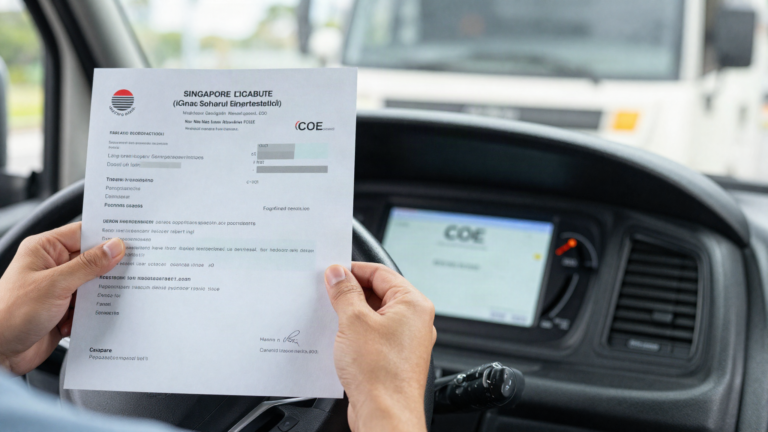
- Documents You’ll Need
- How LTA Ownership Transfer Actually Works
- Deregistration vs Transfer: What Happens to the COE
- Road Tax and Insurance Cut-Off
- What Actually Drives Your Resale Price
- Getting Multiple Valuations Without Getting Lowballed
- The Trade-In vs Scrap Decision Point
- FAQ
- Sources
The Trade-In / Resale Process, Step by Step
Whether you’re trading a van into a dealer against a new purchase or selling a lorry directly to another operator, the mechanics behind the scenes are the same. Only the paperwork ownership changes hands. Here’s the sequence in the order it actually happens on the ground, not the marketing-brochure version:
- Step 1 — Get a settlement figure. If the vehicle is financed, call your bank or finance company for the exact outstanding balance and early settlement terms. This number sets your real floor price — you cannot legally transfer a vehicle with an unresolved charge against it.
- Step 2 — Get the vehicle valued. Approach the dealer you’re buying from (for a trade-in), a used commercial vehicle buyer, or run it past a couple of independent parties. Bring your service records; a vague verbal estimate without documents is not a real quote.
- Step 3 — Agree the deal structure. For a trade-in against a new or another used vehicle, the trade-in value is usually netted off the new vehicle’s price — confirm in writing whether GST, COE handling, and any loan settlement shortfall are baked into that net figure or billed separately. If you’ve financed the current vehicle, see our guide on refinancing a commercial vehicle loan for how outstanding balances interact with a new purchase.
- Step 4 — Settle the loan. Once a price is agreed, the buyer’s payment (or the dealer’s trade-in credit) is used to clear the outstanding loan first, with any surplus paid to you. Your finance company issues a letter of discharge once the balance is cleared — this is what proves the vehicle is unencumbered.
- Step 5 — Decide the COE path. The COE either transfers with the vehicle to the new owner (most common when selling to another operator or dealer) or you deregister and claim a pro-rated COE rebate. This decision needs to be locked in before you initiate the LTA transfer, because it determines which LTA transaction you’re actually filing. See the COE handling section below.
- Step 6 — Transfer ownership through LTA. Both parties complete the transfer online via Singpass (or at a counter in specific exception cases), within 7 days of the sale.
- Step 7 — Handle road tax and insurance. Road tax runs with the vehicle and is typically apportioned or refunded; insurance is cancelled by the seller and taken out fresh by the buyer, effective from the transfer date.
- Step 8 — Confirm and file. Both parties get an SMS confirmation once the transfer completes. Keep it, along with the settlement letter and the final invoice, in your company’s records — not just for accounting, but because ACRA-registered fleet owners occasionally need this trail for audits or GST reconciliation.
If you’re on the other side of this transaction — acquiring a replacement vehicle rather than just disposing of the old one — it’s worth reading our guide to buying a commercial vehicle in Singapore alongside this one, since the COE bid and registration timeline on the new vehicle needs to be sequenced against your old vehicle’s disposal.
Don’t let the trade-in conversation and the loan settlement conversation happen separately with two different people at the dealer. Get one written breakdown that shows: trade-in value, loan settlement amount, and the net figure applied to your new purchase. Verbal “don’t worry, it’ll work out” answers are where fleet owners get surprised at signing.
Settling Outstanding Finance Before You Sell
Most commercial vehicles in Singapore are financed through hire purchase agreements running 5 to 7 years, and the finance company retains a legal interest in the vehicle until the loan is fully repaid — practically, this means you cannot transfer ownership cleanly while a balance remains outstanding. The standard sequence is:
- Request an official settlement figure (not your own amortisation estimate — banks often charge early settlement rebate adjustments or fees that change the exact number).
- Compare that figure against your expected sale or trade-in value. If the vehicle is worth less than the outstanding loan — a real possibility on a heavily depreciated goods vehicle with COE running down — you’re in negative equity and need to fund the shortfall out of pocket or via the new purchase’s financing.
- Once payment clears, obtain the letter of discharge / loan settlement letter from your finance company. This document is what confirms to LTA and the buyer that the vehicle is free of encumbrance and can be transferred.
Fleet owners running several financed vehicles should also check whether any cross-collateralisation or blanket security arrangement exists across the fleet — some SME financing packages tie multiple vehicles to a single facility, which changes what “settling this vehicle’s loan” actually requires administratively.
Documents You’ll Need

Because SGFleetGuide’s audience is mostly company-owned fleet vehicles rather than individually-owned ones, the document list below includes the ACRA and authorisation paperwork that a private car sale wouldn’t need.
| Document | Who needs it | Why it’s required |
|---|---|---|
| Vehicle log card | Seller | Confirms current registration details, engine/chassis numbers, and ownership history against LTA’s records |
| Loan settlement letter / discharge letter | Seller (if financed) | Proves the vehicle is free of any outstanding charge before transfer can proceed |
| Original ACRA business profile printout (valid up to 14 days) | Buyer and/or seller, if a company | LTA requires this to verify the company as registered owner or incoming owner |
| NRIC / Employment or Immigration Pass of an authorised signatory | Company buyer/seller | Must be a director, sole proprietor, partner named on the ACRA printout, or a manager with written authorisation from one of them |
| Written letter of authorisation | Company representative not listed on ACRA | Required if the person submitting the transaction isn’t a director/partner/sole proprietor themselves |
| Motor insurance certificate (new policy) | Buyer | Buyer’s insurance must be in force covering the full road tax period before the vehicle can legally be used |
| Vehicle inspection certificate | Both, where applicable | Some transactions (older vehicles, certain transfer types) require a current inspection pass |
| Service and maintenance records | Seller | Not an LTA requirement, but the single biggest lever you have to justify a higher valuation — see the next section |
| Parking certificate | Buyer, for heavy goods vehicles | Required for heavy goods vehicle registrations under the buyer’s name, covering the full road tax period |
For a fuller checklist covering the buyer’s side of a used commercial vehicle transaction — what to inspect, what to ask for — see our used commercial vehicle buying checklist.
How LTA Ownership Transfer Actually Works
LTA’s transfer-of-ownership process is largely digital now, and understanding the default path (versus the exceptions) saves a wasted trip to a service centre.
The default: online transfer via Singpass. Ownership must be transferred within 7 days of the sale. The seller initiates with the vehicle registration number and the buyer’s identification details (NRIC, FIN, or company registration for a corporate buyer), name, mobile number, and email. The buyer then completes their side with valid payment (credit/debit card or internet banking) and confirmation that motor insurance is in force in their name for the full road tax period. The transfer fee is $25, payable via NETS or PayNow. Both parties get an SMS confirmation once it’s done.
Counter-based transfers are the exception, not the default — required only for light goods vehicles bought by hawkers or farmers under specific licence conditions, diplomatic vehicles, or where a party is a foreigner ineligible for Singpass. These require Form M01, both parties’ identification, the $25 fee, an insurance certificate, and (where applicable) an inspection certificate.
Special conditions worth knowing before you commit to a deal:
- Heavy goods vehicle buyers need a parking certificate covering the full road tax period before the transfer completes.
- Light goods vehicle buyers purchasing as an individual (not a business) need a valid hawker or farm licence in specific circumstances.
- If the registered owner is deceased, the transfer is handled by an administrator or executor with a Grant of Letters of Administration or Grant of Probate — this occasionally comes up with older, family-run fleet businesses inheriting a sole proprietor’s registered assets.
Before agreeing to buy or accepting a trade-in on a vehicle, both parties should use LTA’s transfer fee enquiry service to confirm the registration details match what’s being represented — engine and chassis number tampering, while rare, is exactly the kind of thing this step catches.
The 7-day transfer window is a legal requirement, not a suggestion — LTA can and does flag overdue transfers. If a deal is agreed but the buyer’s financing or insurance isn’t ready in time, don’t let the vehicle change hands or start operating under the new owner before the transfer is actually filed; you remain the registered owner (and liable) on paper until it goes through.
Deregistration vs Transfer: What Happens to the COE
This is the part of the process fleet owners most often get wrong, because it looks like a formality when it’s actually a financial decision.
Option 1 — COE transfers with the vehicle. When you sell or trade in a vehicle with remaining COE life to another owner (an individual, another company, or a dealer who will resell it), the COE simply carries over as part of the ownership transfer — the buyer inherits whatever time is left on the original 10-year Category C COE. No rebate changes hands; the value of that remaining COE tenure is instead built into the sale price you negotiate. This is the standard path for a vehicle that’s still mechanically sound and within a reasonable age band.
Option 2 — You deregister and claim a COE rebate. If you’re taking the vehicle off the road entirely (scrapping it, exporting it, or the buyer only wants the chassis/parts and will register a different vehicle against a fresh COE), you deregister instead of transferring. LTA then calculates a COE rebate pro-rated to the time remaining on the COE, based on the Quota Premium or Prevailing Quota Premium paid. If the vehicle is deregistered for export within 2 years of its original registration date, the rebate is capped at 80% of the QP paid.
The rule that changes the whole calculation for commercial vehicles: there is no PARF rebate on Category C. Source: LTA PARF/COE rebate policy. For a private car, deregistering early nets you both a COE rebate and a PARF rebate based on the ARF originally paid, which can meaningfully cushion the loss on an early exit. For a goods vehicle or bus, only the COE rebate applies — PARF rebates are explicitly restricted to cars and taxis. This is exactly why our Category C COE guide treats the entire COE premium as a straight sunk operating cost rather than a partially-recoverable deposit — because for commercial vehicles, it is.
Both PARF and COE rebates (where COE rebate applies) expire 12 months from the deregistration date, so if you’re weighing a deregister-and-rebate path, don’t let the paperwork drift.
Road Tax and Insurance Cut-Off
Road tax follows the vehicle, not the person, and it’s usually handled as part of the ownership transfer transaction rather than as a separate step — any unused portion is typically factored into the transfer rather than refunded directly to the seller in cash, though the exact handling can vary by how the deal is structured between buyer and seller. Insurance works differently: it is a personal (or corporate) contract, not something that transfers with the vehicle. The seller needs to formally cancel their policy on the vehicle (or have their broker do it) effective on the transfer date, and the buyer needs a new policy in force before the vehicle can legally be driven under their ownership — LTA’s online transfer process checks for this before letting the transfer complete. Fleet owners running a master policy across multiple vehicles should specifically confirm with their insurer or broker that removing one vehicle from the schedule doesn’t trigger a premium recalculation across the rest of the fleet that catches you by surprise at renewal. Insurer practice varies; confirm with your specific broker.
What Actually Drives Your Resale Price
Used commercial vehicle valuation in Singapore isn’t published the way COE premiums or car valuations sometimes are — dealers and buyers arrive at a number through a combination of remaining COE tenure, mileage, condition, and market demand for that specific vehicle type at that moment. This is based on how used commercial vehicle dealers describe their valuation process; no single published formula exists for goods vehicles the way it does for PARF-eligible cars. The factors that consistently move the number, in roughly descending order of impact:
| Factor | How it affects resale price |
|---|---|
| Remaining COE tenure | The single biggest lever for a Category C vehicle — since there’s no PARF cushion, buyers price almost entirely off how many years of COE life are left, discounted more steeply as the 10-year mark approaches |
| Mileage relative to age | High mileage for the vehicle’s age signals harder use and pulls the price down; unusually low mileage on an older vehicle can raise questions about odometer accuracy or long idle periods that hurt reliability |
| Service and maintenance records | A complete, dated service history lets a buyer price in confidence rather than a risk discount — an unverifiable history gets treated as a red flag by default, even if the vehicle is actually fine |
| Physical and mechanical condition | Rust, chassis damage, engine or transmission wear, and cargo-area condition are inspected directly; commercial vehicles used for cargo work show wear differently from passenger cars and buyers who specialise in fleet vehicles inspect accordingly |
| Vehicle type and market demand | Popular, easy-to-resell configurations (standard vans, common lorry tonnages) hold value better than niche or heavily modified configurations that narrow the pool of interested buyers |
| Accident and claims history | A vehicle with a clean claims history is more attractive than one with prior structural repairs, even if currently roadworthy |
| Timing relative to COE expiry | Selling with 2+ years of COE remaining gets meaningfully more buyer interest than selling in the final 6–12 months, when the pool of buyers willing to take on a near-expiry vehicle shrinks fast |
The COE-tenure and timing factors interact in a way that catches fleet owners off guard: a vehicle in good physical condition with only a year of COE left can still get a weak trade-in offer, because the buyer is really pricing the remaining COE time, not the vehicle’s physical state. If you’re comparing this vehicle against a used purchase for its replacement, our used commercial vehicle checklist covers the same remaining-COE-tenure math from the buyer’s side.
Getting Multiple Valuations Without Getting Lowballed
A single quote — especially from the dealer you’re buying your next vehicle from — is an opening offer shaped by that dealer’s margin needs on the new sale, not a neutral market read. Practical ways to avoid getting lowballed:
- Get at least two independent quotes before you start trade-in negotiations at a dealership, ideally from buyers who don’t have a new-vehicle sale riding on the number they give you.
- Separate the trade-in conversation from the new-purchase discount conversation where you can. Dealers sometimes make up a soft trade-in figure with a better new-vehicle discount, or vice versa — ask for both numbers itemised so you can compare against an independent cash-sale quote on equal terms.
- Present your service records upfront, not after a quote comes back low. A buyer who has to ask for maintenance history (and doesn’t get a clear answer) will price in a risk discount by default; handing over organised records before the inspection removes that discount from the conversation entirely.
- Know your own numbers before you walk in — outstanding loan balance, remaining COE tenure in months, and current mileage. A buyer who senses you don’t know your own settlement figure has more room to lowball than one negotiating against someone who clearly does.
- Time your shopping around, not just your sale. Valuations can move with market-wide COE premium trends — a Category C premium spike or dip shifts what buyers are willing to pay for remaining COE tenure across the board, so a quote gathered weeks apart can genuinely differ for reasons that have nothing to do with your specific vehicle.
Ask every valuation provider the same direct question: “how much of this number is remaining COE tenure versus the vehicle itself?” A buyer who can answer that split clearly is giving you a real valuation; one who can’t, or won’t, is more likely just anchoring you to a round number.
The Trade-In vs Scrap Decision Point

Because Category C carries no PARF rebate, the trade-in-versus-scrap decision for a commercial vehicle hinges almost entirely on remaining COE value and physical condition — there’s no PARF cushion to soften a bad outcome the way there is for a private car. Broadly, three situations play out:
- Healthy COE tenure, decent condition: trade-in or direct resale almost always beats scrapping. The remaining COE has real market value to another operator, and a working vehicle is worth more running than dismantled.
- Near-expiry COE (roughly the final 6–18 months), condition still fine: this is the genuine grey zone. The pool of buyers willing to take on a near-expiry commercial vehicle shrinks, trade-in offers drop accordingly, and the alternative — deregistering, claiming the pro-rated COE rebate, and scrapping — can sometimes net a similar or better outcome once you account for a weak trade-in quote plus the hassle of finding a buyer for a vehicle nobody wants to hold long. Run both numbers side by side rather than assuming trade-in wins by default.
- Poor condition and/or near-expired COE together: this is usually where scrap-for-COE-rebate wins outright. A vehicle needing significant repair with only months of COE left has genuinely limited resale demand — dealers and other operators will price in both the condition risk and the short remaining runway, often landing below what a straight deregistration-and-COE-rebate path would net you, especially once you factor in the admin cost of a private sale that may not close quickly.
The exact cutover point between “trade-in wins” and “scrap wins” depends on the specific vehicle, prevailing Category C premiums, and buyer demand at the time; there’s no published formula, so treat this as a decision framework to run your own numbers through, not a fixed rule. The only way to know which side of that line your vehicle sits on is to actually get a trade-in quote and a scrap/COE-rebate estimate side by side before deciding — don’t assume either path automatically wins.
Don’t let a COE run past its 10-year mark by accident while you’re weighing options. If the COE lapses before you’ve either sold, transferred, or deregistered the vehicle, you lose the ability to run it on the road at all and the decision gets made for you — usually on worse terms than if you’d acted with a few months of runway left.
FAQ
How long do I have to transfer ownership after selling a commercial vehicle?
LTA requires the ownership transfer to be completed within 7 days of the sale. Most transfers are done online via Singpass for a $25 fee, with both the seller and buyer completing their respective steps before the transfer is finalised.
Can I sell a commercial vehicle that still has an outstanding loan?
Not directly to a new owner while the loan remains active — the finance company holds an interest in the vehicle. You need a settlement figure, the buyer’s or dealer’s payment used to clear the balance, and a letter of discharge from the finance company before ownership can transfer cleanly.
Does a Category C commercial vehicle get a PARF rebate when I deregister it?
No. PARF rebates are restricted to cars and taxis. A Category C goods vehicle or bus only qualifies for a COE rebate, pro-rated to remaining COE time, if it’s deregistered before the COE expires — the ARF-linked PARF rebate simply doesn’t apply.
What documents does LTA need if the vehicle is owned by my company, not me personally?
An original ACRA business profile printout (valid up to 14 days), plus the NRIC or work pass of a director, sole proprietor, or partner named on that printout — or a manager with written authorisation from one of them if they can’t attend personally.
Should I let the remaining COE transfer with the vehicle, or deregister and claim the rebate?
If the vehicle is being sold to continue operating (to another company or via a dealer for resale), the COE typically transfers with it and its remaining value gets built into your sale price. Deregistering and claiming the COE rebate makes more sense when the vehicle is being scrapped, exported, or is otherwise coming off the road entirely.
What happens to my road tax and insurance when I sell?
Road tax is generally handled as part of the ownership transfer rather than refunded separately to the seller. Insurance doesn’t transfer with the vehicle — you need to cancel your policy effective on the transfer date, and the buyer needs their own policy in force before the vehicle can legally operate under their name.
How do I get the best trade-in price for an ageing commercial vehicle?
Get at least two independent valuations, present organised service and maintenance records upfront, know your loan settlement figure and remaining COE tenure before negotiating, and sell earlier in the COE cycle rather than waiting until the final year, when buyer demand for near-expiry vehicles drops sharply.
Is it better to scrap an old commercial vehicle than trade it in?
It depends on remaining COE tenure and condition — there’s no fixed rule, since Category C has no PARF cushion to fall back on. Get a trade-in quote and a scrap/COE-rebate estimate side by side before deciding; for vehicles with healthy COE time left in reasonable condition, trade-in or resale usually wins.
Sources
- LTA — Transfer Ownership
- LTA — Deregister a Vehicle
- LTA — PARF and COE Rebate
- LTA — ID Documents Requirement for Transfer of Vehicle and Rebate
- LTA — Application Form for Transfer of Vehicle (M01)
- LTA — Certificate of Entitlement (COE)
Written by the SGFleetGuide editorial team. Last updated: 12 September 2026.