
Vehicle Modification Regulations for Commercial Vehicles in Singapore
Any modification that changes a commercial vehicle’s structure, weight, or body type — reefer boxes, tipper hydraulics, tanker bodies, wheelchair ramps — needs LTA in-principle approval before the work is done, then a physical inspection at an LTA-authorised inspection centre before the log card is updated. Restricted zones layer additional requirements on top of the vehicle itself: Changi Airport requires an Airfield Vehicle Permit and Airport Pass, PSA terminals require a PSA Car Entry Permit and personal PSA Pass, and Jurong Island requires a JTC-issued JI Pass plus, for anything carrying dangerous goods, a separate SCDF transport licence and driver permit.
Key Takeaways
- LTA sorts modifications into three buckets, not two: cosmetic/performance changes (suspension, intake, spoilers) need no approval; structural or mechanical changes (engine swaps, exhaust systems, body conversions) need prior approval; and a short list — crash bars, nitrous injection, tinted headlamps, removed chain guards — is simply not permitted regardless of paperwork.
- Illegal modification is a criminal offence, not just a fine-and-move-on matter: LTA’s guidance cites penalties of up to $20,000 and/or up to two years’ imprisonment for individuals who carry out unauthorised modifications — this is enforced against the registered owner, which in a fleet context is usually the company, not the driver. Since a Road Traffic Act amendment took effect on 27 February 2026, repeat offenders face doubled penalties, and workshops and other non-individual entities now face their own separate LTA fines too — up to $40,000 for a first offence and up to $80,000 for a repeat one.
- Body conversions almost always trigger a log card update: a reefer box, tipper body, or tanker shell changes the vehicle’s unladen weight and body classification, both of which are fields on the log card — LTA needs to see the modified vehicle at an authorised inspection centre before that record is corrected.
- The airport, port, and Jurong Island each run their own separate pass system on top of LTA registration: a fully LTA-compliant, freshly-inspected lorry still cannot enter Changi airside, a PSA terminal, or Jurong Island without that facility’s own vehicle and driver passes — LTA compliance is necessary but not sufficient.
- Driving licence class is set by unladen weight, but road rules key off maximum laden weight: a Class 4 licence covers goods vehicles over 2,500kg unladen, but once you’re moving a 10-wheel tipper or a laden tanker semi-trailer combination, you’re usually into Class 5 territory — operators who assign drivers by “which truck looks similar” rather than by logbook weight figures are exposed here.
- Public documentation on vehicle-specific requirements for Jurong Island is genuinely thin — JTC publishes the personnel pass process in detail, but vehicle inspection criteria at Jurong Island checkpoints beyond general “housekeeping” advice are not laid out in public materials the way Changi’s Airfield Vehicle Permit checklist is. This is probably because petrochemical site security procedures are deliberately not published in granular detail.
Table of Contents
- The LTA Modification Approval Process
- Industry-Specific Modification Types
- Changi Airport / Airside Access Requirements
- PSA Seaport Access Requirements
- Jurong Island Access Requirements
- Licence Classes and Permits Cross-Reference
- Practical Compliance Advice
- FAQ
- Sources
The LTA Modification Approval Process
LTA’s vehicle technologies and modifications guidance splits every possible change into three categories, and where your modification falls determines whether you can just do it, need to apply first, or can’t do it at all. Cosmetic and non-structural performance changes — suspension components, intake filters, spoilers and the like — generally don’t require LTA sign-off. A second category covers changes that touch the engine, exhaust system, transmission, or the vehicle’s structure: these require prior approval before the work is carried out. A third, short list is simply prohibited outright, regardless of how it’s engineered — crash bars, nitrous oxide injection systems, tinted headlamps, and removed chain guards are named examples.
For anything in the “approval required” bucket — which covers essentially every industry conversion this article discusses, since a reefer box, tipper body, or tanker shell all change the vehicle’s structure and weight — the practical sequence fleet operators should expect is: (1) submit the proposed modification to LTA for approval before fabrication begins, typically with supporting technical documentation such as manufacturer certification of the parts or system being fitted and, where relevant, test reports from an LTA- or NEA-recognised laboratory; (2) once approved, have the conversion carried out; (3) present the modified vehicle at an LTA-authorised inspection centre — VICOM, JIC (Jurong Inspection Centre), and STA Inspection are the operators running LTA’s Vehicle Inspection & Type Approval System (VITAS) — for physical inspection; and (4) have the log card updated to reflect the new configuration, most importantly the revised unladen weight and body type. LTA’s public modification page confirms the approval requirement and the existence of authorised inspection centres, but does not publish a single consolidated step-by-step timeline or fee schedule for structural modification approval the way it does for some other transactions, so exact processing time will vary by case and is worth confirming directly with LTA or your inspection centre.
This is the same inspection infrastructure that handles routine periodic inspections — see our guide to LTA vehicle inspection for commercial vehicles for how often your fleet needs to go through this cycle even without a modification in the mix. A modified vehicle doesn’t get a pass on its next scheduled inspection either — the inspector will be checking the modification against what’s now on record.
LTA’s penalty framework for illegal modification — up to $20,000 in fines and/or up to two years’ imprisonment for individuals, doubled for repeat offenders — attaches to the registered keeper of the vehicle. For a fleet, that’s the company, not necessarily the driver. Since a Road Traffic Act amendment effective 27 February 2026, workshops and other non-individual entities that carry out or permit illegal modifications now face their own direct LTA fines too — up to $40,000 for a first offence and up to $80,000 for a repeat one — so the old assumption that only the vehicle owner is on the hook no longer holds. If you’re outsourcing a body conversion to a vendor, get their confirmation in writing that the modification has been submitted for and received LTA approval before the vehicle goes back into service — don’t rely on the vendor’s verbal assurance that “everyone does it this way.”
Industry-Specific Modification Types
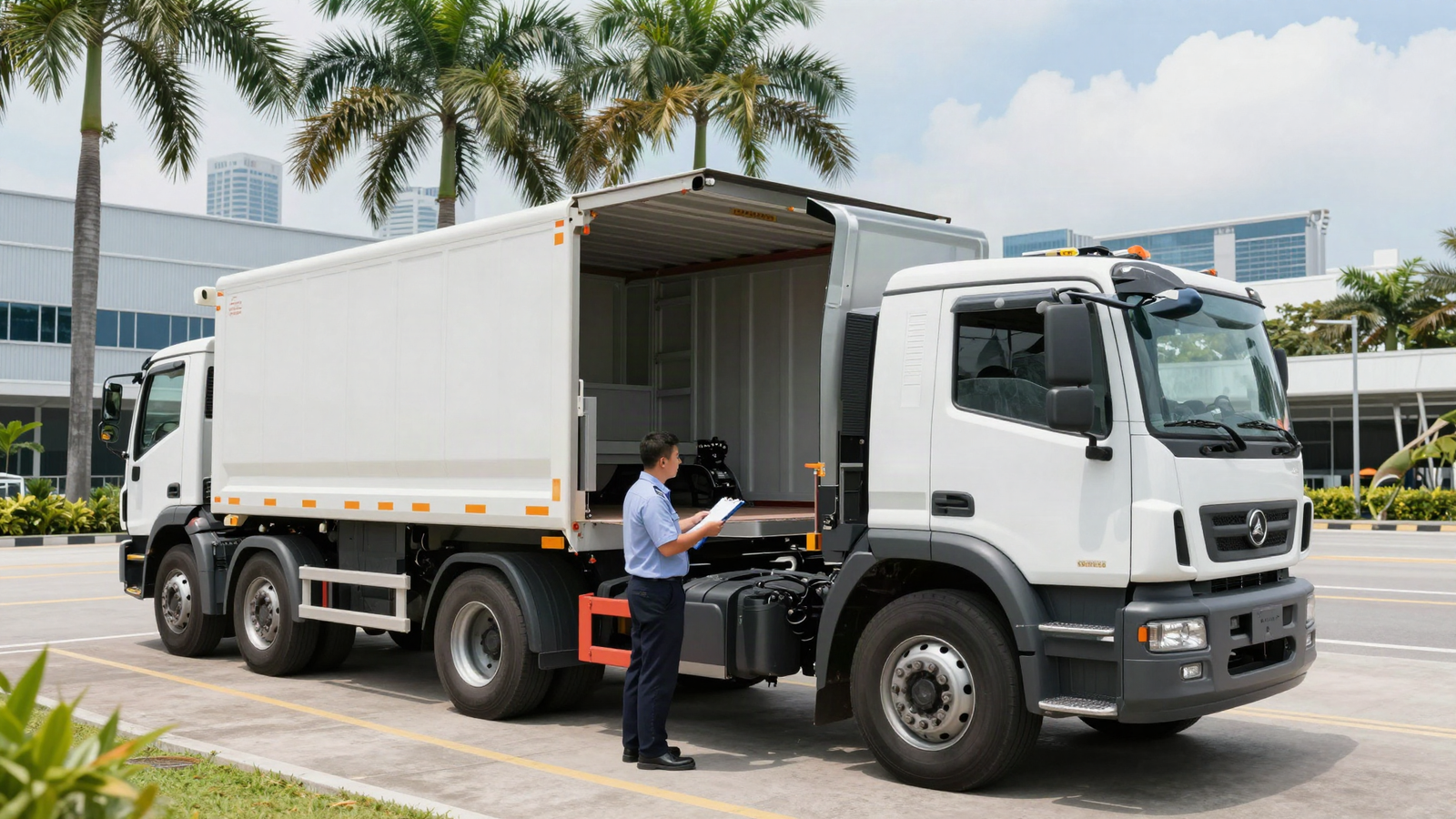
Different sectors of Singapore’s commercial fleet run different bodies on top of broadly similar chassis, and each conversion type interacts with the LTA approval process a little differently.
Refrigerated / reefer conversions (F&B, cold chain, pharma logistics): an insulated box and refrigeration unit are fitted onto a goods vehicle chassis. LTA sets dimension limits on the refrigerated box that must be adhered to, and because the conversion changes both the vehicle’s overall body type and its unladen weight, it falls squarely into the “approval required” category — expect the log card to be updated to show the new body configuration and weight once the conversion is inspected. Industry guides confirm LTA dimension limits exist for reefer boxes, but the specific published limits are set out in LTA’s Construction and Use Rules technical annexes rather than consumer-facing pages, so a workshop quoting you a box size should be able to point to the exact rule reference.
Tipper / hydraulic conversions (waste management, construction, quarrying): fitting a tipping body and hydraulic ram system is a structural modification by definition — it changes how the vehicle handles load, its centre of gravity, and often its unladen weight enough to push it into a different weight band. These are amongst the heaviest commercial vehicles on the road (10-wheel tippers routinely exceed 20 tonnes gross), which is why they intersect directly with the driving licence question covered further down.
Tanker conversions (liquid cargo — fuel, chemicals, water, waste liquids): a tanker shell is a structural fitment requiring LTA approval like any other body conversion, but if the cargo is a scheduled petroleum product, flammable liquid, or listed chemical, a second layer of approval applies on top of LTA’s: the Singapore Civil Defence Force (SCDF) requires the bulk tank itself to be tested and certified by a Professional Engineer, and issues a separate transport licence (valid up to two years) that must be displayed at the top right-hand corner of the vehicle’s windscreen. Heavier or higher-risk loads — three metric tons or more of scheduled materials, tube trailers of any quantity, or Schedule 1 chemicals — additionally require a GPS tracking device, an in-vehicle immobiliser, and an orange-coloured licence plate (a specific colour code SCDF requires operators to match). This is a materially heavier compliance burden than a standard tanker for non-hazardous liquids like potable water or non-scheduled waste.
Canopy / curtain-side conversions (general logistics, distribution): these tend to be lighter-touch conversions than a reefer or tipper — a canopy frame or curtain-side body doesn’t always change the vehicle’s structural classification the way a tipping mechanism or insulated box does. Whether a specific canopy or curtain-side fitment needs prior LTA approval depends on whether it materially changes the vehicle’s unladen weight or overall dimensions from what’s on the existing log card — this is worth confirming with your inspection centre before assuming a “simple” body swap is exempt. General modification rules would treat any body change that alters recorded weight or dimensions as approval-required, but LTA has not published a canopy/curtain-side-specific carve-out either way.
Wheelchair-accessible / passenger conversions (medical transport, inclusive ride-hailing, school and staff transport): installing a wheelchair ramp or lift and reconfiguring seating changes both the vehicle’s passenger capacity and its structure, which is why these conversions go through LTA approval and inspection like any other structural change. Singapore has also moved on the regulatory side of accessible transport more broadly — point-to-point operators rolled out inclusive ride-hailing options for wheelchair users from January 2025 — but that’s a service-licensing matter distinct from the vehicle modification approval itself.
For a general primer on how these vehicle categories are classified and registered in the first place, see our guide to commercial vehicle types in Singapore.
| Modification Type | Typical Industry | LTA Approval Needed? | Additional Body Beyond LTA |
|---|---|---|---|
| Refrigerated / reefer box | F&B, cold chain, pharma | Yes — structural + weight change | None publicly specified beyond LTA |
| Tipper body + hydraulic ram | Construction, waste, quarrying | Yes — structural + weight change | None publicly specified beyond LTA |
| Tanker shell (non-hazardous liquid) | Water, non-scheduled waste liquids | Yes — structural + weight change | None publicly specified beyond LTA |
| Tanker shell (scheduled/flammable/chemical) | Fuel, chemical, petrochemical logistics | Yes — structural + weight change | SCDF transport licence, PE-certified tank, driver HTDP |
| Canopy / curtain-side body | General logistics, distribution | Depends — confirm if weight/dimensions change | None publicly specified |
| Wheelchair ramp / lift + reseating | Medical transport, accessible ride-hailing | Yes — structural + capacity change | Service licensing (separate from vehicle mod) |
Changi Airport / Airside Access Requirements
Getting a modified commercial vehicle onto Changi’s airside apron and taxiway-adjacent areas is a separate exercise from getting it past LTA. Changi Airport Group publishes a reasonably detailed Airfield Vehicle Permit (AVP) application procedure, and it’s worth reading in full if your fleet services the airport directly rather than through a ground-handling subcontractor.
A vehicle operating airside needs a valid AVP, and the documentation list is specific: the vehicle registration form and log card, proof of Changi Airport Airside Insurance with coverage that explicitly extends to airside operation for the full permit period, a current LTA inspection certificate (valid within three months of application), four colour photographs of the vehicle, compliance details for any obstacle light fitted, an airside parking tenancy agreement, and — where applicable — MOM lifting equipment certification for vehicles carrying scissor lifts, booms, or cranes, plus commissioning certificates for any fuel bowser or dispenser equipment on board. AVPs need renewal three months before expiry, and there’s a distinct category structure — a Category One AVP process exists alongside what appears to be a separate application track, though CAG’s public materials don’t fully spell out the operational difference between categories in a single consolidated document. The categorisation exists based on the naming in CAG’s published forms, but the precise scope difference between AVP categories isn’t laid out clearly enough in public documents to state with certainty; confirm directly with the Airside Driving Centre if your operation needs anything beyond routine airside delivery access.
Separately, the driver needs an Airfield Driving Permit (ADP), which is a different document from the vehicle’s AVP — one covers the machine, the other covers the person behind the wheel, and CAG runs its own theory and practical assessment (a published Category One theory handbook exists) before issuing it. For one-off or short-notice vehicle access rather than an ongoing airside operation, CAG also offers a Temporary Entry Permit (TEP) for vehicles.
Beyond the vehicle and driving permits, personnel who need to be at Changi at all — inside or outside the security-restricted area — generally require an Airport Pass, issued and tracked through CAG’s Airport Pass In Changi (APIC) system, which involves its own security vetting separate from the AVP/ADP process. If your drivers are only ever airside for scheduled deliveries under a ground-handling agent’s umbrella, your logistics partner may already hold the AVP and manage driver passes on your behalf — worth clarifying contractually rather than assuming.
The three-month AVP renewal lead time and the requirement for a current (within three months) LTA inspection certificate mean your airside-cleared vehicles need their LTA inspection and airport permit cycles tracked together, not separately. A vehicle that’s current on its LTA inspection but whose AVP lapses because nobody flagged the renewal window still can’t enter airside — and swapping in a spare vehicle at short notice means that vehicle needs its own AVP already in place, since there’s no same-day workaround documented publicly for an uncleared vehicle.
PSA Seaport Access Requirements
PSA Singapore’s published Pass Conditions, Safety and Security Rules set out both a vehicle-side and driver-side requirement. On the vehicle side, operating any motor vehicle within PSA’s restricted port areas requires a valid PSA Car Entry Permit, and vehicles may only be parked in PSA-designated authorised lots — unauthorised parking triggers clamping or towing with fees ranging roughly $200–$450 depending on vehicle class, plus daily storage charges. For the four named terminal areas — Tanjong Pagar, Keppel, Brani, and Pasir Panjang — drivers additionally need the prior written approval of that specific Terminal Manager before bringing a vehicle into the operational zone, meaning port access isn’t a single blanket authorisation across all of PSA’s terminals.
On the driver side, each individual needs a personal PSA Pass and must be 18 years of age or older, hold a valid driving licence appropriate to the vehicle, and be “duly authorised by PSA” — a phrase that in practice means the pass itself is the authorisation record. Drivers must carry their NRIC or passport, and where relevant their work permit or employment pass, and produce these on request. PSA’s rules also specify baseline vehicle condition requirements — tyres in good condition, and functioning brakes, lights, and reverse buzzer — which line up with the kind of pre-trip checks any compliant fleet should already be running under Traffic Police rules for commercial vehicles, but are called out separately here because PSA enforces them at its own checkpoints independent of TP.
What PSA’s public pass conditions document does not spell out in detail is a vehicle modification-specific requirement — there’s no published PSA rule that says, for example, “a modified tanker needs X additional certification to enter Pasir Panjang.” The safe assumption for anyone running a modified commercial vehicle (tanker, flatbed with oversized load, etc.) into a PSA terminal is that your vehicle needs to already be LTA-compliant and appropriately inspected before you even apply for the PSA Car Entry Permit, since PSA is checking for a valid, roadworthy, properly-registered vehicle rather than running its own parallel structural inspection regime. PSA’s published conditions focus on access, conduct, and safety-at-the-checkpoint rather than vehicle engineering standards, which is consistent with LTA already owning that layer of regulation.
Jurong Island Access Requirements
Jurong Island is Singapore’s dedicated petrochemical and energy hub, and access is controlled by JTC Corporation through the Jurong Island Pass (JI Pass) system, run on the Jurong Island Online Pass System (JIPASS). The pass structure is sponsor-based: you cannot self-apply for a JI Pass without a sponsoring company already operating on the island initiating the request. JTC’s published pass types include long-term E Pass and S Pass categories, a short-term Visitor Pass, a Commercially Important Person (CIP) pass, and supplementary passes for companions. Processing timelines JTC publishes are up to 10 working days for long-term passes and around 3 working days for short-term passes, and first-time applicants go through one-time biometric enrolment at the Jurong Island Pass Office before the digital pass becomes usable at checkpoints.
This is where public documentation genuinely thins out for fleet operators specifically. JTC’s public materials describe the personnel pass process in reasonable detail, and mention general vehicle “housekeeping” advice (keeping the vehicle tidy, removing unnecessary loose items) ahead of checkpoint inspection, but do not publish a separate, itemised vehicle inspection checklist for entering Jurong Island the way Changi publishes its AVP document list. Jurong Island’s checkpoint vehicle screening almost certainly includes security and safety inspection given the site’s hazard profile, but the specific criteria are not laid out in public JTC materials, likely for security reasons; fleet operators should get this confirmed directly from their sponsoring company or JTC rather than assuming a standard checklist applies.
Where public documentation is much more specific is dangerous goods transport, which SCDF regulates separately from JTC’s general island access pass. SCDF’s transport circular on scheduled petroleum and flammable materials sets out that any vehicle carrying these goods needs an SCDF-issued transport licence displayed on the windscreen, valid for up to two years, with the bulk tank tested and certified by a Professional Engineer before the licence is issued. Vehicles carrying three metric tons or more of scheduled materials, any quantity of tube trailers, or Schedule 1 chemicals need a GPS tracking device, an in-vehicle immobiliser, and an orange-coded licence plate. Drivers of these vehicles need a HazMat Transport Driver Permit (HTDP), obtained by passing security screening and completing a HazMat Transport Driver Course at an SCDF-accredited institution, also valid for two years. Foreign-registered vehicles carrying these goods must enter Singapore via Tuas Checkpoint specifically and report to the Cargo Examination Hall for driver verification and inspection, with 24-hour advance notification required for restricted-area access. SCDF’s circular does note that materials other than Schedule 1 chemicals can move between Tuas Checkpoint and Jurong Island, and within Jurong Island itself, at any time — implying tighter time-of-day restrictions apply elsewhere for the highest-risk chemical category, though the circular doesn’t spell out those restricted hours in the excerpt available publicly.
In practice, a tanker heading to Jurong Island typically needs three separate layers of authorisation stacked on top of each other: the vehicle’s own LTA approval and inspection as a modified tanker, JTC’s JI Pass for the vehicle and driver to physically enter the island, and — if the cargo is a scheduled or flammable material — SCDF’s transport licence and HTDP-holding driver. Missing any one of the three means the vehicle doesn’t move, regardless of the other two being in order.
Licence Classes and Permits Cross-Reference

Vehicle modification and driving licence class interact in one specific, easy-to-miss way: a structural conversion that adds weight — a reefer box, a tipper body, a tanker shell — can push a vehicle’s unladen weight across a licence class threshold even if the base chassis was originally within a lower class. Singapore’s driving licence classes, per the Singapore Police Force’s official driving licence classification, are set by the vehicle’s unladen weight (ULW), not its laden or gross weight — a distinction that matters because other road rules, such as the blind-spot mirror and vehicle photo compliance requirements covered in our MOM driver compliance guide, key off maximum laden weight instead.
Class 3/3A covers cars and goods vehicles up to 3,000kg ULW (motor tractors under 2,500kg), carrying up to 7 passengers plus the driver, with 3A restricted to automatic-only vehicles. Class 4/4P covers goods or passenger vehicles above 2,500kg ULW; 4P is a newer automatic-only variant introduced in September 2025 alongside a faster certification track. Class 4A/4AP covers heavy omnibuses running fixed public transport routes. Class 5/5P covers the heaviest category — locomotives, prime movers, and heavy tractor-trailer combinations — generally understood to apply once a vehicle’s unladen weight moves well beyond the Class 4 range, though exact published thresholds vary slightly depending on the source and the specific vehicle configuration (rigid truck versus articulated tractor unit). The general weight-based hierarchy across Class 3 through Class 5 is confirmed by SPF’s own page, but the precise unladen-weight cutoff separating “still Class 4” from “now needs Class 5” for edge-case configurations like a heavily-bodied rigid tipper is not stated with a single clean number across sources, so a fleet should verify the specific vehicle’s licence class requirement against its actual log card weight rather than assume by vehicle type alone.
| Licence Class | Vehicle / Weight Band | Additional Permit Needed for Restricted Zones |
|---|---|---|
| Class 3 / 3A | Cars, vans, light goods vehicles up to 3,000kg ULW | AVP/ADP (airside), PSA Car Entry Permit + PSA Pass (port), JI Pass (Jurong Island) |
| Class 4 / 4P | Goods/passenger vehicles above 2,500kg ULW (e.g. 10ft–14ft lorries) | Same as above; SCDF transport licence + HTDP if carrying dangerous goods |
| Class 4A / 4AP | Heavy omnibuses, fixed public transport routes | Generally not applicable to airport/port/Jurong Island freight access |
| Class 5 / 5P | Heavy locomotives, prime movers, tractor-trailer combinations, 10-wheel tippers | Same as Class 4 row; SCDF requirements apply in full for tanker/chemical loads |
Practical Compliance Advice
Treat vehicle modification and restricted-zone access as two separate compliance tracks that happen to intersect, not one combined process. Get LTA approval and inspection sorted first — before the vehicle goes anywhere near an airport, port, or Jurong Island application — because every restricted-zone pass process this article found assumes a properly registered, LTA-compliant vehicle as a starting condition rather than checking vehicle engineering standards itself.
Build lead time into your fleet planning that accounts for the slowest link in the chain, which for most operators will be the restricted-zone pass rather than the LTA modification approval. JTC’s own published figures — up to 10 working days for long-term Jurong Island passes — are longer than a same-day or same-week turnaround, and Changi’s three-month AVP renewal window means airside access can’t be arranged reactively once a permit has already lapsed.
Where this article has had to flag a gap in public information — Jurong Island’s specific vehicle checkpoint criteria, the precise scope difference between Changi’s AVP categories, exact tonnage cutoffs at the Class 4/Class 5 boundary — the honest position is that these are operational details your sponsoring company, ground-handling agent, or the relevant authority itself will confirm on a case-by-case basis, and no publicly available source lays them out with the granularity a procurement or compliance checklist would want. Building your internal SOPs on a confirmed answer from LTA, CAG, PSA, JTC, or SCDF directly — rather than on a workshop’s or vendor’s informal explanation — is the safer default whenever a modification or access requirement sits in one of those gaps.
FAQ
Do I need LTA approval to fit a canopy on my lorry?
It depends on whether the canopy changes the vehicle’s recorded unladen weight or dimensions on the log card. If it does, treat it as a structural modification requiring approval; if genuinely unchanged, check with your inspection centre before assuming it’s exempt, since LTA hasn’t published a specific canopy carve-out.
Can I convert a standard lorry into a tipper myself?
No — a tipping body and hydraulic ram system is a structural modification requiring LTA approval before the work is done and inspection afterward. Unapproved modification can carry fines of up to $20,000 and/or up to two years’ imprisonment under LTA’s framework.
What licence do I need to drive a 10-wheel tipper truck?
Most 10-wheel tippers exceed the Class 4 unladen weight range and require a Class 5 licence, though the exact threshold depends on the specific vehicle’s logged unladen weight. Confirm against the vehicle’s log card rather than assuming by body type alone.
Does my driver need a special pass to enter Changi Airport airside?
Yes — separate from the vehicle’s Airfield Vehicle Permit (AVP), the driver needs an Airfield Driving Permit (ADP), and personnel accessing Changi more broadly generally need an Airport Pass issued through CAG’s APIC system.
Is a JI Pass the same as permission to bring a vehicle onto Jurong Island?
The JI Pass, applied for through a sponsoring company on JTC’s Online Pass System, covers personnel and general entry. Public JTC materials don’t publish a separate itemised vehicle checklist the way Changi does — confirm vehicle-specific requirements with your sponsor.
What extra requirements apply to a tanker carrying chemicals to Jurong Island?
On top of LTA approval for the tanker conversion and a JI Pass for island access, SCDF requires a transport licence for the vehicle (bulk tank PE-certified, licence displayed on the windscreen) and a HazMat Transport Driver Permit for the driver, obtained via security screening and an SCDF-accredited course.
Can a Class 4 licence holder drive any lorry over 2,500kg unladen?
Class 4 covers goods and passenger vehicles above 2,500kg ULW generally, but very heavy configurations — prime movers, heavy tractor-trailer combinations, some 10-wheel tippers — typically require Class 5 instead. Check the specific vehicle’s licensed weight class rather than assuming Class 4 covers everything above the Class 3 cutoff.
Sources
- LTA OneMotoring — Vehicle Technologies and Modifications
- VICOM — Vehicle Inspection & Type Approval System (VITAS)
- Changi Airport Group — Airfield Vehicle Permit Application Procedure
- Changi Airport Group — Category One Airfield Vehicle Permit Application
- Changi Airport Group — Airport Pass In Changi (APIC) Information Hub
- PSA Singapore — Pass Conditions, Safety and Security Rules
- JTC Corporation — How to Enter Jurong Island (JI Pass)
- JTC — Jurong Island Online Pass System (JIPASS)
- SCDF — Circular on Requirements for Road Transportation of Dangerous Goods
- Singapore Police Force — Singapore Driving Licence Classes
Written by the SGFleetGuide editorial team. Last updated: 18 September 2026.

One Comment