PQP Renewal Calculator Guide for Singapore Commercial Vehicles
PQP (Prevailing Quota Premium) is what you pay LTA to renew an expiring COE instead of bidding for a new one — it’s set monthly as a moving average of recent COE prices in your vehicle’s category, not a fresh auction result. For Category C (goods vehicles and buses), the PQP for September 2026 is $92,907 for a 10-year renewal, or roughly $46,454 for a 5-year renewal. Goods vehicles can keep renewing in 5-year blocks until they hit their statutory lifespan, unlike cars, which get only one 5-year renewal. Miss the renewal window by more than a month and LTA requires the vehicle to be deregistered and disposed of.
Key Takeaways
- PQP is not a new bid — it’s a published rate based on the moving average of recent COE prices in your category, so you don’t compete against other bidders to renew.
- The Category C PQP for September 2026 is $92,907 for a 10-year renewal, calculated from the last three months of bidding results, and it changes every month.
- Goods vehicles get a renewal path cars don’t — Category C can renew for 5 years repeatedly until it hits its statutory lifespan (20 years for most goods vehicles), while cars get only one 5-year renewal before 10-year terms or deregistration.
- 5-year renewal costs half the PQP, rounded up — a smaller upfront outlay, but you’re back at the renewal table twice as often.
- Miss renewal by more than a month past expiry and the vehicle must be deregistered — there’s no extension beyond that grace period.
- LTA’s PQP enquiry tool on OneMotoring gives the exact payable amount for your specific vehicle, rather than a general category average.
Table of Contents
- What Is PQP, and How Is It Different From a COE Bid?
- How LTA Calculates the PQP Renewal Amount
- 5-Year vs 10-Year Renewal for Goods Vehicles and Buses
- What Happens If You Don’t Renew
- How to Use LTA’s PQP Calculator on OneMotoring
- A Worked Example: Renewing a Category C COE
- FAQ
What Is PQP, and How Is It Different From a COE Bid?
Every vehicle in Singapore runs on a Certificate of Entitlement that expires after 10 years. When you first bought the vehicle, you or your dealer bid for that COE in an open bidding exercise — a competitive auction where the price is whatever the market pays that fortnight. Renewal works differently.
Prevailing Quota Premium, or PQP, is the amount LTA sets for renewing an existing COE rather than winning a new one. You’re not bidding against other buyers, and you’re not risking an unsuccessful bid. LTA publishes a PQP rate for each category, and if you renew instead of deregistering, that published rate is what you pay — no auction involved.
This is the whole point of PQP as a policy. Open bidding prices are volatile — Category C alone moved by more than $3,000 between the last two bidding exercises before this article was written. If renewal ran on live bidding, a fleet operator with a dozen lorries coming up in the same quarter would be exposed to whatever the market happened to be doing that fortnight. PQP smooths that out by pricing renewal off a trailing average instead of one auction result. It also doesn’t reset your vehicle’s age or condition — you’re paying for the right to keep operating the same physical vehicle, with everything else about it (mileage, wear, inspection schedule) unchanged.
How LTA Calculates the PQP Renewal Amount
LTA defines PQP as the moving average of Quota Premiums from bidding exercises held in the preceding three months, for your vehicle’s category. Since LTA runs two exercises most months, that means averaging six data points — the closing prices across the three months before the renewal month — though months with no bidding are excluded rather than counted as zero.
Here’s what that looked like heading into September 2026 for Category C (goods vehicles and buses), using the actual closing premiums from each 2026 bidding exercise:
| Bidding Exercise | Category C Closing Premium |
|---|---|
| June 2026, 1st exercise | $94,000 |
| June 2026, 2nd exercise | $93,001 |
| July 2026, 1st exercise | $95,000 |
| July 2026, 2nd exercise | $93,889 |
| August 2026, 1st exercise | $91,545 |
| August 2026, 2nd exercise | $90,002 |
Add those six figures and divide by six: the result is $92,906.17, which LTA rounds to the published September 2026 Category C PQP of $92,907. That figure applies for the whole month regardless of which day in September you renew, and resets again on 1 October based on the July–September window.
For a planning estimate using recent bidding results, use our PQP Renewal Calculator. Confirm the exact vehicle-specific payable amount on LTA OneMotoring before renewing.
PQP is a trailing indicator, not a forecast. If COE prices are climbing fast — as Category C did through most of 2026 — the published PQP for the current month can sit below where fresh bids are actually landing. That’s good news if you’re renewing now, but it also means next month’s PQP is likely to rise further if the trend holds. There’s no way to lock in a lower rate ahead of time; you pay whatever PQP is published for the month you submit your renewal.
5-Year vs 10-Year Renewal for Goods Vehicles and Buses

This is where Category C genuinely differs from private cars, and it’s worth understanding before you commit either way.
Every owner renewing a COE chooses between a 5-year renewal (50% of the published PQP, rounded up) and a 10-year renewal (the full PQP). For private cars and motorcycles, the 5-year option is a one-time offer: once that term is up, the owner must commit to a full 10-year renewal or deregister — no going back to another 5-year term.
Goods vehicles and buses work differently. A Category C vehicle can renew for 5 years, and when that period ends, renew for another 5 years, repeatedly — there’s no cap on how many 5-year renewals a goods vehicle can take. The only hard stop is the vehicle’s statutory lifespan: 20 years for most goods vehicles and private/excursion/school buses, 17 years for omnibuses. Once a vehicle hits that limit, it can’t be renewed again regardless of renewal type, and must be deregistered. Cars and most motorcycles have no statutory lifespan at all, which is why they can keep doing 10-year renewals indefinitely once they’ve used their one 5-year option — goods vehicles trade that unlimited runway for repeatable 5-year flexibility within a fixed total lifespan.
Which makes more sense comes down to capital planning and how confident you are in the vehicle’s remaining useful life. A 5-year renewal roughly halves the upfront outlay and gives an earlier exit point if the vehicle underperforms or you’d rather replace it than keep paying rising PQP on an ageing chassis. A 10-year renewal locks in the current rate for a full decade and means one fewer administrative event to track, but commits more capital at once with no chance to revisit the rate if COE prices later fall.
For vehicles registered under Category C, it’s also worth revisiting how the category itself is defined and weight-banded in the first place — see our Category C COE guide for Singapore for the weight classes and vehicle types that fall under this bracket, since that classification is fixed at first registration and follows the vehicle through every renewal decision after.
What Happens If You Don’t Renew
COE renewal isn’t automatic, and LTA doesn’t chase you for it — the obligation sits with the vehicle owner to apply before the existing COE expires.
Miss the expiry date and there’s a one-month grace period in which you can still renew, but you’ll pay a late renewal fee on top of the PQP itself. Beyond that window, the option disappears entirely — LTA requires the vehicle to be deregistered and disposed of immediately. There’s no further extension and no appeal for a vehicle that’s simply run past its deadline through an administrative slip.
For a fleet manager, this is a scheduling risk more than a cost risk. A lapsed COE means the vehicle is off the road immediately, with no window to sort a replacement while a renewal payment is processed. If it runs daily deliveries or a contracted route, the gap lands the same day the grace period closes. The fix is unglamorous: track expiry dates on a shared fleet calendar with at least two months’ lead time, and settle the renewal decision well before the grace period is ever relevant.
How to Use LTA’s PQP Calculator on OneMotoring
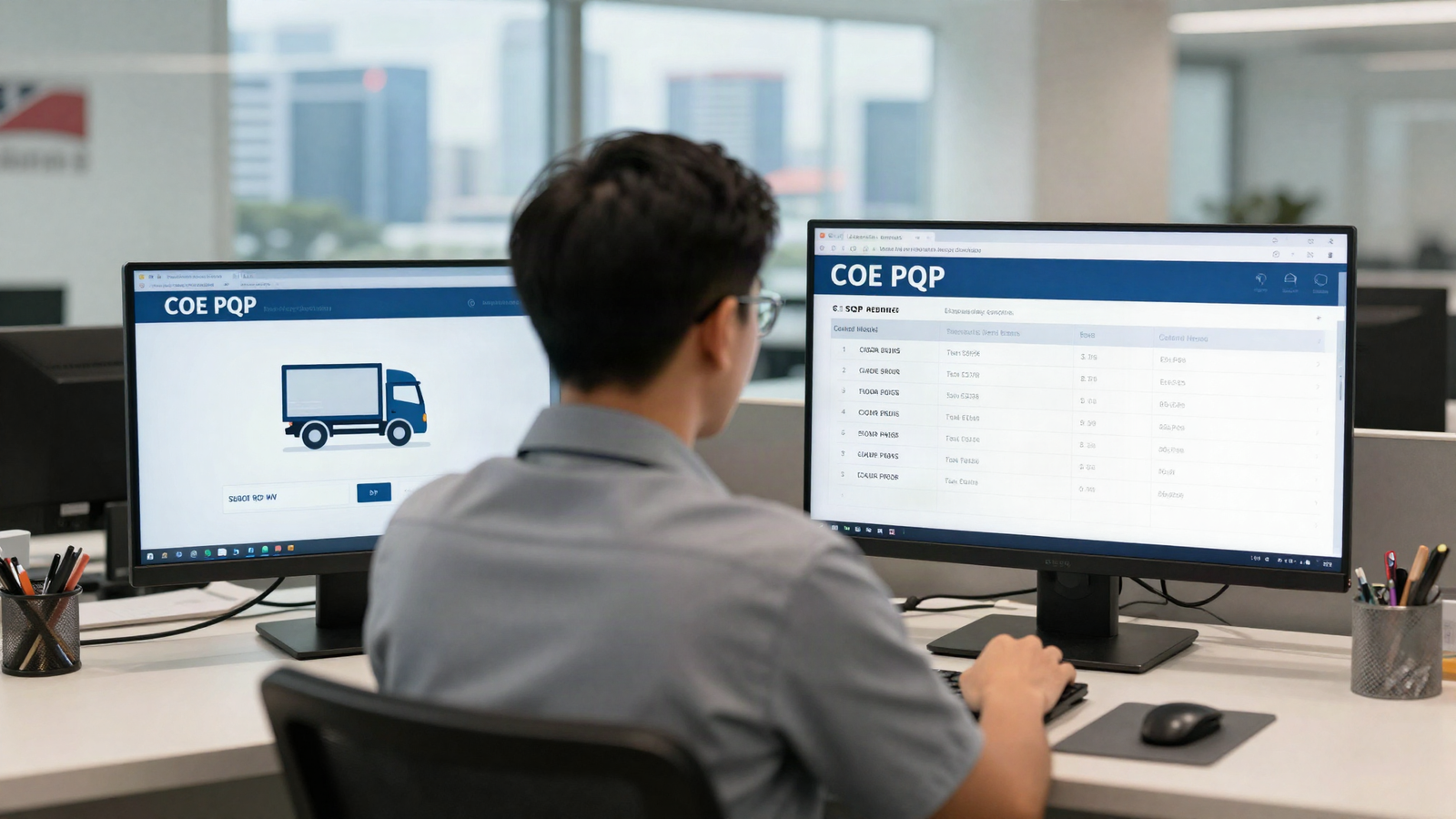
LTA’s OneMotoring portal has a dedicated digital service for this — “Enquire PQP Rates to Renew COE” — under Digital Services rather than the general COE information pages, which is where people sometimes lose it on the first search.
To find and use it:
- Go to OneMotoring at onemotoring.lta.gov.sg and log in with Singpass, since a vehicle-specific enquiry requires authentication.
- Navigate to Digital Services, then look for “Enquire PQP Rates to Renew COE” — searching “PQP” in the site search also surfaces it directly.
- Enter your vehicle number. The tool pulls the registered category automatically.
- Review the output, showing the current month’s rate as both the 10-year figure and the 5-year (half) figure.
Because the tool is tied to your actual vehicle rather than a generic category lookup, it accounts for edge cases you might otherwise miss, such as a vehicle sitting right at a renewal-window boundary. If vehicles are registered under a company rather than an individual, make sure whoever holds Singpass authorisation for the corporate entity is the one running the enquiry, since a personal login won’t necessarily surface company-registered vehicles. LTA’s exact digital-service navigation labels and menu structure can change between OneMotoring redesigns; verify the current click path on the live portal.
A Worked Example: Renewing a Category C COE
Say you run a 3-tonne goods vehicle registered under Category C, and its COE expires in September 2026. Here’s how the numbers work out, using the real September 2026 Category C PQP of $92,907.
Option 1 — 10-year renewal: Pay the full PQP of $92,907 upfront. The COE is valid for another 10 years, through September 2036 — subject to the vehicle’s statutory lifespan (20 years for most goods vehicles from first registration), so check where this renewal lands against that ceiling before committing to a full decade.
Option 2 — 5-year renewal: Pay 50% of the PQP, rounded up: $92,907 ÷ 2 = $46,453.50, rounded up to $46,454. The COE is valid through September 2031. Because Category C allows repeated 5-year renewals, you can renew for another 5-year block in 2031 at whatever PQP is current then, and again after, as long as the vehicle hasn’t hit its statutory lifespan.
The 5-year path costs half as much upfront but doubles your exposure to renewal-timing risk — you’re back at the table in 2031 paying whatever Category C PQP has become by then, rather than locking in today’s rate for the full decade. For a vehicle nearing its statutory lifespan anyway, it also matches your actual planning horizon more closely. Neither figure includes registration fees, insurance renewal, or a late fee — this assumes renewing before expiry.
FAQ
Is PQP the same as the COE price I see in bidding results?
No. The bidding-results price is a closing premium from a live auction that fortnight. PQP is a separate calculated figure — the moving average of recent bidding results in your category — used specifically for renewals, not new bids.
Can I choose which month to renew in to get a lower PQP?
You can renew any time before your COE expires, and since PQP moves monthly, timing a renewal for a more favourable month is a legitimate, if limited, way to manage cost — provided you don’t push past your actual expiry date chasing a better rate.
Can a goods vehicle keep doing 5-year renewals indefinitely?
Not indefinitely — only until the vehicle reaches its statutory lifespan: 20 years for most goods vehicles and private, excursion, or school buses, and 17 years for omnibuses. Within that lifespan, there’s no limit on the number of 5-year renewals.
What’s the late renewal fee if I miss my COE expiry date?
LTA allows renewal within one month after expiry with a late fee on top of the PQP. The exact amount is published on OneMotoring and worth checking at the time, since even one day into the grace period costs more than renewing on time. LTA’s late fee schedule can be revised; confirm the current amount on OneMotoring.
Does PQP differ for buses versus goods vehicles, even though both are Category C?
No — PQP is calculated per COE category, not per vehicle type within it. Goods vehicles and buses share the same published Category C rate each month, though their statutory lifespans can differ.
Where do I find the exact PQP amount for my specific vehicle right now?
Use LTA’s “Enquire PQP Rates to Renew COE” service on OneMotoring, log in with Singpass, and enter your vehicle number — it returns the current rate for that vehicle’s actual category.
Author: Keith Kwai, editor and publisher of SGFleetGuide, with 25 years experience in B2B and B2C companies. More about the author.
Last updated: 11 September 2026
Sources: LTA OneMotoring — Certificate of Entitlement (COE) Renewal | LTA OneMotoring — Enquire PQP Rates to Renew COE | LTA OneMotoring — Certificate of Entitlement (COE) | Motorist Singapore — Latest COE Prices and Bidding Results 2026 | The Right Workshop — COE Renewal Singapore & Current PQP Rates



One Comment