New bus conduct rules from 23 September: fines up to $500, or $5,000 for serious offences
The Land Transport Authority (LTA) announced on 21 September 2026 that new regulations on passenger conduct aboard public buses and at bus interchanges and terminals would take effect on 23 September 2026.
The rules are set out in two sets of regulations made under the Transport Sector (Miscellaneous Amendments) Act, which Parliament passed in October 2025. Their purpose, LTA said, is to bring buses into line with the framework that already applies to trains, and to sit alongside the Conditions of Carriage that public bus operators already use.
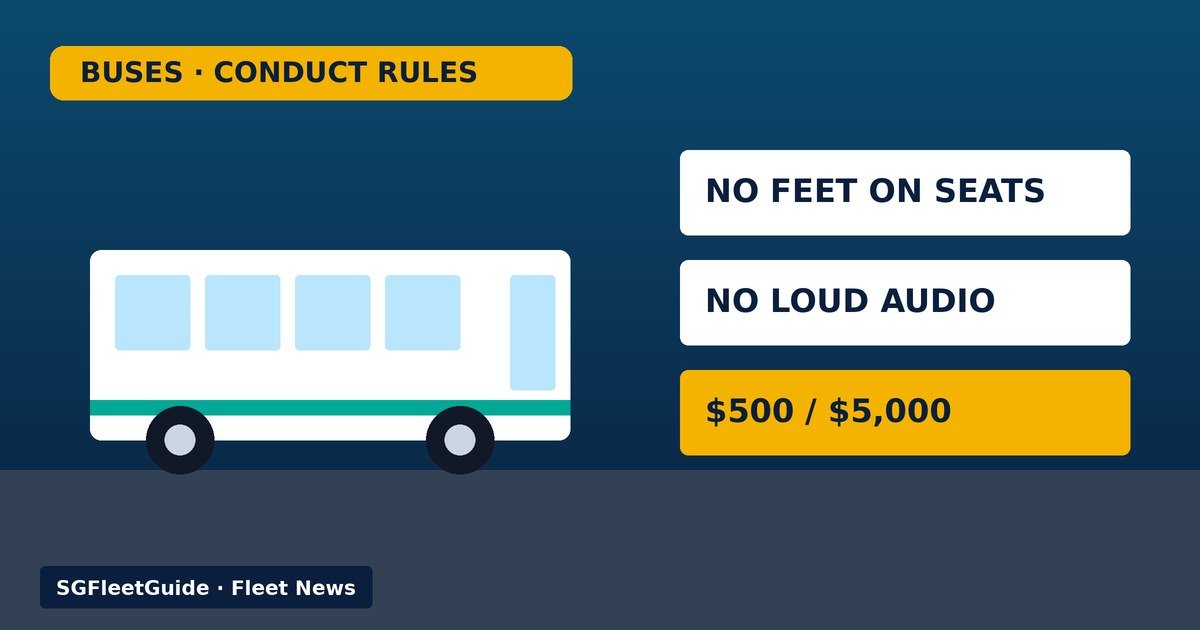
Under the new regulations, a range of nuisance behaviour becomes an offence. Examples LTA gave include putting your feet on seats, playing audio loudly, littering, and eating or drinking on board a bus. These carry a maximum penalty of $500. More serious conduct, such as causing obstruction or danger to other commuters inside an interchange or terminal, or soiling any part of a bus, interchange or terminal, carries a maximum penalty of $5,000. LTA said the penalties match those already in the Rapid Transit Systems Regulations.
Enforcement will rest with operator staff rather than drivers. Empowered staff such as ticket inspectors and interchange staff can issue Administrative Notifications of Offences to people suspected of breaking the rules, after which LTA will investigate. Bus captains will not issue these notices, so they can focus on driving safely. They can still ask passengers to stop disruptive behaviour, require those who do not comply to get off, and call the Bus Operations Control Centre or, in serious cases, the police.
LTA said it and the operators will continue to use discretion and fairness, particularly where commuters have physical or mental health conditions.
What it means for operators: the rules apply to public buses, interchanges and terminals, not to private, chartered or company buses. Private bus and staff-transport operators remain responsible for setting and enforcing their own passenger rules, but the new framework is a useful benchmark for conduct policies and for briefing drivers on how to handle disruptive passengers without leaving the driver’s seat.
Source: Land Transport Authority — Read the original