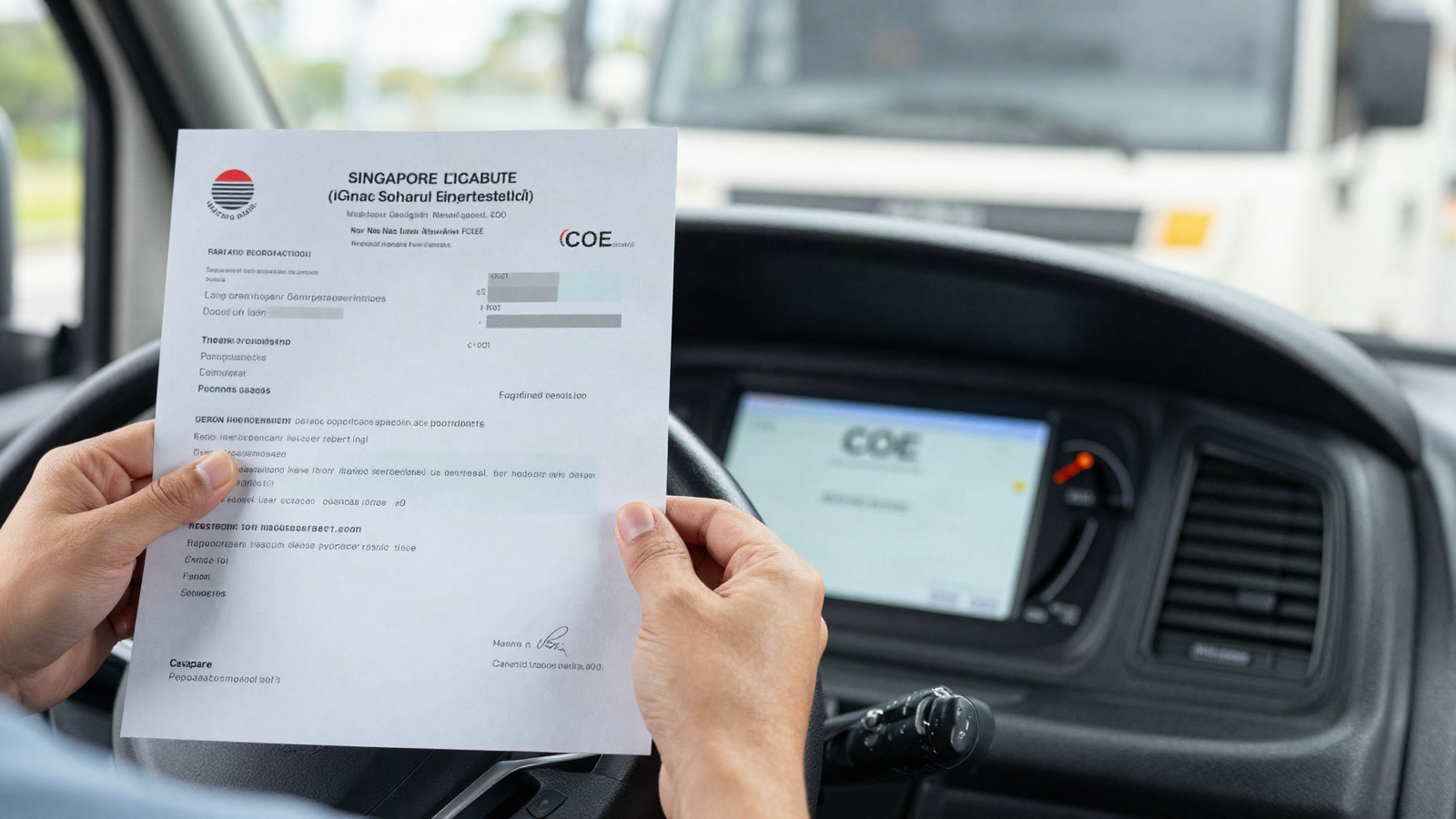
COE for Commercial Vehicles: Category C Explained
Certificate of Entitlement (COE) Category C covers goods vehicles and buses. It runs for 10 years from registration, carries no PARF rebate when the vehicle is scrapped, and is bid for twice monthly with a $10,000 fixed deposit — as of September 2026, premiums were running around $93,000.
Key Takeaways
- Category C is the COE class for goods vehicles and buses — it is not the same category cars bid in, and its premium moves independently of car COE prices.
- No PARF rebate applies to Category C at end of life. Whatever you pay for the COE is fully sunk when the vehicle is deregistered or scrapped.
- COE validity is 10 years from registration; if you want to keep running the vehicle past that, you renew — at whatever the market premium happens to be then, not what you originally paid.
- Bidding happens twice a month, requires a $10,000 fixed deposit, and the COE itself is only valid for 3 months after being awarded — your registration paperwork needs to move fast enough to use it within that window.
- The quota premium (QP) that everyone pays is set by a uniform-price mechanism, not by each bidder’s own bid — see below for how that actually works.
- As of September 2026, Category C premiums were around $93,101 — this moves with each bidding exercise, so treat any figure (including this one) as a snapshot, not a fixed budgeting number.
What Category C Actually Covers
Category C is LTA’s COE class for goods vehicles and buses. Unlike the passenger car categories (which split by engine capacity/power), Category C is defined by vehicle function rather than a size threshold within it — broadly, it’s the category commercial fleet buyers bid in when registering a van, lorry, truck, or bus for business use, rather than a private car. If you’re still at the stage of deciding what to buy in the first place, our main guide to buying a commercial vehicle in Singapore covers that ground before you get to the COE bid itself.
Don’t confuse COE category (Category C — a registration-and-bidding classification) with driving licence class (Class 3/4/5 — who’s legally allowed to drive the vehicle). They’re determined on different bases and one doesn’t tell you the other. See our MOM Driver Compliance Guide for licence classes.
How Category C Compares to Categories A, B, D and E
LTA runs five COE categories, and it helps to see where Category C sits among them rather than treat it in isolation:
- Category A — non-fully-electric cars up to 1,600cc and 97kW (130bhp), plus fully electric cars up to 110kW (147bhp). Private cars only.
- Category B — non-fully-electric cars above 1,600cc or 97kW, plus fully electric cars above 110kW. Also private cars only.
- Category C — goods vehicles and buses. This is the fleet category.
- Category D — motorcycles, with a much lower $1,500 bidding deposit rather than the $10,000 required for A, B, C and E.
- Category E — the “Open” category, usable to register any vehicle type except a motorcycle. A Category E COE can register a goods vehicle just as a Category C one can.
Two points carry practical weight for fleet buyers. First, Category C and Category E COEs are transferable once if bid for individually — Categories A, B and D are not. Second, a Category E COE can substitute for a Category C one, so some buyers watch both premiums and register under whichever is cheaper, though Category E also draws bids from car buyers and moves on its own demand. The categories are priced independently: a spike in car COE premiums doesn’t mechanically move Category C, since each clears against its own quota and its own bidder pool.
Why the No-PARF-Rebate Rule Matters

Most passenger car COE categories carry a PARF (Preferential Additional Registration Fee) rebate — when the car is scrapped within its COE life, the owner gets back a portion of the ARF paid at registration, which partly offsets the sunk COE cost. Category C has no such rebate. Whatever premium you paid at the COE bid is gone entirely once the vehicle reaches the end of its life, whether that’s through scrapping or letting the COE lapse.
This changes how you should think about total cost of ownership for a goods vehicle versus a passenger car bought around the same time: there’s no partial recovery built into the scheme. Every dollar of the COE bid is a straight operating cost amortised over the holding period, not a partially-recoverable deposit. If you’re financing the purchase rather than paying cash, our guide to commercial vehicle credit and financing covers how lenders typically treat that sunk-cost structure when sizing a loan.
How Bidding Actually Works
- Bidding exercises run twice monthly, typically starting the first and third Monday of each month and running over three working days, through participating banks or directly via OneMotoring.
- A $10,000 fixed deposit is required to place a bid.
- The minimum reserve price is $1 — in practice, market premiums run far higher, but the mechanism itself has no built-in floor.
- Once awarded, a COE is valid for 3 months. Your vehicle approval, inspection, and registration paperwork all need to complete within that window, or the COE lapses and you’re back to bidding again — at whatever the next premium happens to be.
The 3-month COE validity window is unforgiving if your import, inspection, or shipping timeline slips. Sequence your paperwork so the COE bid happens close to when you can actually complete registration — bidding too early just burns clock you can’t get back.
How the Quota Premium Is Actually Set
It’s worth understanding the pricing mechanism, because COE bidding doesn’t work like a normal auction where you pay what you bid. Through each exercise, LTA publishes a running Current COE Price (CCP) — the highest unsuccessful bid at that point, plus $1. When bidding closes, the last CCP becomes the Quota Premium (QP), and every successful bidder in that category pays that same uniform price, regardless of how much higher their own bid was. A bidder at $100,000 and one at $93,200 both pay $93,101 if that’s where the category clears — bidding well above the eventual price costs nothing extra, it just improves your odds of winning. That’s also why bidding strategy tends to focus on getting the amount roughly right rather than shading it: over-bidding is free at settlement, under-bidding loses you the vehicle for that round.
How LTA Sets the Category C Quota Each Quarter
The quota — the number of COEs released for bidding — is announced quarterly, then split roughly evenly across that quarter’s six bidding exercises. LTA’s formula starts from 25% of the replacement COEs arising from vehicles deregistered over the preceding twelve-month period, then layers on category-specific adjustments. Category C additionally carries a small built-in growth allowance — LTA has provided for 0.25% per annum growth in the Category C vehicle population, measured against the population as at the preceding 31 December — plus further adjustments for expired temporary COEs, commercial vehicle turnover scheme activity, and guaranteed deregistrations.
For August–October 2026, the total quota across all categories was 19,085, up 0.2% from the prior quarter, with the next announcement covering November 2026 to January 2027. The practical takeaway: quota size is set well ahead and barely moves quarter to quarter, so premium swings within a quarter come almost entirely from demand — how many businesses choose to bid, and how aggressively — not from LTA adjusting supply mid-quarter.
What Category C Premiums Have Looked Like Recently

As of September 2026, Category C premiums were around $93,101, per LTA’s COE Bidding Results data. This number moves with every bidding round and reflects quota, demand, and broader vehicle population trends — it is not a fixed government price, and it’s the single biggest reason a “typical commercial vehicle cost” figure ages badly within weeks of being published. Check the current premium directly before finalising any purchase budget.
Zooming out, the direction of travel over the past few years has clearly been upward, though not in a straight line. Pulling individual exercises from the same dataset: Category C premiums ran around $54,000 in July 2022, climbed to roughly $77,000 by January 2023, eased back to around $70,000 in June 2024, and were back up near $91,000–$95,000 across mid-to-late 2026. The dips within that climb show premiums do soften when supply loosens or demand cools — it isn’t a one-way ratchet — but budget against the current live premium, not what a similar vehicle cost a year or two ago. If you’re weighing purchase timing against Singapore’s longer-term vehicle policy direction, our piece on the 2030 ICE vehicle phase-out is worth reading alongside this one, since it bears on how a 10-year COE commitment on a diesel or petrol vehicle should be evaluated today.
Renewing a Category C COE
If you want to keep a vehicle running past its original 10-year COE, you renew — either bidding again in the open market or, more commonly, paying the Prevailing Quota Premium (PQP) instead. The PQP is the moving average of COE prices over the last three months for that category, so it smooths single-exercise spikes but still tracks the broader market rather than offering a discount. Because there’s no PARF rebate to offset this, a renewal decision on an older goods vehicle is a genuine buy-vs-renew-vs-replace calculation, not a formality — compare it against a replacement vehicle’s total cost, including a fresh COE bid, and against financing terms in our credit and financing guide if the replacement isn’t a cash purchase.
FAQ
What is COE Category C?
The Certificate of Entitlement category for goods vehicles and buses in Singapore, separate from the passenger car COE categories, with its own bidding pool and premium movement.
Does Category C get a PARF rebate?
No. Unlike most passenger car categories, Category C carries no PARF rebate on scrapping — the COE cost is fully sunk.
How long does a Category C COE last?
10 years from the vehicle’s registration date.
How much is a Category C COE right now?
It changes with every bidding exercise (twice monthly) — as of September 2026 it was around $93,101. Check LTA’s current bidding results before budgeting a purchase.
How is the COE quota premium actually determined?
Through a uniform-price mechanism: the price rises through the bidding exercise as the Current COE Price, and the price at the close of bidding — the highest unsuccessful bid plus $1 — becomes the Quota Premium every successful bidder in that category pays, regardless of how much higher any individual bid was.
How does Category C compare to other COE categories?
Categories A and B cover private cars split by engine size/power, Category D covers motorcycles with a much smaller deposit, and Category E is an “open” category that can also be used to register a goods vehicle. Each category has its own quota and clears at its own premium — they don’t move in lockstep.
What happens if my COE lapses before I finish registering the vehicle?
You lose it and need to bid again, at whatever the next premium happens to be — there’s no extension or refund mechanism for a lapsed COE.
Is renewing an old goods vehicle’s COE cheaper than buying a new vehicle?
It depends on the current premium and the vehicle’s remaining useful life — run the comparison explicitly rather than assuming renewal is automatically cheaper, since there’s no PARF offset either way.
Author: Keith Kwai, editor and publisher of SGFleetGuide, with 25 years experience in B2B and B2C companies. More about the author.
Last updated: 11 September 2026
Sources: LTA — Certificate of Entitlement | LTA/data.gov.sg — COE Bidding Results | LTA — COE Quota for August 2026 to October 2026 | LTA/OneMotoring — COE Open Bidding




3 Comments