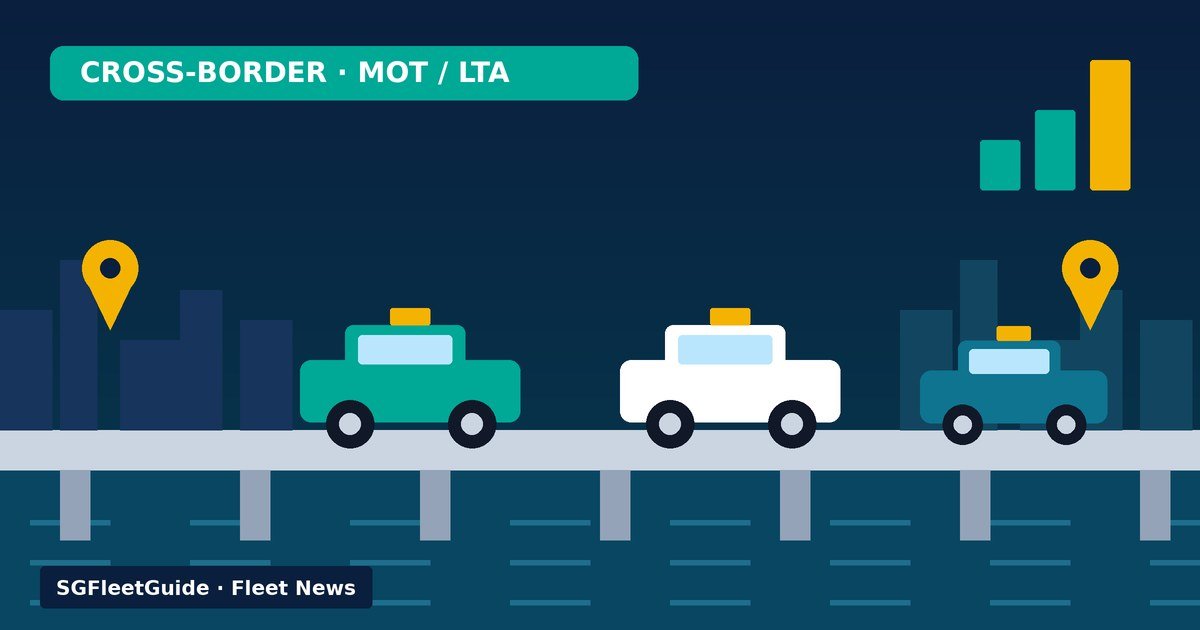
Cross-border taxi quota rises to 500 per country from 16 November, with CDG Zig and Kumpool joining Grab
Singapore and Malaysia will raise the quota of licensed cross-border taxis from 300 to 500 per country from Monday, 16 November 2026, the two countries’ transport ministries said in a joint statement on 6 November. From the same day, two more ride-hail operators, Singapore’s CDG Zig and Malaysia’s Kumpool, will be licensed under the Cross-Border Taxi Scheme, joining GrabCar, which has so far been the only licensed ride-hail operator on the route.
According to CNA, the higher quota means the scheme can take up to 1,000 licensed cross-border taxis from both countries combined, up from 600 today. The Straits Times reported that the new figure completes the target of 500 licensed cross-border taxis per country that the two ministries first announced in a joint statement on 5 December 2025. The quota was raised from 200 to 300 per country as part of an overhaul on 4 May 2026.
That May overhaul added new designated pick-up points for ride-hail and e-hailing bookings, allowed more flexible drop-offs and introduced extra requirements to support enforcement against illegal domestic point-to-point trips, the ministries said. Passengers can now be dropped off anywhere in Singapore and within an operating boundary covering Johor Bahru, Iskandar Puteri, Forest City, Kulai and Senai. CNA noted that pick-ups in the other country are still limited to designated locations. The Straits Times reported that fixed fares also went up in May: a four-seater taxi from Ban San Street Terminal in Bugis to Larkin Sentral in Johor Bahru, or anywhere within 35km of it, now costs $80, up from $60.
The ministries said travellers who used the enhanced service liked the point-to-point drop-offs, and that families and business travellers could ride in larger and premium vehicles. LTA chief executive Ng Lang said expanding licensed cross-border services gives travellers more options and greater flexibility. CDG Zig told CNA it would announce fare details later, and Kumpool described its licence as a significant milestone for regulated cross-border ride-hailing.
Not everyone in the trade is cheering. National Taxi Association executive secretary Teo Siew Pan told CNA that the quota has now been raised twice in one year, and that members are understandably concerned about job opportunities and earnings. The association has asked LTA to consider issuing the extra licences in phases, and wants more pick-up points added. It did welcome the two new platforms, saying they give drivers more choice.
Our analysis: for Singapore taxi and private hire operators, this is the biggest change to the Causeway point-to-point market since May. The reported facts point to two effects pulling in different directions. More licences and three booking platforms should make legal cross-border trips easier to find and book, which is the main tool the two governments are using against illegal cross-border drivers who have long competed with door-to-door pick-ups. But a fixed-fare street-hail product that now has 200 more vehicles per side could see thinner earnings per licence unless demand grows as fast as supply, which is the risk the NTA is pointing to.
Fleet owners weighing whether to apply should watch three things that have not yet been published: how LTA will allocate the 200 additional Singapore licences, and whether it will phase them in as the NTA asked; what CDG Zig and Kumpool will charge, and what commission and booking rules they will set for drivers; and whether more pick-up points will follow. Enforcement is also tightening in the background. In a written parliamentary reply on 3 November, the Ministry of Transport said LTA has already retrieved vehicle location data from its systems to act against serious offences such as illegal cross-border taxi services. For drivers working the route without a licence, that is a clear signal that the risk of being caught is rising.
For motorists and businesses that move staff across the Causeway, the practical takeaway is simpler: from 16 November there should be more licensed cars and more apps to choose from, but fares, waiting times and pick-up rules for the two new operators are still unknown. We will update readers when LTA, CDG Zig or Kumpool publish those details.
Source: Ministry of Transport (Singapore and Malaysia) joint statement, 6 November 2026; CNA and The Straits Times, 6 November 2026 — Read the original