Private-hire car loan limits: what they could mean for COE demand, ride-hailing fares and drivers
Since Friday, 30 October 2026, individuals buying cars registered as private-hire cars can borrow only 60 or 70 per cent of the purchase price, depending on the open market value, with loan tenure capped at seven years. Previously, such buyers could potentially finance the full price. We covered the rule change itself yesterday. In an explainer published on 30 October, CNA asked economists and industry players what the change could mean in practice.
The authorities said some buyers may have registered cars as private-hire vehicles mainly to get looser financing, without planning to drive for ride-hailing. They pointed to a recent surge in registrations of self-drive private-hire cars owned by individuals, at around 500 a month. According to the Land Transport Authority, there were 98,621 private-hire cars in Singapore as of September.
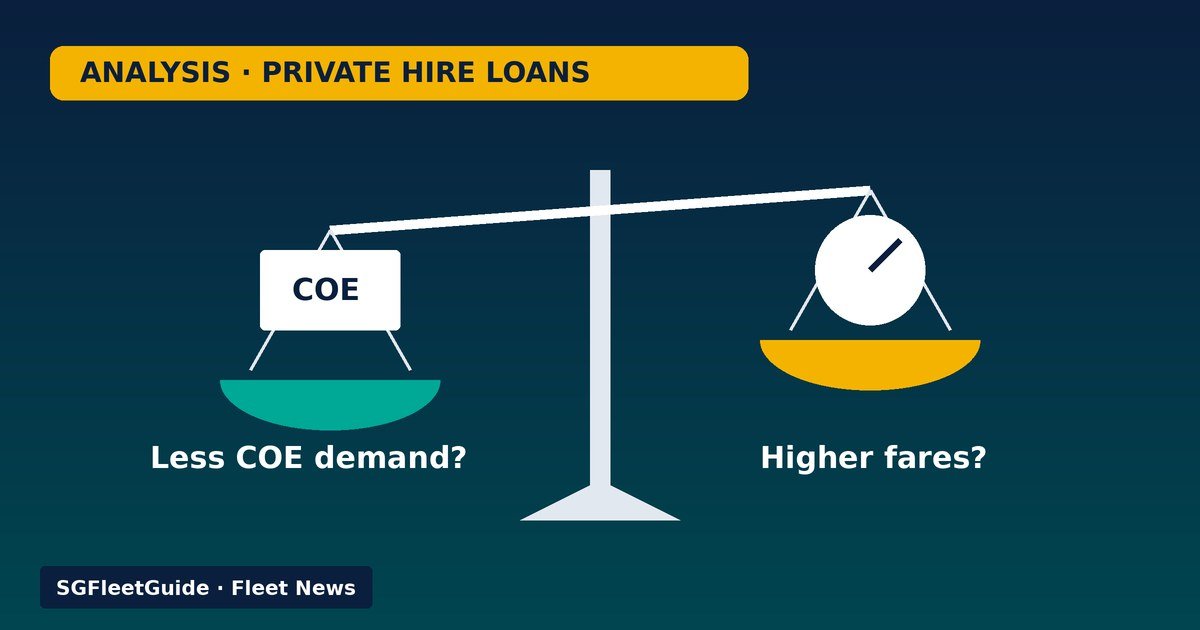
COE demand: some easing, size unclear. NUS Business School Assistant Professor Lee Kwok Hao told CNA that removing the financing advantage should reduce demand from buyers who used private-hire registration mainly for bigger or longer loans. But some may still buy under normal loan rules, through company ownership or other financing, so the net effect depends on how many leave the market altogether. He expects some downward pressure on COE premiums, but said the size is uncertain.
SUSS Associate Professor Walter Theseira said the outcome depends on each buyer’s choice: some can afford the same car with a regular loan, some may pick a cheaper car to manage the downpayment, and some may be priced out. With recent auctions offering around 5,000 car quotas a month, he said the change is not the same as removing 10 per cent of demand, and prices may move little if other bidders are willing to pay similar premiums.
Ride-hailing fares: little change expected. Both academics expect a limited effect on fares. Assoc Prof Theseira noted that the rules target cars that were not being used for private-hire work in the first place. Asst Prof Lee said fares could be affected only if the limits materially reduce the number of active drivers or raise their costs, adding that passenger demand and platform pricing also matter, and that higher vehicle costs may be absorbed partly through lower driver earnings or platform margins.
Drivers and fleets. NTUC Assistant Secretary-General Yeo Wan Ling, adviser to the National Private Hire Vehicles Association, said the association will watch whether the change makes car ownership harder for genuine drivers, increases their dependence on rental fleets or raises operating costs. Company-owned private-hire cars are not covered by the new limits. Carro’s Kyran Wong said registering a car as a private-hire vehicle just to get a full loan is not common among its customers, while Vincar Group’s Vincent Ng said some dealers, such as in the parallel-import segment, had actively promoted 100 per cent loans.
For fleets, the likely near-term effect on COE prices and fares looks modest, but driver demand for rental private-hire cars is worth watching.
Source: CNA, 30 Oct 2026 — Read the original