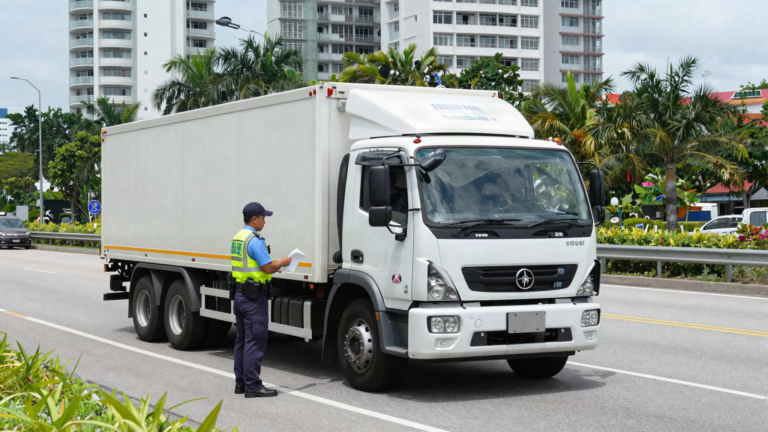
Carrying Dangerous Goods: Vehicle Modifications and Compliance for Singapore Fleets
Any Singapore fleet moving petroleum, flammable materials, or scheduled chemicals in bulk or above small-package thresholds needs an SCDF Petroleum & Flammable Materials (P&FM) Transport Licence for the vehicle and a HazMat Transport Driver Permit (HTDP) for the driver — on top of the ordinary Class 4 or Class 5 driving licence for the vehicle itself. Tanks need professional-engineer certification and periodic hydrostatic/radiographic testing, the vehicle needs a fire safety inspection and (above 3 tonnes) GPS tracking and an orange licence plate, and the vehicle is barred from Singapore’s road tunnels regardless of how well it’s certified.
Key Takeaways
Further reading: See our commercial vehicle modification regulations guide for the broader LTA approval and inspection process.
- Two separate approvals stack on top of each other: an SCDF transport licence for the vehicle (and its tank) and a separate HazMat Transport Driver Permit for the individual driver — neither substitutes for the other, and neither substitutes for the driver’s ordinary Class 4/5 licence.
- Small quantities are exempt, but the exemption is narrow: SCDF’s published thresholds exempt petroleum under roughly 130kg/20L-200L and flammable materials under similarly small amounts carried in limited containers — but mixing classes, or carrying any Schedule 1 chemical, removes the exemption regardless of quantity.
- Bulk tanks carry their own certification burden: a Professional Engineer must certify the tank, with hydrostatic testing roughly every 5 years and radiographic testing roughly every 10 years, on top of a third-party vehicle inspection before SCDF will issue the transport licence.
- LTA already bans dangerous-goods vehicles from road tunnels outright — a rule we cover in detail in our guide to Traffic Police and commercial vehicle rules — so route planning for a licensed tanker or hazmat vehicle has to work around the CTE, KPE, MCE, Fort Canning Tunnel and Sentosa Gateway Tunnel from the outset, not as an afterthought.
- CNG is a shrinking, thinly-documented category in Singapore. The compressed natural gas vehicle scheme peaked around 2010 and has since been overtaken by the government’s push toward electric vehicles, which means public, transport-specific modification standards for CNG cargo cylinders are hard to find and this article flags that gap plainly rather than guessing at numbers.
- Placarding and firefighting-equipment specifics are the least publicly documented part of the regime. SCDF’s application process requires photos of a vehicle’s “plates and warning labels,” which tells you labelling is mandatory, but the exact standard (UN hazard diamonds, GHS pictograms, or an SCDF-specific format) isn’t spelled out in the publicly available circular — treat this as something to confirm directly with SCDF or your Accredited Training Institution before you spec a new vehicle.
Table of Contents
- What Counts as “Dangerous Goods” for Road Transport in Singapore
- Fuel and Petroleum Tanker Requirements
- Chemical and Hazmat Tanker Requirements
- CNG-Specific Requirements
- SCDF Approval, Placarding, and Labelling
- Licence Classes and Permits: The Full Cross-Reference
- Practical Compliance Checklist for Fleet Operators
- FAQ
What Counts as “Dangerous Goods” for Road Transport in Singapore
In most jurisdictions, “dangerous goods” is one unified transport classification. In Singapore, the practical reality for a fleet operator is that the term gets split across agencies depending on what’s in the tank or on the flatbed. The Singapore Civil Defence Force (SCDF) regulates the transport of petroleum and flammable materials under the Fire Safety Act and its subsidiary Fire Safety (Petroleum and Flammable Materials) Regulations — this is the regime that covers fuel tankers, gas cylinders, solvents, and most of what a fleet manager would intuitively call “hazmat.” The National Environment Agency (NEA) separately administers the Environmental Protection and Management Act’s Hazardous Substances framework, which governs the import, possession, and use of hazardous chemicals — this matters most to the consignor/consignee of a chemical shipment rather than the vehicle itself, though a fleet moving NEA-controlled substances needs assurance the substance is properly licensed at both ends of the trip. The Land Transport Authority (LTA), for its part, doesn’t run a dangerous-goods vehicle licensing scheme at all — its interest is route and infrastructure safety, most visibly the outright ban on dangerous-goods vehicles from Singapore’s road tunnels.
For a fleet manager, the operational takeaway is this: SCDF is the agency whose paperwork determines whether your vehicle and driver are legally allowed to move the cargo at all. NEA’s rules matter for the cargo’s own legal status. LTA’s rules matter for where you’re allowed to drive once you’re compliant. All three can independently stop a job — a compliant vehicle carrying an improperly-licensed chemical is still a problem, and a fully compliant tanker still can’t cut through the CTE tunnel to save time.
SCDF’s own transport circular defines a licensed vehicle broadly: a road tanker, tank truck, semi-trailer, trailer, or “any other vehicle intended or adapted for use on roads” for transporting petroleum or flammable materials. It also distinguishes bulk transport (anything other than individual containers under 250 litres) from package transport (individual containers under 250 litres water capacity) and flags multi-load transport — two or more different petroleum or flammable material types carried in separate containers on the same trip — as its own category with its own compliance considerations.
SCDF publishes explicit exemption thresholds below which a P&FM transport licence isn’t required: petroleum under roughly 130kg carried in no more than 2 cylinders, under 20 litres for Class I petroleum, or under 200 litres for Class II/III petroleum; and flammable materials under roughly 130kg in no more than 2 cylinders, under 20 litres for liquids, or under 10kg for solids. Mixing classes of petroleum, mixing different types of flammable materials, or carrying any Schedule 1 chemical removes the exemption regardless of quantity — so a small-batch delivery run can still trigger full licensing if the load is mixed.
Fuel and Petroleum Tanker Requirements
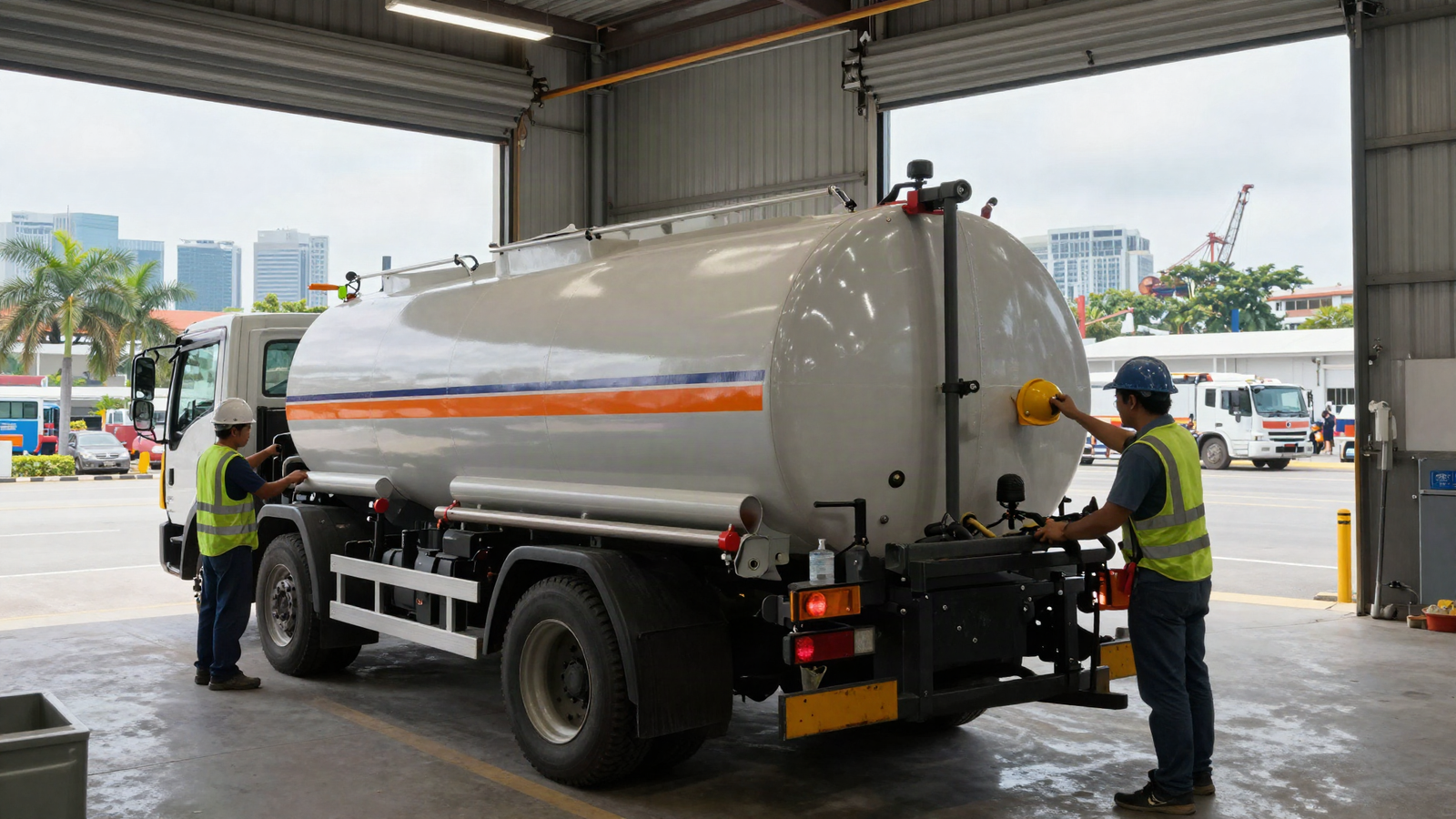
A vehicle moving petroleum in bulk — the classic fuel tanker — sits at the centre of SCDF’s P&FM Transport Licence regime. Before SCDF will issue the licence, the vehicle needs a third-party vehicle inspection, and if it carries a bulk tank, that tank must be tested and certified by a Professional Engineer. For bulk tanks specifically, the documented testing cadence includes hydrostatic testing roughly every 5 years and radiographic testing roughly every 10 years, each endorsed by a Professional Engineer — this is a recurring cost and scheduling obligation, not a one-time certification at purchase.
Once licensed, the vehicle has ongoing display and tracking obligations. The SCDF-issued transport licence must be displayed at the top right-hand corner of the vehicle’s windscreen at all times — a simple thing to overlook after a windscreen replacement, but a licensing lapse in the eyes of an inspecting officer. Vehicles carrying 3 metric tonnes or more (or carrying any Schedule 1 chemical, regardless of weight) must also carry a tracking device with an annual inspection certificate — the circular specifically names Astrata as the tracking system referenced — and must display an orange-coloured licence plate (colour code 3284/CW84, or the Sikkens LP2B equivalent) rather than the standard plate colour.
Licence validity runs up to a maximum of 2 years, though the exact term depends on what’s being carried: locally-registered vehicles carrying under 3 metric tonnes of standard P&FM materials can choose between a 1-year or 2-year term, while any vehicle carrying a Schedule 1 chemical is limited to a 1-year licence regardless of size. Applications go through the GoBusiness Licensing Portal, and SCDF’s stated service standard is to return an outcome within 3 working days when the submission is complete and in order — in practice, allow more lead time than that for a new vehicle, since a first-time application typically needs the PE tank certification and inspection paperwork assembled before submission, and any missing document resets the clock.
Bulk and package applications also require an approved Transport Emergency Response Plan (TERP) — SCDF maintains separate templates depending on whether the shipment is bulk or packaged — which sets out what the driver and operator do in the event of a spill, fire, or collision involving the load. This is a document every dangerous-goods fleet needs on file and, more usefully, one every driver on that route should actually have read rather than filed away.
Chemical and Hazmat Tanker Requirements
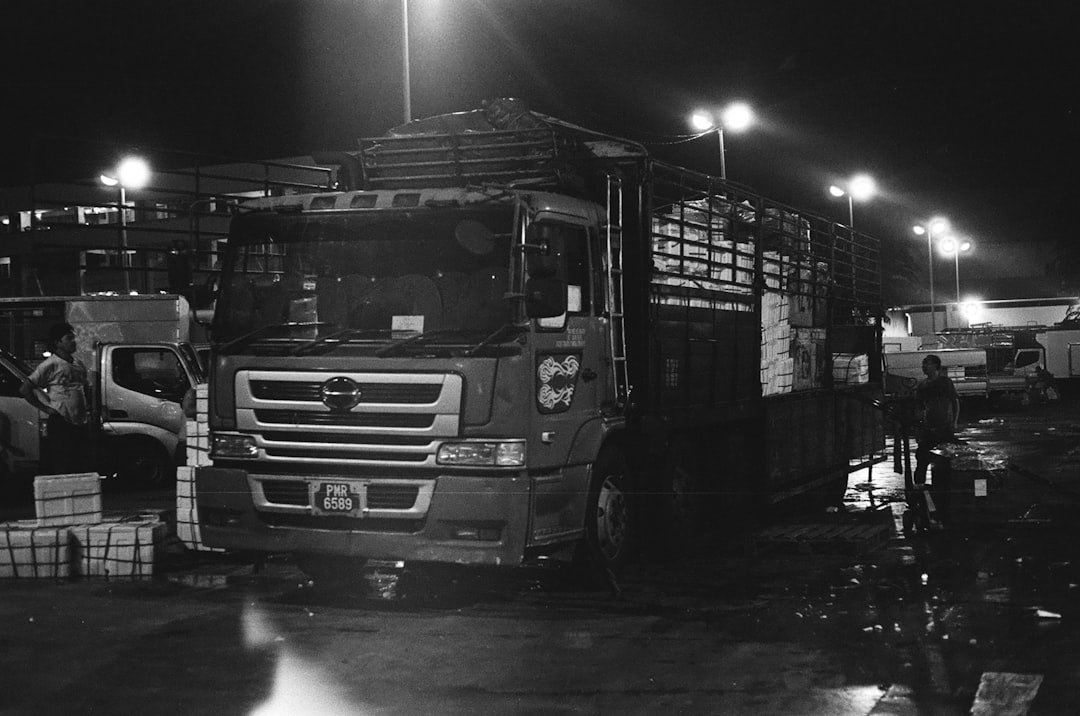
The same P&FM Transport Licence framework extends to flammable-material chemical tankers — solvents, flammable liquids, and similar cargo fall under the same licensing, inspection, and TERP requirements described above for petroleum. Where it diverges is around Schedule 1 chemicals, which SCDF treats as a stricter sub-category: a Schedule 1 load triggers the shorter 1-year licence term regardless of the quantity carried, and the exemption thresholds that apply to small petroleum or flammable-material quantities don’t apply at all once a Schedule 1 chemical is in the mix.
Beyond SCDF’s transport-licensing lane, a chemical hazmat load frequently has an NEA dimension that sits outside the vehicle’s own paperwork: many industrial chemicals are separately controlled under NEA’s Hazardous Substances framework, which governs whether the consignor is licensed to possess or supply the substance and whether the consignee is licensed to receive it. A fleet operator isn’t generally the one holding that licence, but a compliance failure on the shipper’s or receiver’s side can still leave the vehicle carrying cargo it has no legitimate destination for — which is a commercial and liability problem even when the vehicle’s own SCDF paperwork is spotless. The precise division of responsibility between SCDF’s transport licence and NEA’s substance-possession licensing for a given chemical isn’t laid out in a single public document; fleet operators handling regulated chemicals should confirm the specific substance’s NEA status directly with the shipper rather than assuming SCDF licensing alone covers it.
Standard practice for this class of cargo — as with fuel — includes compatibility checks between the tank lining/construction and the specific chemical carried, since a tank certified for one flammable liquid isn’t automatically approved for a different, more corrosive or more reactive one. This is standard chemical-transport industry practice internationally, but we could not verify from public SCDF material whether Singapore’s regulations mandate a specific compatibility-certification step per chemical type, versus leaving it to the PE certifying the tank; confirm with your certifying engineer.
CNG-Specific Requirements
Compressed natural gas is the thinnest-documented category in this article, and it’s worth being upfront about why. Singapore ran a CNG vehicle scheme starting around 2002 that peaked around 2010 with roughly 2,700 CNG cars and 2,800 CNG taxis on the road, according to the Ministry of Transport’s own retrospective parliamentary reply on the scheme. Since then, government fuel-transition policy has moved decisively toward electric vehicles rather than CNG, and the scheme has effectively wound down as a mainstream fuel category. That history matters for a fleet operator considering CNG cargo cylinders or a CNG tanker today: this is a shrinking niche, not a mature, actively-maintained regulatory lane, and it shows in how little dedicated public guidance exists for it compared with petroleum tankers.
What we can say with reasonable confidence is that CNG, as a compressed flammable gas, would fall under the same general P&FM/flammable-materials licensing umbrella described above rather than a wholly separate CNG-specific regime — SCDF’s flammable-materials category is defined broadly enough to capture compressed gases, and the same HazMat Transport Driver Permit requirement for the driver would logically apply. This is an inference based on the general structure of SCDF’s flammable-materials licensing and the absence of any separate CNG-specific transport licence category in the material we could find; it has not been confirmed against a CNG-specific SCDF circular. Cylinder-specific technical requirements — approved cylinder standards, mandatory pressure relief devices, periodic requalification testing intervals, and vehicle-mounting/crash-protection specifications — are standard features of CNG transport regulation in other markets, but we were unable to locate a Singapore-specific public document setting out equivalent figures for road transport of CNG cylinders or bulk CNG tankers. Do not use any specific cylinder testing interval or pressure figure until you’ve confirmed it directly with SCDF or an Accredited Training Institution; we have deliberately not invented numbers here. If CNG cargo transport is a live consideration for your fleet, this is a case where a direct enquiry to SCDF’s licensing desk will get you further, faster, than public search.
If a customer asks about moving CNG cargo, treat it as a bespoke compliance question rather than a standard quote line. Budget extra lead time to get a direct answer from SCDF before committing to a job, and price in the uncertainty — a scarcely-documented regulatory lane usually means a slower approval process, not a faster one, even when the underlying safety requirements turn out to be similar to petroleum transport.
SCDF Approval, Placarding, and Labelling
The approval sequence for a new dangerous-goods vehicle runs, in practice, in this order: get the tank designed and built to a standard your Professional Engineer will certify; have the PE certify the tank (with hydrostatic/radiographic test records where applicable); arrange the third-party vehicle inspection and Fire Safety Inspection certificate; fit tracking hardware and the orange plate if the vehicle will carry 3 tonnes or more or any Schedule 1 chemical; prepare a Transport Emergency Response Plan; and submit the full package through the GoBusiness Licensing Portal alongside vehicle registration/log card copies and photographs showing the vehicle’s plates and warning labels.
That last requirement — photographic evidence of “plates and warning labels” as part of the application — confirms that visible hazard labelling on the vehicle is mandatory before SCDF will license it. What isn’t spelled out in the publicly accessible circular is the exact labelling standard: whether SCDF requires UN Class hazard diamonds in the internationally-recognised format, GHS pictograms consistent with Singapore Standard SS 586 (Singapore’s national adaptation of the Globally Harmonised System, which Singapore has adopted under the Ministry of Manpower’s Workplace Safety and Health framework primarily for workplace chemical labelling), an SCDF-specific placard format, or some combination of these. Given that SS 586/GHS pictograms are the labelling standard Singapore businesses already use on hazardous chemical containers and safety data sheets under WSH regulations, it’s reasonable to expect SCDF’s vehicle warning labels to align with the same pictogram system rather than inventing a separate one — but this article could not confirm that alignment against SCDF’s own placarding specification, so verify the exact format required with your SCDF Accredited Training Institution or licensing officer before signage is fabricated.
Similarly, on-board firefighting equipment and electrical earthing/bonding requirements during loading and unloading are standard features of petroleum and flammable-material transport regulation in most comparable jurisdictions, but the publicly accessible SCDF transport circular we reviewed does not itemise a specific extinguisher type, class, or quantity, nor a specific earthing/bonding procedure. Do not assume a specific extinguisher rating or earthing procedure satisfies SCDF’s requirement without direct confirmation; the Fire Safety (Petroleum and Flammable Materials) Regulations almost certainly contain technical provisions on this that sit outside the summary-level circular we were able to access, and a fleet manager should request the full regulation text or ask their licensing consultant directly. This is one of the clearest places in this whole compliance area where “commonly assumed” and “publicly verifiable” diverge, and we’d rather flag the gap than paper over it with a plausible-sounding number.
For fleets that also carry general commercial cargo alongside occasional dangerous-goods runs, it’s worth reviewing how this licensing interacts with your existing fleet mix — our guide to commercial vehicle types in Singapore covers how vehicle classification for registration and COE purposes sits alongside (and separately from) the licensing layers covered here.
| Cargo Type | Key Vehicle/Tank Requirement | Required Licence/Permit |
|---|---|---|
| Bulk petroleum (fuel tanker) | PE-certified tank; hydrostatic test ~5 yrs, radiographic test ~10 yrs; third-party vehicle inspection; Fire Safety Inspection certificate | SCDF P&FM Transport Licence (up to 2 yrs) + driver HTDP |
| Package petroleum/flammables (small containers) | Warning labels displayed; exempt below ~130kg/2 cylinders/20L-200L thresholds if single class only | SCDF P&FM Transport Licence unless under exemption threshold; HTDP if licensed |
| Schedule 1 chemicals | Same tank/inspection regime as bulk petroleum; no small-quantity exemption | SCDF P&FM Transport Licence (1 yr max) + driver HTDP + TERP |
| Vehicles carrying ≥3 metric tonnes P&FM | GPS/tracking device (Astrata) with annual inspection; orange licence plate (colour code 3284/CW84 or Sikkens LP2B) | Same SCDF licence, with tracking + plate as additional conditions |
| CNG cylinders/tankers | Presumed (not confirmed) to fall under flammable-materials tank/cylinder standards; specific cylinder/PRD standards have not been publicly confirmed | Presumed same P&FM licence + HTDP structure (not confirmed) — confirm directly with SCDF |
Licence Classes and Permits: The Full Cross-Reference
A driver moving dangerous goods in Singapore needs three separate things to line up, and it’s easy for a fleet manager to have two of the three sorted and miss the third. First is the ordinary driving licence class for the vehicle itself — this has nothing to do with the cargo and everything to do with the vehicle’s weight and construction. Based on Traffic Police/Road Traffic (Motor Vehicles, Driving Licences) Rules classifications, Class 4 covers heavy motor vehicles and heavy motor tractors with unladen weight over 2,500kg, which is the class that covers most rigid lorries and tankers, while Class 5 covers heavy vehicles not constructed to carry a load themselves — chiefly prime movers — with unladen weight above roughly 7,250kg, relevant for articulated hazmat combinations. These figures match the same licence-class thresholds we’ve cross-checked in our companion guide on MOM and driver compliance in Singapore, but as noted there, confirm current thresholds directly against Traffic Police/LTA before making a hiring or vehicle-purchase decision on the strength of them.
Second is the vehicle’s own SCDF transport licence — covered above — which is a property of the vehicle and tank, not the driver, and travels with the vehicle rather than any individual employee.
Third, and the one most specific to this topic, is the driver-level HazMat Transport Driver Permit (HTDP). SCDF’s transport circular states plainly that the driver of a licensed vehicle is required to hold a valid HTDP at all times when transporting petroleum or flammable materials. Getting one requires passing a security screening and attending the HazMat Transport Driver Course at an SCDF Accredited Training Institution (ATI); the permit itself is described as a smart card carrying biometric data, valid for a period of two years before renewal is needed. Critically, the HTDP is a permit layered on top of the ordinary Class 4/5 driving licence — it doesn’t replace it, and a driver can hold a perfectly valid heavy-vehicle licence while being completely unqualified, absent the HTDP, to sit behind the wheel of a licensed dangerous-goods vehicle.
For fleet managers building out a hazmat-capable driver roster, this means recruitment and scheduling both need a two-gate check: does this driver hold the right licence class for the vehicle, and separately, does this driver hold a current, unexpired HTDP for this specific job. A lapsed HTDP renewal is arguably a higher day-to-day operational risk than a licence-class mismatch, because it expires on a fixed 2-year clock regardless of how experienced or careful the driver is, and it’s the kind of administrative deadline that’s easy to lose track of across a driver roster of any size.
Practical Compliance Checklist for Fleet Operators
- Confirm the licence category before you buy or lease the vehicle: a bulk tanker, a Schedule 1 chemical carrier, and a small package-transport van sit under meaningfully different SCDF licence terms and renewal cadences — know which one you’re buying into before capital is committed.
- Track the tank’s own certification clock separately from the vehicle’s: PE certification, hydrostatic testing (~5 years), and radiographic testing (~10 years) run on their own schedules and can lapse quietly if only the vehicle’s roadworthiness and licence renewal dates are being watched.
- Run a two-gate driver check for every hazmat assignment: Class 4/5 driving licence valid for the vehicle, and separately, a current HTDP for the driver — don’t assume one implies the other.
- Route around Singapore’s tunnel network as a hard constraint, not a preference. Vehicles carrying dangerous goods are barred from road tunnels outright, a rule confirmed in our Traffic Police and commercial vehicle rules guide — build this into route planning software and driver briefings from day one rather than discovering it mid-route.
- Keep the Transport Emergency Response Plan current and actually briefed to drivers, not just filed for the SCDF application — a TERP nobody has read is a compliance document, not an emergency response capability.
- Confirm placarding, firefighting equipment, and earthing procedures directly with SCDF or your ATI rather than copying a template from another jurisdiction — this article has flagged these as the least publicly documented parts of the regime for good reason.
- Check your insurance coverage against the cargo, not just the vehicle. Dangerous-goods cargo has different risk and liability profiles than general freight — see our goods-in-transit insurance guide for how standard policies typically treat (or exclude) hazardous cargo.
FAQ
Do I need a special driving licence class to drive a fuel tanker in Singapore?
Not a special class specific to dangerous goods — you need the ordinary Class 4 (or Class 5 for certain articulated combinations) licence appropriate to the vehicle’s weight, plus a separate HazMat Transport Driver Permit (HTDP) issued by SCDF. The HTDP is a permit, not a licence class.
How long does an SCDF P&FM Transport Licence last?
Up to a maximum of 2 years for most vehicles. Locally-registered vehicles carrying under 3 metric tonnes can choose 1 or 2 years; any vehicle carrying a Schedule 1 chemical is limited to a 1-year licence regardless of quantity carried.
Can a small delivery van carrying a few gas cylinders skip SCDF licensing?
Possibly — SCDF sets exemption thresholds around 130kg in no more than 2 cylinders, or small litre/weight limits for liquids and solids. But mixing classes of material, or carrying any Schedule 1 chemical, removes the exemption regardless of how small the load is.
Are dangerous-goods vehicles allowed in Singapore’s road tunnels?
No. LTA’s road tunnel safety rules explicitly prohibit vehicles carrying dangerous goods, including explosives and flammable substances, from tunnels such as the CTE, KPE, MCE and Fort Canning Tunnel — this is a routing constraint that applies regardless of how well-licensed the vehicle is.
What is the HazMat Transport Driver Permit (HTDP)?
A biometric smart-card permit, valid for 2 years, that SCDF requires every driver of a licensed P&FM vehicle to hold at all times. It requires security screening and completion of the HazMat Transport Driver Course at an SCDF Accredited Training Institution before issuance.
Is CNG cargo transport well-regulated in Singapore right now?
Public documentation is thin. Singapore’s CNG vehicle scheme peaked around 2010 and has since been overtaken by the shift to EVs, and we could not locate Singapore-specific public standards for CNG cylinder transport modifications. Confirm directly with SCDF before committing to a CNG cargo job.
Does NEA or SCDF regulate hazmat vehicle transport in Singapore?
SCDF regulates the vehicle and driver for petroleum/flammable-material transport under the Fire Safety Act. NEA separately regulates possession, import, and use of hazardous chemicals under the Environmental Protection and Management Act — a fleet may need both the SCDF vehicle licence and assurance the cargo itself is NEA-compliant at origin and destination.
What happens if a driver’s HTDP lapses mid-contract?
The driver is no longer legally permitted to operate the licensed vehicle for dangerous-goods transport until the permit is renewed, regardless of how valid their underlying driving licence is — treat HTDP renewal dates as a hard scheduling deadline, not a soft reminder.
Sources
- SCDF — Transport Circular: Requirements on Road Transportation of Dangerous Goods (1 Oct 2025)
- SCDF — Petroleum & Flammable Materials (P&FM) Transport Licence
- SCDF — Acts, Codes & Regulations
- Singapore Statutes Online — Fire Safety (Petroleum and Flammable Materials) Regulations
- LTA — Road Tunnel Safety Guide
- LTA — Road Tunnel Operations & Safety
- Ministry of Transport — Written Reply on the CNG Vehicle Scheme and Hydrogen Fuel Cell Plans
- ChemSafetyPro — GHS in Singapore (SS 586)
- Singapore Customs / NEA — Hazardous Substances Competent Authority Requirements
- Singapore Statutes Online — Road Traffic (Motor Vehicles, Driving Licences) Rules
Written by the SGFleetGuide editorial team. Last updated: 12 September 2026.