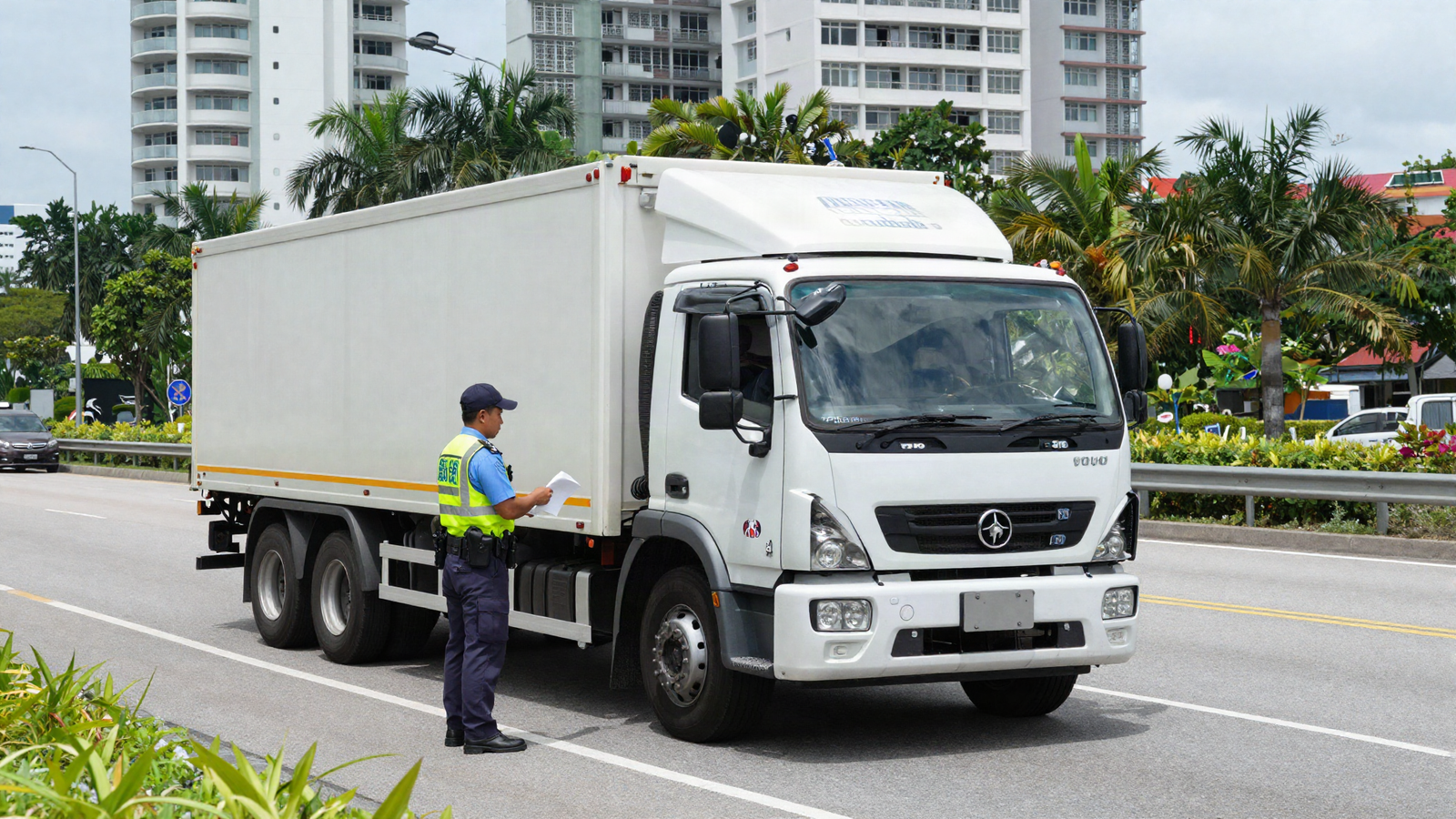
Traffic Police Rules for Commercial Vehicles in Singapore: Weight Limits, Loading and Route Restrictions
Singapore doesn’t work off a single “don’t overload the truck” rule — it sets weight limits per axle under the Road Traffic (Motor Vehicles, Construction and Use) Rules, on top of separate maximum-laden-weight classes that decide parking, speed-limiter and inspection requirements. LTA and Traffic Police run joint islandwide operations checking for overloading, insecure loads and unauthorised expressway use, and while the fines themselves are modest by regional standards, the demerit points attached to these offences put your ordinary driving licence — not some separate “vocational” document — on the line. This guide walks through the numbers, the routes, and what actually belongs in a driver briefing.
Key Takeaways
- Weight limits are set per axle, not as one overall number: under the Construction and Use Rules, no single wheel may carry more than 6 tonnes, and total gross weight scales with axle count — 19 tonnes for a 2-axle rigid vehicle up to 46 tonnes for a 5-axle-plus articulated combination.
- Registration class and structural weight limit are two different things: the Light/Heavy/Very Heavy Goods Vehicle classification (by maximum laden weight — up to 3,500kg, 3,501–16,000kg, and above 16,000kg) governs parking and speed-limiter rules; the axle-load rule is what decides whether you’re actually overloaded.
- An unsecured load is a small fine with a big multiplier effect: it’s a composition fine of up to $180 and up to 6 demerit points — cheap in isolation, but heavy vehicles have accounted for the large majority of enforcement action and of the accidents that follow when a load actually comes loose.
- Not every heavy vehicle can just use the expressway: mobile cranes, low loaders and other “excluded vehicles” need an LTA permit first, and even with one, travel is off-limits during the morning and evening peak windows without special authorisation.
- Overloading and unauthorised expressway use both carry real penalties: up to $1,000 and/or three months’ imprisonment for a first offence, doubling for repeat offenders — and that’s before the demerit points and insurance consequences.
- There’s no separate “vocational licence” for lorry and truck drivers: unlike taxi and private-hire drivers, who hold a TDVL or PDVL with its own points system, a goods vehicle or bus driver’s livelihood rides on their ordinary Class 3/3A, 4, 4A or 5 driving licence under the standard Driver Improvement Points System.
Table of Contents
- Axle Load and Gross Vehicle Weight Limits
- How LTA and Traffic Police Check Vehicle Weight
- Load Securing: Tarping, Strapping and Weight Distribution
- Restricted Routes for Heavy Vehicles
- Demerit Points and Your Driving Licence
- Overloading Penalties: Fines and Consequences
- Practical Compliance Advice for Fleet Operators
- FAQ
Axle Load and Gross Vehicle Weight Limits
Fleet operators tend to think about vehicle weight in one number — the maximum laden weight (MLW) printed on the vehicle log card. That number matters, but it’s not the number that decides whether you’re overloaded on the road. Two separate systems are running at once, and mixing them up is the most common compliance mistake fleets make.
The first system is registration classification. LTA splits goods vehicles into three bands by maximum laden weight: Light Goods Vehicles (LGVs) up to 3,500kg, Heavy Goods Vehicles (HGVs) from 3,501kg to 16,000kg, and Very Heavy Goods Vehicles (VHGVs) above 16,000kg. This classification decides things like whether you need a Vehicle Parking Certificate (required once MLW exceeds 5,000kg) and which speed-limiter and inspection rules apply.
The second system is the structural weight limit under the Road Traffic (Motor Vehicles, Construction and Use) Rules — the rule that actually defines “overloaded.” It works per axle and per wheel, not as a single vehicle-wide figure:
| Limit | Maximum |
|---|---|
| Weight on any single wheel | 6 metric tonnes |
| Weight on any 2 wheels in line (same axle) | 12 metric tonnes |
| Gross vehicle weight — 2 axles | 19 metric tonnes |
| Gross vehicle weight — 3 axles | 28 metric tonnes |
| Gross vehicle weight — 4 axles (rigid) | 34 metric tonnes |
| Gross vehicle weight — 4-axle articulated combination | 39 metric tonnes |
| Gross vehicle weight — 5-or-more-axle articulated combination | 46 metric tonnes |
There’s also a load-spread rule that matters for anything carried in a way that concentrates weight: the total load transmitted by more than two wheels onto any 600mm-wide transverse strip of road surface can’t exceed 12 tonnes. In practice, this is the rule that catches badly distributed cargo — a load bunched over one axle rather than spread evenly across the bed can put you over the limit on paper even if the total cargo weight looks fine on a delivery order.
Your vehicle’s MLW rating and its structural axle-weight limit are not interchangeable. A vehicle registered as an HGV under the MLW bands can still be overloaded well below its MLW ceiling if the cargo is poorly distributed across the axles. Don’t rely on total tonnage alone — know how your specific vehicle’s axle configuration maps to the table above.
How LTA and Traffic Police Check Vehicle Weight
Weight and load compliance isn’t checked through a single dedicated “weigh station” the way it might be in a larger country with long-haul trucking corridors — Singapore’s enforcement model is built around joint, islandwide operations run periodically by LTA together with the Traffic Police, rather than fixed checkpoints every vehicle passes through routinely. LTA has not published the specific weighing equipment or methodology used at these roadside checks, so the exact mechanism (fixed platform scales, portable axle scales, or weigh-in-motion sensors) isn’t confirmed in public sources; fleet operators should assume any roadside stop can include a weight check.
These operations tend to bundle several related checks into one exercise, which is worth knowing because it changes what “being pulled over” actually means for a commercial driver. A three-day joint LTA–Traffic Police operation in August reportedly stopped 166 commercial vehicles and issued 121 traffic summonses — for speeding, mobile phone use, and failing to keep left — alongside 93 separate LTA violations, including 7 overloaded vehicles and 19 vehicles operating on expressways without the required exclusion permit. A separate islandwide sweep reported over 130 offences, with more than 80 involving overloaded vehicles and over 50 involving oversized or excluded vehicles without permits.
The pattern in both operations is the same: a stop that starts as a routine traffic check can surface a weight or permit violation, and the two enforcement regimes (Traffic Police for road conduct, LTA for vehicle and load compliance) work off the same stop. Speed limiter compliance rides along in the same sweeps — one operation flagged 17 heavy vehicles missing the required speed-limiter label, a separate and mandatory requirement for goods vehicles above 12,000kg MLW and buses with 23 or more seats.
A driver stopped for a minor moving violation can end up cited for an unrelated weight or permit issue in the same encounter. If your loading process runs close to the axle limits as a matter of routine, treat every stop as a potential weight check, not just a ticket for the original reason the vehicle was flagged.
Load Securing: Tarping, Strapping and Weight Distribution
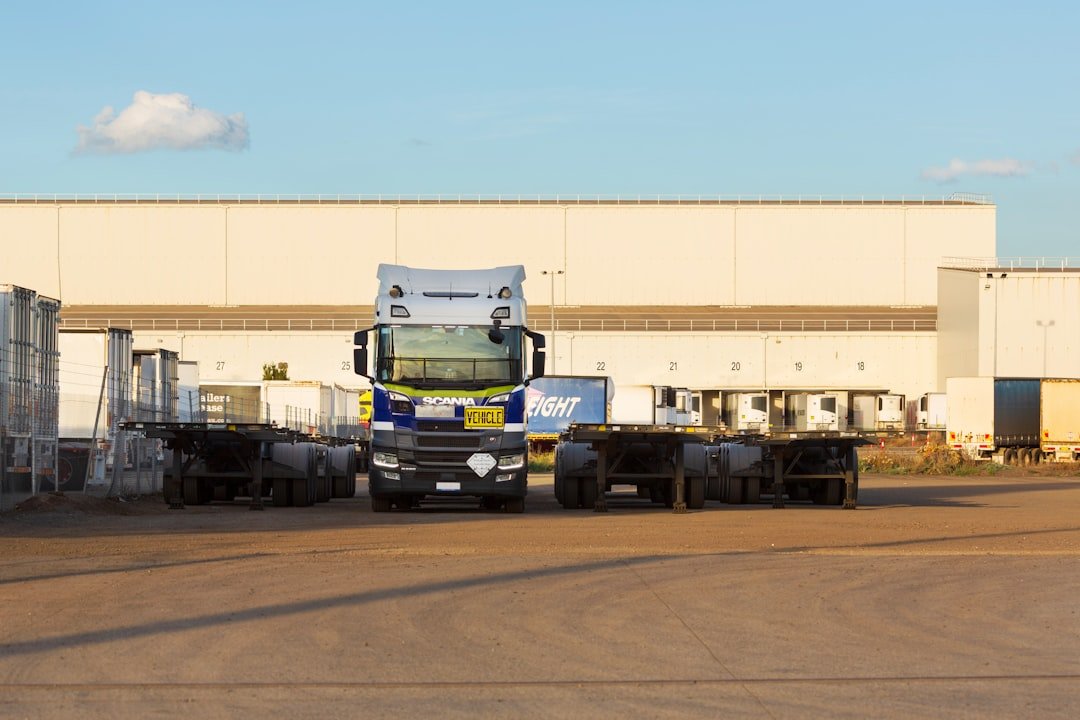
The legal requirement is simple to state and easy to under-invest in: cargo must be properly secured so that it cannot fall out and endanger other road users. The Workplace Safety and Health Council has published dedicated guidelines on safe loading and unloading of vehicles, covering securing methods, weight distribution, and equipment for different cargo types — worth building into a driver induction pack rather than treating as an afterthought.
One specific rule catches operators who haul long or bulky items: where cargo protrudes more than 300mm beyond the rear of the vehicle, a clean red flag must be attached to mark the overhang. This isn’t a suggestion — it’s an enforceable requirement, and between 2021 and 2023, Traffic Police and LTA recorded roughly 3,300 enforcement actions covering red-flag non-compliance, missing Oversized Vehicle Movement permits, breaches of permit conditions, and unauthorised use of expressways by excluded vehicles.
Insecure loads specifically are a smaller but telling category. In the most recent published breakdown covering 2015 to 2017, Traffic Police recorded 248 instances of improperly secured loads, and heavy vehicles accounted for roughly 80% of them. Thirteen accidents in the same period were traced to objects falling off vehicles — eleven of those thirteen involved heavy vehicles. The penalty for an unsecured load is a composition fine of up to $180 and up to 6 demerit points: not a heavy fine on its own, but the accident risk sits almost entirely with the vehicles this article is about.
Traffic Police runs road-safety dialogues specifically with heavy vehicle fleet owners and drivers to share load-securing best practice — a genuinely useful, low-cost way to keep a driver pool current, and worth asking about if your fleet operates a meaningful number of goods vehicles.
Restricted Routes for Heavy Vehicles
Route planning for a commercial vehicle in Singapore has to account for restrictions that simply don’t exist for a private car. Get this wrong and the failure mode isn’t a fine — it’s a vehicle wedged under a bridge or turned back at an expressway on-ramp mid-delivery.
Expressway restrictions. Certain vehicle types — mobile cranes, low loaders, tractors, and other categories LTA designates as “excluded vehicles” — cannot use expressways at all without a specific LTA permit. Even with a permit, travel is restricted during peak hours: no travel from 7.00am to 9.30am or 5.00pm to 9.30pm without separate special authorisation. Plan deliveries involving these vehicle types around those windows as a default, not an exception.
Tunnel restrictions. Vehicles exceeding 4.5m in height, 3m in width, or 13m in length are barred from Singapore’s road tunnels, as is any vehicle carrying dangerous goods such as explosives, flammable gases, or radioactive substances — no permit route around this one.
Lorry Restricted Roads. Roads marked with a “Lorry Restriction” sign are off-limits to goods vehicles above the posted weight threshold unless the vehicle holds specific authorisation. Refuse collection vehicles are automatically exempted; most other goods vehicles are not.
Height- and weight-restricted structures. LTA maintains a public tool — the List of Roads With Height Limit on the LTA PROMPT portal — listing roads and structures by maximum clearance. It’s a genuinely practical resource: check it before committing a new route or a taller-than-usual vehicle to an unfamiliar road, rather than finding out at the structure itself.
Oversized Vehicle Movement (OVM) permits. A permit is required where a vehicle’s width exceeds 3m (2.6m on designated controlled roads), where rear overhang exceeds 40% of the vehicle’s length or 1.8m, or where weight exceeds the type-specific laden limits. Permit conditions commonly restrict travel to off-peak or night-time hours, require warning signage, and in some cases mandate an auxiliary police escort.
The CBD and the old “Restricted Zone.” There is no blanket ban on trucks entering Singapore’s central business district today. The historical Restricted Zone under the old Area Licensing Scheme was the predecessor to Electronic Road Pricing (ERP) — it has been superseded, and ERP now applies uniformly to vehicles that enter priced roads and gantries, commercial vehicles included. ERP rate schedules differ by vehicle category, with goods vehicles and buses typically charged at a different rate band than cars; confirm the current rate table on LTA’s ERP page before budgeting, since rates are revised periodically. The practical constraint for heavy vehicles in the city isn’t a zone ban — it’s the lane and lorry-restriction rules above, plus the general road-safety requirement to keep left except when overtaking, which Traffic Police actively enforces against heavy vehicle drivers on multi-lane roads.
For anything route-specific, LTA’s OneMotoring Commercial Vehicles page and the PROMPT portal are the two places to check before dispatch, not after a driver calls in stuck.
Demerit Points and Your Driving Licence
Here’s a distinction worth getting right, because a lot of fleet operators assume goods vehicle and bus drivers hold something called a “vocational licence” the way taxi and private-hire drivers do. They don’t. Taxi drivers (TDVL) and private-hire car drivers (PDVL) are on a separate points system — the Vocational Licence Points System — that tracks service and conduct issues like overcharging or meter tampering, with its own suspension thresholds starting as low as 6 points in a rolling 24-month window.
Goods vehicle and bus drivers are not on that system. They’re on the same Driver Improvement Points System (DIPS), run by Traffic Police, that applies to every ordinary driving licence holder in Singapore — the Class 3/3A licence that covers cars and light goods vehicles, Class 4 for heavier goods vehicles, Class 4A for heavy vehicles with a trailer, and Class 5 for buses. There’s no separate document to protect and no separate scheme to watch — accumulate enough points on the licence itself, and you lose the ability to drive that vehicle class, full stop.
Under DIPS, drivers earn between 3 and 12 demerit points per offence depending on severity. The specific point value attached to overloading or oversized-vehicle offences specifically has not been confirmed in public point-schedule summaries reviewed for this article; treat any specific number quoted elsewhere for these offences with caution until confirmed against Traffic Police’s current published schedule. Points accumulate over a rolling window, and once a driver crosses the threshold, a licence suspension follows automatically.
The thresholds themselves are changing. Under the current system (through 31 December 2026), a non-probationary driver hits a first suspension at 24 or more demerit points within 24 months, triggering a 12-week suspension; a second threshold breach (12 or more points within 12 months) brings a 24-week suspension, escalating further on subsequent breaches up to 5 years. Probationary drivers — those within their first year of holding a licence — face revocation at 13 or more points.
From 1 January 2027, the system tightens. The first-suspension threshold drops to 18 points within 24 months, with the suspension itself lengthened to 4 months; a second breach brings 6 months, and later breaches are standardised at 5 years rather than a sliding scale. Probationary revocation drops to 12 points. Traffic Police has cited a rise in road fatalities as the reason for tightening the system, alongside discontinuing the Safe Driving Course (due to weak uptake and limited effect on driver behaviour) and restricting the DIPS Retraining Course option to first-time suspensions only.
A Class 4 driver suspended for 4 months (under the 2027 thresholds) is a driver who cannot legally drive your heavy vehicles at all during that period — not a fine you absorb, a seat you have to fill. Track individual drivers’ accumulated points the same way you’d track a vehicle’s inspection due date, not just after an accident happens.
Overloading Penalties: Fines and Consequences
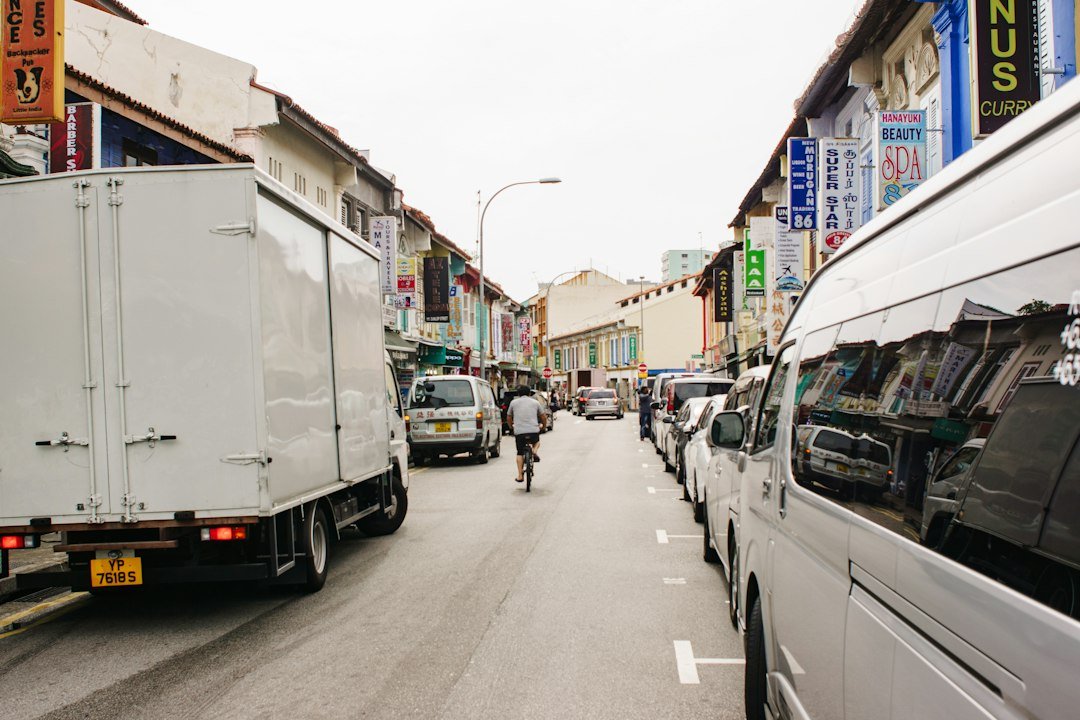
The headline penalty for overloading, and for the related offence of an excluded vehicle using an expressway without a permit, is consistent across the enforcement reporting reviewed for this article: a fine of up to $1,000 and/or up to three months’ imprisonment for a first offence, with both the fine and the jail term doubling for repeat offenders — up to $2,000 and/or six months. The same penalty tier applies to operating a heavy vehicle without a required speed-limiter certificate, and it roughly doubles on repeat non-compliance there too.
Compare that to the insecure-load offence covered earlier — a composition fine of up to $180 and up to 6 demerit points — and the gap tells you something about how the two offences are treated. An unsecured load is priced as a lower-tier compliance lapse; overloading and unauthorised expressway use are priced closer to offences that put other road users and infrastructure directly at risk, which lines up with LTA’s own stated reasoning: overloaded vehicles can become unstable or spill cargo, and oversized or excluded vehicles can obstruct traffic or damage road structures.
The fine itself is rarely the real cost for a fleet operator. A summons for overloading or an excluded-vehicle violation also feeds into a driver’s DIPS points, it can trigger a failed roadworthiness or weight check that takes the vehicle off the road mid-shift, and — depending on how your commercial motor policy is worded — a conviction tied to an accident can complicate a claim. None of that shows up on the composition fine itself, which is exactly why it gets underweighted in a lot of internal risk assessments.
Practical Compliance Advice for Fleet Operators
Most of what’s covered above turns into a handful of concrete habits rather than a compliance department. Here’s what actually moves the needle for a Singapore fleet running goods vehicles day to day.
- Separate MLW from axle limits in driver training: make sure whoever loads the vehicle understands that “under the MLW rating” doesn’t automatically mean “under the axle limit” — distribution matters as much as total weight.
- Build a load-securing checklist into pre-trip inspection: tarps and straps checked, weight distributed rather than bunched over one axle, and a red flag fitted whenever cargo overhangs the rear by more than 300mm. Make it a signed checklist item, not a verbal reminder.
- Brief drivers on their actual route restrictions, not generic ones: if a route regularly uses a height-restricted road or crosses into Lorry Restricted territory, that’s a route-specific briefing item, checked against LTA’s height-limit list and the OneMotoring commercial vehicle rules before the route is assigned, not discovered by the driver at the structure.
- Carry the documentation that matches the vehicle, not a generic folder: valid road tax and inspection certificate, Vehicle Parking Certificate where MLW requires one, Speed Limiter Certificate for vehicles above the mandatory threshold, and — for anything oversized or on the excluded-vehicle list — the specific LTA permit for that vehicle and that route.
- Track DIPS points across your driver pool proactively: a driver quietly accumulating points from speeding or mobile-phone tickets is a bigger scheduling risk than a single dramatic incident — you find out about the incident immediately, but points accumulate quietly until a suspension notice arrives.
- Time expressway-restricted movements around the peak windows by default: if a vehicle type or load needs an excluded-vehicle permit, build the 7.00am–9.30am and 5.00pm–9.30pm no-go windows into the dispatch schedule as a standing rule, not a per-trip check.
- Treat every roadside stop as a potential weight or permit check: given how LTA and Traffic Police run joint operations, a driver stopped for something unrelated can still be checked for load compliance in the same encounter — drivers should know what documentation to hand over without a search.
FAQ
What’s the maximum weight a goods vehicle can carry in Singapore?
It depends on axle configuration, not a single figure. Under the Construction and Use Rules, no single wheel may carry more than 6 tonnes, and total gross vehicle weight scales from 19 tonnes for a 2-axle rigid vehicle up to 46 tonnes for a 5-or-more-axle articulated combination.
Is a Light Goods Vehicle (LGV) the same thing as a vehicle’s structural weight limit?
No. LGV, HGV and VHGV are registration classifications based on maximum laden weight (up to 3,500kg, 3,501–16,000kg, and above 16,000kg respectively), used mainly for parking and speed-limiter rules. Whether a specific load overloads the vehicle is governed separately by the axle-weight rules under the Construction and Use Rules.
What happens if my load isn’t secured properly?
An unsecured load carries a composition fine of up to $180 and up to 6 demerit points. If cargo protrudes more than 300mm beyond the rear of the vehicle, a clean red flag must be displayed to mark the overhang, separately enforced from the general load-securing requirement.
Do all heavy vehicles need a permit to use expressways?
Not all — but certain categories LTA designates as “excluded vehicles” (mobile cranes, low loaders, tractors and similar) do need a specific LTA permit, and even with one, travel is barred during the 7.00am–9.30am and 5.00pm–9.30pm peak windows without additional special authorisation.
Is there a truck ban in Singapore’s CBD?
No blanket ban exists today. The old Restricted Zone under the Area Licensing Scheme was replaced by Electronic Road Pricing, which applies to vehicles entering priced roads regardless of type. The practical restrictions on heavy vehicles in the city come from Lorry Restricted Road signage, lane-keeping rules, and route-specific height or weight limits, not a CBD-wide truck ban.
How many demerit points before I lose my driving licence?
Through 31 December 2026, a non-probationary driver faces a 12-week suspension at 24 or more points within 24 months. From 1 January 2027, that threshold drops to 18 points within 24 months, with the first suspension lengthened to 4 months. Probationary drivers face revocation at a lower point count (13 currently, 12 from 2027).
Does a goods vehicle or bus driver have a separate “vocational licence” like a taxi driver?
No. Taxi and private-hire drivers hold a separate vocational licence (TDVL/PDVL) under its own points system. Goods vehicle and bus drivers operate on their ordinary driving licence — Class 3/3A, 4, 4A or 5 — under the standard Driver Improvement Points System that applies to all drivers.
Where can I check if a road has a height or weight restriction before sending a vehicle down it?
LTA publishes a List of Roads With Height Limit on its PROMPT portal, searchable by road name. For weight-specific restrictions and Lorry Restricted Roads, check LTA’s OneMotoring Commercial Vehicles page, which also covers expressway exclusions and Oversized Vehicle Movement permit conditions.
What’s the penalty for overloading a commercial vehicle?
Up to $1,000 and/or up to three months’ imprisonment for a first offence, doubling to up to $2,000 and/or six months for repeat offenders. The same tier of penalty applies to operating an excluded vehicle on an expressway without a permit.
Author: Keith Kwai, editor and publisher of SGFleetGuide, with 25 years experience in B2B and B2C companies. More about the author.
Last updated: 11 September 2026
Sources: LTA OneMotoring — Commercial Vehicles | Singapore Statutes Online — Road Traffic (Motor Vehicles, Construction and Use) Rules | Singapore Police Force — Driver Improvement Point Systems | Mothership — S’pore Lowers Demerit Points Threshold From 2027 | Ministry of Home Affairs — Parliamentary Reply on Insecure Vehicle Loads | Ministry of Transport — Parliamentary Reply on Large and Bulky Item Transport | LTA PROMPT — List of Roads With Height Limit | Must Share News — LTA & Traffic Police Joint Enforcement Operation | Must Share News — LTA Islandwide Heavy Vehicle Enforcement




3 Comments