Buying a Used Commercial Vehicle in Singapore: Inspection Checklist and Red Flags
Before buying a used commercial vehicle in Singapore, check the remaining COE validity first — it drives resale value more than mileage does — then get an LTA-authorised inspection centre to run a pre-purchase check on the chassis, brakes, and engine. Cross-check the chassis and engine numbers against the digital vehicle particulars, ask for service records, and treat a seller who resists any of this as your answer.
Key Takeaways
- COE remaining validity matters more than the odometer: a vehicle with 3 years of COE left is a fundamentally different purchase from one with 8 years left, even if both show the same mileage.
- Goods vehicles have a hard 20-year lifespan cap: unlike cars, they cannot be renewed indefinitely — once the vehicle hits 20 years from first registration, it must be deregistered, whatever the remaining COE says.
- Low mileage on an old vehicle is not automatically a good sign: long idle periods, short-haul stop-start use, and tropical humidity all age a commercial vehicle’s seals, hoses, and brakes faster than distance alone.
- MAS’s loan-to-value and tenure caps don’t apply to commercial vehicles: banks and finance companies set their own down payment and tenure terms for goods vehicles, which is why used commercial vehicle financing varies more than car loans do.
- Singapore has no free public accident-history database for vehicles: you’re relying on the seller’s disclosure, workshop repair records, and what you can physically verify — there’s no LTA equivalent of a Carfax report.
- Lemon Law protection only exists if you buy from a business: the Consumer Protection (Fair Trading) Act’s used-vehicle remedies don’t apply to private, consumer-to-consumer sales, which changes your legal position materially depending on who you buy from.
Table of Contents
- COE Remaining Validity: Why It’s the First Number You Check
- Mileage vs. Age: What Actually Matters More
- The Mechanical Inspection Checklist
- Accident and Flood History: What You Can (and Can’t) Verify
- Pre-Purchase Inspection Options: VICOM, STA, and What Each Checks
- Financing a Used Commercial Vehicle: What’s Different
- Red Flags Checklist: Signs to Walk Away
- Dealer vs. Private Resale: Different Risk Profiles
- FAQ
COE Remaining Validity: Why It’s the First Number You Check
Every vehicle in Singapore is registered against a Certificate of Entitlement (COE) that’s valid for 10 years from first registration. When you buy used, you’re not buying a vehicle — you’re buying whatever’s left of that 10-year clock, plus the vehicle attached to it. A 5-year-old van with 5 years of COE left and a 9-year-old van with 1 year left can look identical in a listing photo and be completely different purchases.
Check the exact expiry date on the vehicle’s registration details, not just “how old” the seller says it is. The remaining COE months are what you’re actually paying for on top of the metal — this is why two vehicles of the same make, model, and mileage can list at very different prices once their COE positions diverge.
Near the 10-year mark, the owner has two choices: deregister the vehicle (triggering a COE rebate, pro-rated to whatever validity is left, paid out based on the original Quota Premium) or renew the COE for another 5 or 10 years by paying the Prevailing Quota Premium — the moving 3-month average of Quota Premiums in recent bidding exercises. A 5-year renewal costs 50% of the PQP; a 10-year renewal costs the full PQP. Category C vehicles (goods vehicles and buses) can go through this renewal cycle more than once, unlike Category A, B, and D vehicles, which can only use the 5-year renewal option a single time.
If you’re buying a vehicle that’s approaching its 10-year mark, ask directly whether the seller intends to renew the COE before handover or sell it “as is” with the clock running out. If COE isn’t renewed within one month of expiry, the vehicle has to be deregistered immediately — you don’t want to discover this after the sale is done. There’s also a hard structural difference between cars and goods vehicles here: goods vehicles carry a statutory lifespan cap of 20 years from first registration, after which they must be deregistered regardless of how much COE has been paid for. A car has no such absolute ceiling. That 20-year wall should shape how much you’re willing to pay for COE renewal on an older lorry or van — you’re not buying indefinite extendability, you’re buying a fixed remaining runway.
PARF (Preferential Additional Registration Fee) rebates apply to private cars, off-peak cars, company cars, private-hire cars, and taxis — not to goods vehicles, buses, or engineering plant. If you’re deregistering a used lorry or van later, budget on the COE rebate only; there’s no PARF cushion to offset a bad purchase decision the way there is with a car.
Mileage vs. Age: What Actually Matters More
The instinct is to treat mileage as the primary health indicator, the way you would with a private car. For commercial vehicles, that instinct is only half right — usage pattern and age tell you as much, sometimes more, than the number on the odometer.
A van doing short island-wide delivery runs racks up stop-start mileage that’s harder on brakes, clutches, and transmissions than an equivalent distance of highway cruising. A lorry that’s covered relatively few kilometres but sat idle for long stretches between jobs can have perished rubber seals, a dried-out clutch plate, and a fuel system that’s seen more condensation than fuel. Tropical humidity accelerates corrosion and rubber degradation regardless of how much the vehicle has actually been driven — a low-mileage commercial vehicle that’s spent years parked outdoors in Singapore’s climate is not automatically the safer buy.
What you actually want to weigh, side by side, is: total mileage, the type of routes it ran (short urban stop-start vs. longer highway hauls), how many owners or drivers it’s had, whether it was used single-shift or multi-shift, and whether it carried loads at or near its rated capacity consistently — overloading accelerates wear on suspension, brakes, and drivetrain components disproportionately to distance covered.
For heavier vehicles specifically — HGVs and above — ask how the vehicle was used relative to its Maximum Laden Weight rating. LTA classifies goods vehicles by weight: Light Goods Vehicles up to 3,500kg MLW, Heavy Goods Vehicles from 3,501kg to 16,000kg, and Very Heavy Goods Vehicles above 16,000kg, with Goods-cum-Passenger Vehicles capped at 5,000kg. A vehicle habitually run near or over its class ceiling has a harder life than the same model used well within its rating, and that shows up in the chassis and suspension years before it shows up in the paint.
The Mechanical Inspection Checklist
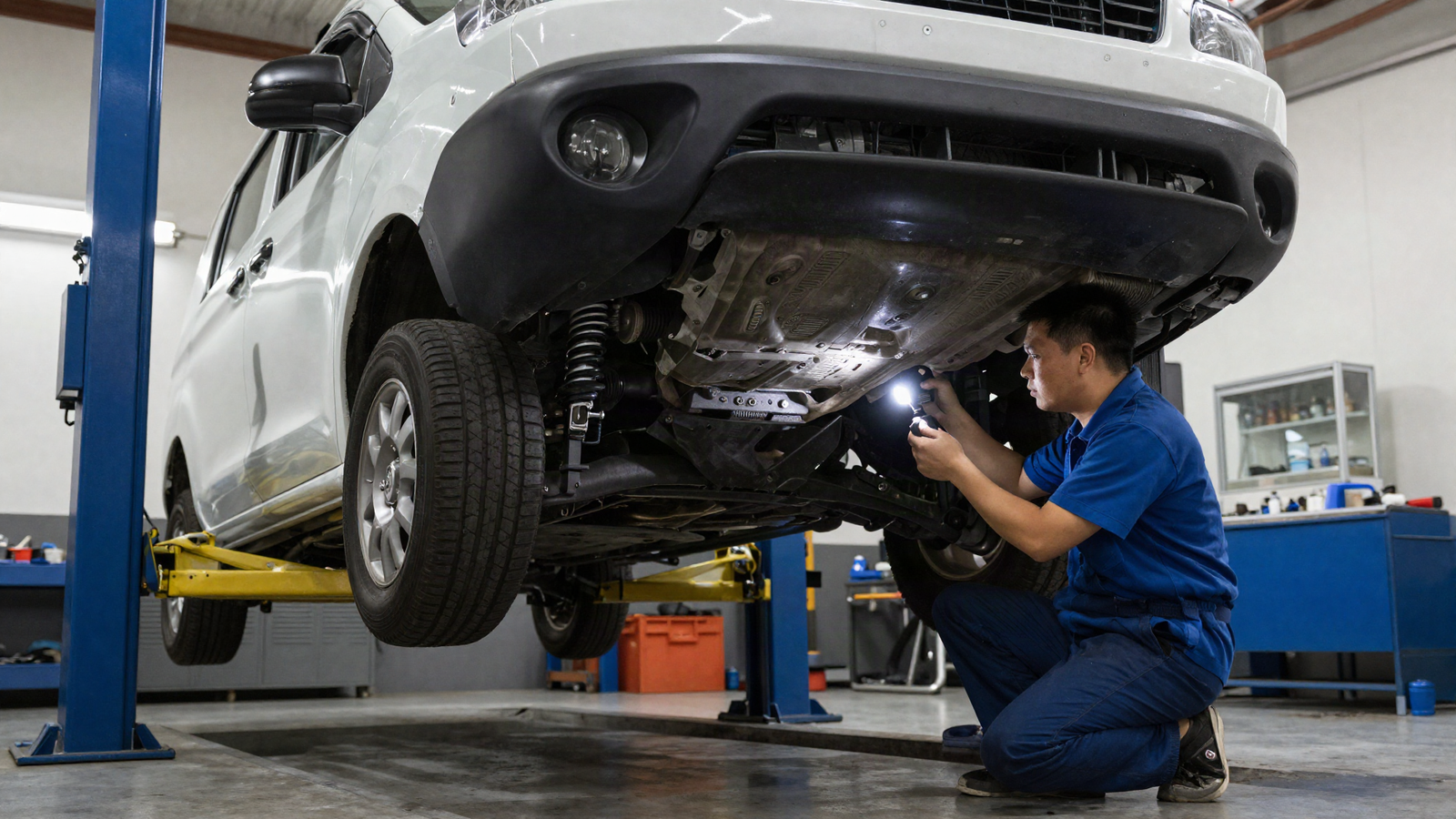
Go through the vehicle systematically rather than starting the engine and hoping for the best. This is the order that surfaces the expensive problems first.
- Engine: Check for oil leaks around the sump, valve cover, and rear main seal. Look at the oil on the dipstick — milky or gritty oil suggests coolant intrusion or metal wear. Listen for knocking on cold start, and check exhaust smoke colour: blue suggests oil burning, white (beyond normal condensation) suggests a head gasket or coolant issue, black suggests an overly rich mixture or injector problems.
- Transmission: On manuals, check clutch engagement point and listen for grinding on gear changes. On automatics, check for delayed or harsh shifts and fluid condition (it should not smell burnt or look dark brown/black).
- Brakes: Check pad and disc/drum wear, look for uneven wear that suggests caliper or cylinder problems, and test for pulling to one side under braking — a common sign on vehicles that have done heavy stop-start delivery work.
- Tyres: Check tread depth and wear pattern across all tyres, including the spare. Uneven wear points to alignment or suspension issues; check manufacture date codes on the sidewall, since a tyre can look fine and still be past its safe service life.
- Chassis and frame: This is the one buyers skip and shouldn’t. Get the vehicle up on a hoist or ramp and check the chassis rails for rust-through, weld repairs, ripples, or mismatched paint that suggests prior accident repair. Pay particular attention to the areas around the rear axle mounts and any tail-lift or load-bed mounting points, where stress cracks show up first on vehicles that have carried heavy or uneven loads.
- Hydraulics and tail-lift (where fitted): Cycle the tail-lift through a full up-down operation and check for jerky movement, slow response, or fluid leaks at the ram seals. Check hydraulic hose condition for cracking or bulging, and inspect the platform itself for structural cracks or repaired welds.
- Underbody and suspension: Check leaf springs for cracked or sagging leaves, shock absorbers for leaks, and bushings for perishing or excessive play.
Do this in daylight, on a dry day, and ideally before the seller has had the vehicle washed. A freshly detailed engine bay and undercarriage on an otherwise well-used commercial vehicle is itself worth asking about — it’s not proof of anything wrong, but it removes your ability to see the leaks and rust that daily grime would otherwise show you.
Accident and Flood History: What You Can (and Can’t) Verify
Be realistic about what’s actually available here. As of writing, LTA does not offer a free public accident-history lookup for individual vehicles akin to a Carfax-style report; verify this has not changed before relying on its absence. What you have instead is the seller’s disclosure, the vehicle’s service and workshop records, and what a physical inspection can turn up.
Ask for the full workshop history, not just the most recent service book. A pattern of repairs clustered around one time period, followed by a run of ordinary maintenance, often marks an accident that was repaired rather than declared. Ask specifically whether the vehicle has ever been in an accident requiring panel, chassis, or frame work, and ask to see the invoice if so — a legitimate repair should have paperwork.
Physical signs of prior accident damage worth checking: paint colour or texture mismatches between panels, uneven panel gaps, overspray on rubber trim or door hinges, and — as covered above — chassis rail welds or ripples that don’t match factory construction.
Flood damage is a separate and often harder-to-spot problem, and Singapore’s periodic heavy rain events mean it’s a real risk in the used market. Signs to check specifically:
- Corrosion in places that shouldn’t corrode from normal use — under the dashboard, inside the fuse box, on seat rail bolts, or on seatbelt retractor mechanisms.
- A musty or heavily “deodorised” smell in the cabin that doesn’t match the vehicle’s stated age or care level — flood-damaged vehicles are often aggressively scented to mask mould.
- Watermarks or tide lines on the underside of carpets, inside door cards, or in the boot/cargo area lining.
- Fogging or moisture inside instrument cluster glass or headlamp/tail-light housings.
- Electrical faults that come and go — flickering dashboard lights, intermittent power windows, or warning lights that clear and reappear — often trace back to corroded connectors from prior water exposure.
- Mismatched carpet or upholstery that looks newer than the rest of the interior, suggesting a partial replacement after water damage.
One thing you can verify through LTA’s OneMotoring digital services: since LTA digitalised vehicle registration in 2023, the physical log card has been replaced by digital vehicle particulars, and a seller can generate an access code so you can view the vehicle’s registered details online before purchase — useful for confirming ownership history and registration particulars line up with what you’ve been told.
Pre-Purchase Inspection Options: VICOM, STA, and What Each Checks
Singapore’s periodic vehicle inspections are run by LTA-authorised centres — VICOM Inspection Centre (five locations: Bukit Batok, Changi, Kaki Bukit, Sin Ming, and Yishun), STA Inspection (two centres, Boon Lay and Sin Ming), and JIC Inspection Services (Jalan Papan). These bodies conduct the mandatory periodic inspection every vehicle must pass to stay registered, covering structural integrity of the chassis frame, wheel systems, braking and steering mechanisms, body condition, lighting and indication systems, and exhaust emissions and noise levels against regulatory limits.
For goods vehicles, the inspection schedule is more frequent than for private cars: vehicles under 10 years old are inspected annually, and vehicles over 10 years old are inspected every 6 months. Buses follow a similar pattern, except omnibuses (public buses), which are inspected every 6 months regardless of age, and buses running on compressed natural gas, which need checks every 3 months.
Separately from this mandatory periodic inspection, both VICOM and STA offer paid pre-purchase or used-vehicle evaluation inspections — a more thorough, buyer-commissioned check that goes beyond the roadworthiness pass/fail criteria of the periodic inspection. Exact service names, scope, and pricing vary and should be confirmed directly with the inspection centre, as current rate cards are not consistently published. The value of commissioning one of these before you commit isn’t just the checklist — it’s having an independent party’s name on the report, which is worth more than a seller’s word if a dispute comes up later.
If you’re buying a vehicle close to its next mandatory inspection date, it’s also worth asking to see (or requesting via access code) its most recent inspection report. These reports typically record the odometer reading at the time of inspection, which gives you a documented mileage checkpoint you can compare against the current reading and the seller’s mileage claim — a practical way to sanity-check for a rolled-back odometer without needing a specialised service.
Financing a Used Commercial Vehicle: What’s Different
If you’ve financed a private car in Singapore before, you’ll know MAS sets hard limits on that loan: a maximum loan-to-value ratio (60% of purchase price if the vehicle’s Open Market Value exceeds $20,000, 70% if it’s at or below that threshold) and a maximum loan tenure. What most first-time commercial buyers don’t realise is that these MAS-mandated caps explicitly exempt commercial vehicles and motorcycles. There is no regulatory LTV floor or tenure ceiling on a goods vehicle loan the way there is on a car loan.
That doesn’t mean financing a used commercial vehicle is easier — in practice it tends to be more conservative, just for commercial reasons rather than regulatory ones. Banks and finance companies set their own down payment and tenure terms for goods vehicles based on their own risk assessment, and that assessment leans harder on the exact same factors this checklist covers: remaining COE validity, vehicle age against the vehicle class’s usable life, and the vehicle’s resale liquidity. A used vehicle with limited COE left is a weaker security asset for a lender than a new one, so it’s common in practice to see lower loan-to-value ratios and shorter tenures offered for used commercial vehicles than for new ones (exact ratios and tenures are set per lender and per applicant and are not publicly standardised, so treat any specific percentage you’re quoted as lender-specific rather than a market norm).
Because loan terms aren’t regulated the same way for commercial vehicles, get financing pre-approved or at least ballpark quoted before you commit to a specific used vehicle — the down payment a lender wants on a 7-year-old lorry with 2 years of COE left can be materially higher than what you’d assume from car-loan experience.
Insurance costs also diverge from what a private car buyer expects. Commercial vehicle No Claims Discount caps lower than private car NCD (typically 20% after 3+ claim-free years, versus 50% for private cars) and a single claim on a commercial policy typically resets it straight to 0% rather than stepping down. Older, used commercial vehicles with thinner claims history or higher-risk usage profiles (multiple drivers, longer routes, heavier loads) will generally see this reflected in the quote — budget for insurance as part of the total cost of ownership, not an afterthought once the purchase is done.
Red Flags Checklist: Signs to Walk Away

Some issues are worth negotiating around. Others should end the conversation. Here’s where to draw the line.
- Odometer reading inconsistent with service records or inspection history: if a workshop invoice or inspection report from two years ago shows higher mileage logic doesn’t support against today’s reading, that’s not a clerical error — treat it as rolled-back mileage until proven otherwise.
- Chassis or engine number that doesn’t match the digital vehicle particulars: physically verify the stamped chassis number (usually on the frame near the firewall or front cross-member) and engine number against the official record. A mismatch is a serious problem, potentially indicating a rebuilt or grey-market vehicle, and is not something to take the seller’s explanation on faith for.
- Service records with unexplained gaps: a commercial vehicle in active daily use that shows long stretches with no service history at all suggests either under-maintenance or a seller who can’t produce the full picture.
- Reluctance to allow an independent pre-purchase inspection: a seller who’s confident in the vehicle’s condition has no reason to block a VICOM or STA inspection commissioned by you. Resistance here is one of the clearest signals available.
- Price significantly below comparable listings with similar COE remaining: if it looks too cheap for its COE position and mileage, assume there’s a reason and find out what it is before you find out the hard way.
- Fresh detailing that seems disproportionate to the vehicle’s use case: as noted above, this isn’t proof of a problem, but a heavily cleaned engine bay or undercarriage on a vehicle that’s clearly seen hard commercial use is worth a direct question.
- No willingness to put the sale, mileage, and condition claims in writing: get the agreed mileage, condition, and any seller representations documented in the sale agreement — verbal assurances are worth nothing if a dispute arises later.
Dealer vs. Private Resale: Different Risk Profiles
Who you buy from changes your legal position, not just your negotiating position. Singapore’s Consumer Protection (Fair Trading) Act, which includes the Lemon Law provisions covering defective second-hand goods and vehicles, applies to purchases from a business — a licensed dealer selling in the course of trade. It does not apply to consumer-to-consumer transactions, meaning a private, individual-to-individual sale.
Bought from a dealer, you generally have recourse if a defect surfaces within 6 months of purchase — remedies can include repair, replacement, price reduction, or rescission of the contract, though “satisfactory quality” for a used vehicle is judged against its age and the price paid, not against new-vehicle standards, and normal wear and tear or a fault you were told about beforehand won’t qualify. Bought privately, you’re relying entirely on ordinary contract terms and whatever due diligence you did before handing over payment — there’s no statutory safety net behind you if something goes wrong afterward.
That doesn’t make private sales a bad idea — pricing is often more negotiable, and a private seller who’s owned and operated the vehicle themselves can usually give you a more honest account of its real-world quirks than a dealer’s sales pitch will. But it does mean the burden of verification shifts almost entirely onto you: the mechanical inspection, the paperwork checks, and the pre-purchase inspection matter more, not less, when there’s no dealer standing behind the sale afterward. If you’re buying privately, treat every step in this checklist as non-negotiable rather than optional diligence.
FAQ
How much COE validity should I look for in a used commercial vehicle?
There’s no fixed threshold — it depends on your intended holding period and budget. A vehicle with less than 2 years of COE left will need a renewal decision (and a PQP payment) almost immediately, which should be priced into your offer. Compare the total cost — purchase price plus any near-term COE renewal — against a vehicle with more COE remaining before deciding which is actually cheaper.
Can I check a used commercial vehicle’s accident history through LTA?
Not through a dedicated public accident-history report. LTA’s digital vehicle particulars service (accessible via an access code from the seller) confirms registration and ownership details, but a comprehensive accident history relies on the seller’s disclosure, workshop invoices, and your own physical inspection.
Do goods vehicles get a PARF rebate like private cars?
No. PARF rebates apply to private cars, off-peak cars, company cars, private-hire cars, and taxis. Goods vehicles, buses, and engineering plant are not PARF-eligible — only the COE rebate applies when they’re deregistered before COE expiry.
What’s the difference between a periodic inspection and a pre-purchase inspection?
The periodic inspection is the mandatory roadworthiness check every vehicle must pass to remain registered, run on a schedule set by vehicle age and type. A pre-purchase inspection is a separate, buyer-commissioned check — offered by the same LTA-authorised centres — that typically goes into more mechanical detail than the pass/fail criteria of the periodic check.
Is a low-mileage older commercial vehicle a safe bet?
Not automatically. Long idle periods degrade rubber seals, hoses, and brake components, and Singapore’s humid climate accelerates corrosion regardless of distance driven. Ask about usage pattern and storage conditions, not just the odometer figure.
Does buying from a dealer instead of a private seller actually matter legally?
Yes. Lemon Law protections under the Consumer Protection (Fair Trading) Act apply to purchases from a business, giving you recourse if a defect appears within 6 months. They do not apply to private, consumer-to-consumer sales, where you have no equivalent statutory remedy.
What financing terms should I expect for a used commercial vehicle?
MAS’s loan-to-value and tenure caps for motor vehicle loans explicitly exempt commercial vehicles, so terms are set entirely by the individual bank or finance company. In practice, expect more conservative down payment and tenure terms on an older, used vehicle with less COE remaining than you’d see for a new one — get quotes before committing to a specific vehicle rather than assuming car-loan norms will carry over.
What’s the single most important physical check before buying?
Getting the vehicle up on a hoist to inspect the chassis frame for rust-through, weld repairs, or ripples. This is the check most private buyers skip, and it’s the one most likely to reveal a prior structural accident repair that a surface-level walkaround won’t show.
Author: Keith Kwai, editor and publisher of SGFleetGuide, with 25 years experience in B2B and B2C companies. More about the author.
Last updated: 11 September 2026
Sources: LTA OneMotoring — COE Renewal | LTA OneMotoring — PARF & COE Rebate | LTA OneMotoring — Goods Vehicle and Engineering Plant Classification | LTA OneMotoring — Vehicle Inspection | LTA — Authorised Vehicle Inspection Centres | LTA OneMotoring — Digital Vehicle Particulars Access Code | MAS — Financing Restrictions on Motor Vehicle Loans | MAS — Eases Rules on Motor Vehicle Financing | CASE Singapore — CPFTA & Lemon Law



One Comment