Diesel vs Electric Fuel Cost Calculator for Singapore Fleets
To compare diesel and electric running costs, divide the price of fuel or electricity by how far a litre or kWh takes the vehicle, then multiply by your daily distance. A light commercial diesel van in Singapore typically runs S$0.35–S$0.45 per km on fuel alone at current pump prices, while an equivalent electric van charged mostly at a depot or home wallbox typically runs S$0.10–S$0.18 per km — the gap narrows if you rely heavily on public DC fast charging, which can cost several times more than off-peak grid electricity.
Key Takeaways
- The per-km formula is the same for both fuels — price per litre or kWh divided by distance covered — the real work is sourcing honest consumption and price numbers for your vehicle and routes.
- Diesel duty in Singapore is a flat excise, not a percentage — a fixed rate per litre that doesn’t move with pump price swings the way GST does.
- Where you charge matters more than what you drive — depot or home charging on a regulated tariff can cost a third to a fifth of public DC fast charging per kWh.
- Carbon tax doesn’t hit diesel at the pump directly — it’s levied on large industrial facilities, though it indirectly nudges electricity tariffs as generators pass through some carbon cost.
- Fuel cost is only one line in total cost of ownership — maintenance, COE, insurance and resale value can outweigh the per-km fuel gap over a vehicle’s life.
- Build the comparison in a spreadsheet, not your head — a five-line calculator per vehicle lets you test daily mileages and charging mixes before committing.
Table of Contents
- The Basic Formula: Cost Per Km for Diesel and Electric
- Where to Find Current Diesel Pump Prices in Singapore
- Where to Find Commercial EV Charging Tariffs
- Home/Depot Charging vs Public DC Fast Charging
- Diesel Duty and Carbon Tax: What Actually Applies
- Worked Example: Diesel Van vs Electric Van
- What the Calculator Doesn’t Capture
- FAQ
The Basic Formula: Cost Per Km for Diesel and Electric
Strip away the marketing language and the comparison is arithmetic. For a diesel vehicle, cost per km is pump price per litre divided by the vehicle’s actual km-per-litre. For an electric vehicle, it’s electricity price per kWh divided by km-per-kWh (or price per kWh multiplied by kWh-per-100km, divided by 100, if that’s how your spec sheet reports it).
Two things trip operators up. Manufacturer consumption figures are lab numbers — a diesel van rated at 12km/L on a test cycle might return 9-10km/L on real Singapore roads with air-con and stop-start traffic, and an EV rated at 5km/kWh might return 3.8-4.2km/kWh under the same conditions. And the two fuels are priced in different units, so sticker prices alone aren’t comparable — run both through the per-km formula first.
The practical fix: pull three months of pump receipts or telematics data for your current diesel vehicles, and for an EV you’re evaluating, ask the dealer or another operator running that model here for real-world consumption rather than the spec sheet.
Where to Find Current Diesel Pump Prices in Singapore
Singapore’s retail diesel price moves with global crude and refined-product markets rather than sitting at one fixed number. For a live read, check the pump price boards at the major retailers directly — Shell, Esso, Caltex, SPC and Sinopec all publish current prices, and several petrol-price comparison sites aggregate them daily so you can see the spread across brands before committing a fleet fuel card to one network. If your fleet already runs on a corporate fuel card, your statement is the most accurate source, since it reflects the discount tier you actually pay, not the pump board price.
Diesel pump prices in Singapore moved sharply in mid-September 2026: after tracking around S$3.50 per litre earlier in the month, prices at Shell, Esso and Caltex climbed back above S$4.00 per litre (roughly S$4.03–S$4.07) by 14 September 2026, driven by global crude supply pressures. Pump prices move week to week with global fuel markets and vary by retailer; treat any single figure as a snapshot, not a number to budget against long-term. Build your calculator with a price cell you update monthly, since diesel duty is flat but the underlying commodity price is not.
Where to Find Commercial EV Charging Tariffs
Electricity pricing has more moving parts than fuel pricing. If you charge at a depot on a standard commercial account, your effective rate is whatever your retailer or the SP Group regulated tariff charges that quarter — the Energy Market Authority sets it quarterly, published on SP Group’s tariff information page with the breakdown between energy cost, network cost and smaller fees. On an open electricity market contract instead, your rate depends on the plan you signed, so check that rather than assume the SP Group figure applies.
If your fleet instead relies on public charging points, the relevant tariff is whatever the charge point operator publishes for that charger and speed tier — rates differ by operator, AC versus DC, and sometimes time of day. Checking the operator’s own rate card before committing a route is worth the ten minutes it takes; the spread between operators is wide enough to change your per-km number meaningfully.
Public AC charging in Singapore has recently run roughly S$0.58-S$0.74 per kWh, and public DC fast charging roughly S$0.75-S$0.82 per kWh, against a regulated grid tariff around S$0.32-S$0.35 per kWh including GST. Rates vary by operator, location and plan, and change over time; verify the specific network’s current rate before budgeting around it. That gap between grid and public fast-charging pricing is the single biggest lever in an EV fleet’s running cost.
Home/Depot Charging vs Public DC Fast Charging
This is the part of the EV cost story vehicle brochures gloss over. An EV’s cost-per-km isn’t one number — it depends almost entirely on where the electrons come from.
Charging overnight at a depot or a driver’s home on a standard or off-peak commercial tariff is the cheapest way to run an EV in Singapore, and for most SME delivery and service fleets running fixed routes back to a base each night, it’s also the most practical — the vehicle sits idle for hours anyway, and AC charging overnight comfortably fills the battery. Public AC charging during the working day costs more than depot charging but is usually still cheaper than DC fast charging.
Public DC fast charging solves a different problem — topping up quickly mid-shift when a route runs long — and it’s priced for that convenience. A fleet that plans routes around its depot’s charging capacity and treats public fast charging as an occasional buffer, not a routine top-up, sees per-km electricity costs much closer to the low end of the range than one that defaults to public fast charging out of habit.
Still deciding between vehicle types? Our guide to electric commercial vehicles in Singapore covers payload, range and available models — the vehicle side of the decision, alongside the cost math here.
Diesel Duty and Carbon Tax: What Actually Applies
Two separate levies get conflated in fleet conversations, and it’s worth pulling them apart, since only one actually shows up in your diesel price.
Diesel excise duty is charged by Singapore Customs as dutiable goods, at a flat rate per litre rather than a percentage of pump price — Singapore Customs’ own worked example for diesel duty works out to S$0.20 per litre. Being flat, it doesn’t amplify when crude prices spike the way a percentage tax would, but it doesn’t shrink when prices fall either. GST applies on top.
Carbon tax, by contrast, is not a line item on your fuel receipt at all. It’s levied upstream on facilities that directly emit at least 25,000 tonnes of CO2-equivalent a year — power stations, refineries, large manufacturing plants — currently around 50 facilities nationally. The rate rose to S$25 per tonne in 2024 and S$45 per tonne from January 2026, with further increases signalled toward S$50-80 per tonne by 2030. An SME fleet buying diesel at a retail pump isn’t paying this tax directly. The indirect channel runs through electricity: generators sit inside the carbon tax’s scope, and to the extent they pass some cost through in wholesale prices, it shows up embedded in the tariff you pay per kWh — the electricity side of your calculator already carries some climate-policy cost, while the diesel side carries a flat excise duty instead.
Don’t budget for carbon tax as a future direct cost on diesel fuel — as designed today, it isn’t one. Watch diesel excise duty instead, since that’s the lever government has actually used on diesel pricing before.
Worked Example: Diesel Van vs Electric Van
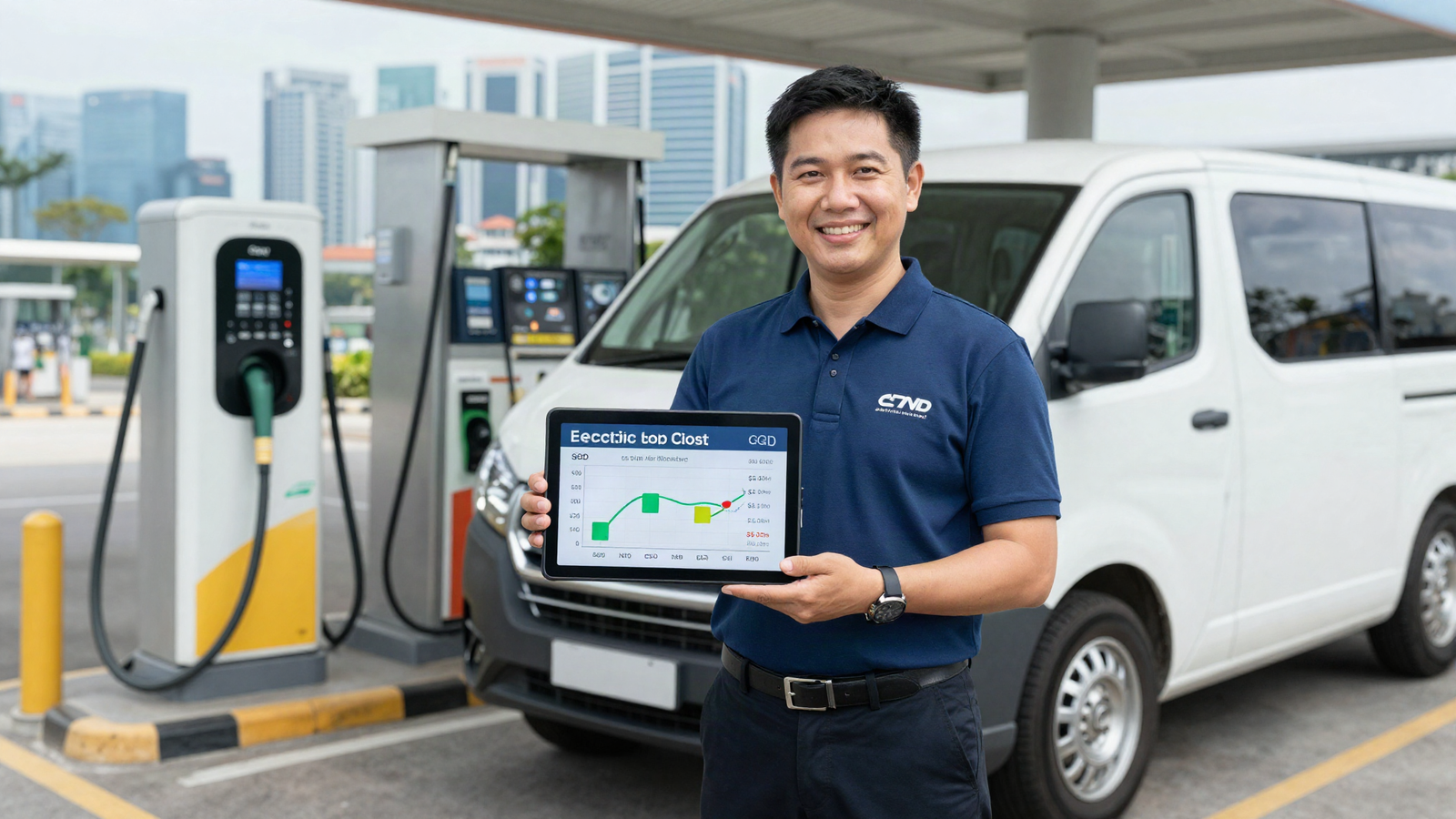
Take a light commercial van on a typical SME delivery pattern: 80km a day, 6 days a week, roughly 25,000km a year. These are representative figures — swap in your own vehicle’s real consumption and current prices before deciding.
Diesel van. 10km/litre real-world, pump price S$4.00/litre (reflecting the mid-September 2026 price level, not the earlier-month low): S$0.40 per km, S$32 for an 80km day, roughly S$10,000 a year at 25,000km.
Electric van, mostly depot-charged. Real-world consumption of 4.2km/kWh, with 85% of charging overnight at the depot on a regulated tariff around S$0.32/kWh, and 15% topped up on public DC fast charging at roughly S$0.78/kWh. Blended price: (0.85 × S$0.32) + (0.15 × S$0.78) ≈ S$0.39/kWh. Cost per km: S$0.39 ÷ 4.2 ≈ S$0.093, about S$7.44 for an 80km day, roughly S$2,330 a year at 25,000km.
On this pattern, the electric van’s fuel-equivalent cost runs at roughly a quarter of the diesel van’s — saving on the order of S$7,700 a year in energy alone at current diesel prices (the exact saving moves with whatever diesel price you plug in). Two caveats: run the math with your actual charging mix (relying on public fast charging for 50% instead of 15% pushes the blended rate toward S$0.55/kWh, cutting the advantage roughly in half), and remember this is fuel cost only — purchase price, COE, financing, insurance, servicing and resale value belong in a fuller comparison. Our EV vs diesel total cost of ownership guide covers that picture.
What the Calculator Doesn’t Capture
A per-km fuel comparison is the right first filter, but it’s deliberately narrow. Worth being explicit about what it leaves out.
- Charging time versus refuelling time — a diesel van refuels in minutes; an EV on a depot AC charger needs hours, which only works if shift patterns leave that window free.
- Route and range risk — an EV’s real-world range varies with air-con load, payload and driving style, so running near empty on a tight schedule is a different risk than a low fuel gauge.
- Battery degradation and resale value — an EV battery’s usable range typically declines slowly over years of use, affecting both cost-per-km and resale value later.
- Upfront price, COE and financing — EVs and diesel vans aren’t purchased at the same price point today, and that gap changes the payback period on any fuel savings.
Treat this fuel calculator as step one of a purchase decision, not the whole decision. It answers “which fuel costs less per km” cleanly — not “which vehicle is cheaper to own,” a different and larger question.
FAQ
How do I calculate cost per km for a diesel vehicle?
Divide the current diesel price per litre by the vehicle’s real-world km-per-litre consumption, using fuel-card or telematics data rather than the manufacturer’s rated figure.
How do I calculate cost per km for an electric vehicle?
Divide the electricity price per kWh by the vehicle’s real-world km-per-kWh consumption, using a blended price weighted by how much charging happens at each rate if you charge from a mix of sources.
Where can I find the current diesel price in Singapore?
Check pump price boards or published rates from major retailers, a fuel-price comparison site, or your own fleet fuel-card statement for the rate you’re actually paying.
Where can I find current EV charging tariffs in Singapore?
For depot or home charging on the regulated tariff, SP Group publishes the current quarterly rate. For public charging, check the specific operator’s published rate card, since rates vary by operator, speed and sometimes time of day.
Is diesel duty a fixed amount or a percentage of the pump price?
A flat excise duty per litre set by Singapore Customs, not a percentage. GST applies on top, as with other dutiable purchases.
Does Singapore’s carbon tax add directly to diesel or petrol prices at the pump?
No. It’s levied on large facilities emitting at least 25,000 tonnes of CO2-equivalent a year, not on retail fuel sales, though it can indirectly affect electricity tariffs.
Is public DC fast charging always more expensive than home or depot charging?
In Singapore’s current market, yes, typically by a wide margin — public fast charging has recently run at roughly double the regulated grid tariff per kWh or more.
Does a lower cost-per-km for an EV mean it’s automatically cheaper to own than a diesel equivalent?
Not necessarily. Fuel cost is one input into total cost of ownership alongside purchase price, COE, financing, insurance and resale value — a useful first filter, not a substitute for a full TCO comparison.
Author: Keith Kwai, editor and publisher of SGFleetGuide, with 25 years experience in B2B and B2C companies. More about the author.
Last updated: 15 September 2026
Sources: Singapore Customs — Duties and Dutiable Goods Overview | Singapore Customs — List of Dutiable Goods | SP Group — Electricity Tariff Information | National Climate Change Secretariat — Carbon Tax | DollarsAndSense — Complete Guide to EV Charging Costs in Singapore | DailyFuels — Singapore Fuel Prices | Goody Feed — Diesel Tops S$4 a Litre (14 Sept 2026)