Heavy Vehicle Blind Spots and Turning Safety: A Guide for Singapore Fleet Drivers and Managers
Lorries, trucks and buses have blind zones on all four sides that are far larger than a car’s, and the danger is worst when the vehicle turns — the rear wheels track inside the front wheels’ path, sweeping through space a pedestrian or cyclist may already occupy. Singapore’s Traffic Police and LTA guidance requires drivers to check blind spots, use a wider turning radius, and give cyclists and pedestrians sufficient space; heavier vehicles (over 12,000kg MLW, registered from April 2015) are also required by LTA to carry additional blind-spot mirrors or camera systems. Fleets that pair this equipment with reversing protocols and mirror-check training cut both the accident risk and the liability exposure that follows a heavy-vehicle collision.
Key Takeaways
- Heavy vehicles have four distinct blind zones — front, rear, and both sides — and the side “no-zones” run the full length of the vehicle, not only past the driver’s window.
- The turning sweep is the highest-risk moment, because the rear of a long vehicle cuts inside the front’s path, closing off space that looked clear a second earlier.
- LTA mandates blind-spot mirrors or camera systems on heavy goods vehicles above 12,000kg MLW registered from 1 April 2015 — this is a specific regulatory requirement, not a general best practice.
- Traffic Police’s RoadSense guidance tells all drivers to check blind spots, keep a safe distance, and watch for vulnerable road users — obligations that apply with more force to vehicles with bigger blind zones.
- Reversing and loading-bay incidents are a distinct risk category from turning incidents, and need their own protocol — a spotter, not just a camera.
- Blind-spot collisions carry outsized liability and insurance consequences for the fleet, not only the driver, because they’re read as a training and systems failure.
Why a Lorry’s Blind Spots Aren’t Just a Bigger Version of a Car’s
Every vehicle has blind spots. What changes with a lorry, tipper truck, or bus is scale and shape. A car’s blind zones are small pockets near the rear pillars and behind each shoulder — a shoulder check clears most of them. A heavy commercial vehicle’s blind zones are structural: the cab sits high and forward, the body is long and often boxed-in, and the driver’s eye line cannot reach several areas no matter how the mirrors are angled.
The zones worth knowing, in general road-safety terms that apply to large vehicles everywhere:
Front blind zone
A high cab and long bonnet (or, on cab-forward trucks, a low seating position relative to the front bumper) can hide a standing adult or a child directly ahead of the vehicle. This matters most when a heavy vehicle is stationary at a crossing and then moves off — the person who was visible while the vehicle was further back can vanish from view in the final metres.
Rear blind zone
This is the largest and best-known zone. A box body, curtain-sider, or bus with no rear window leaves the driver reliant entirely on mirrors and cameras for anything directly behind. A reversing lorry can have a blind area extending well beyond the vehicle’s own length — long enough to fully hide a parked car, a motorcycle, or a person crouching to check a delivery.
Side “no-zones”
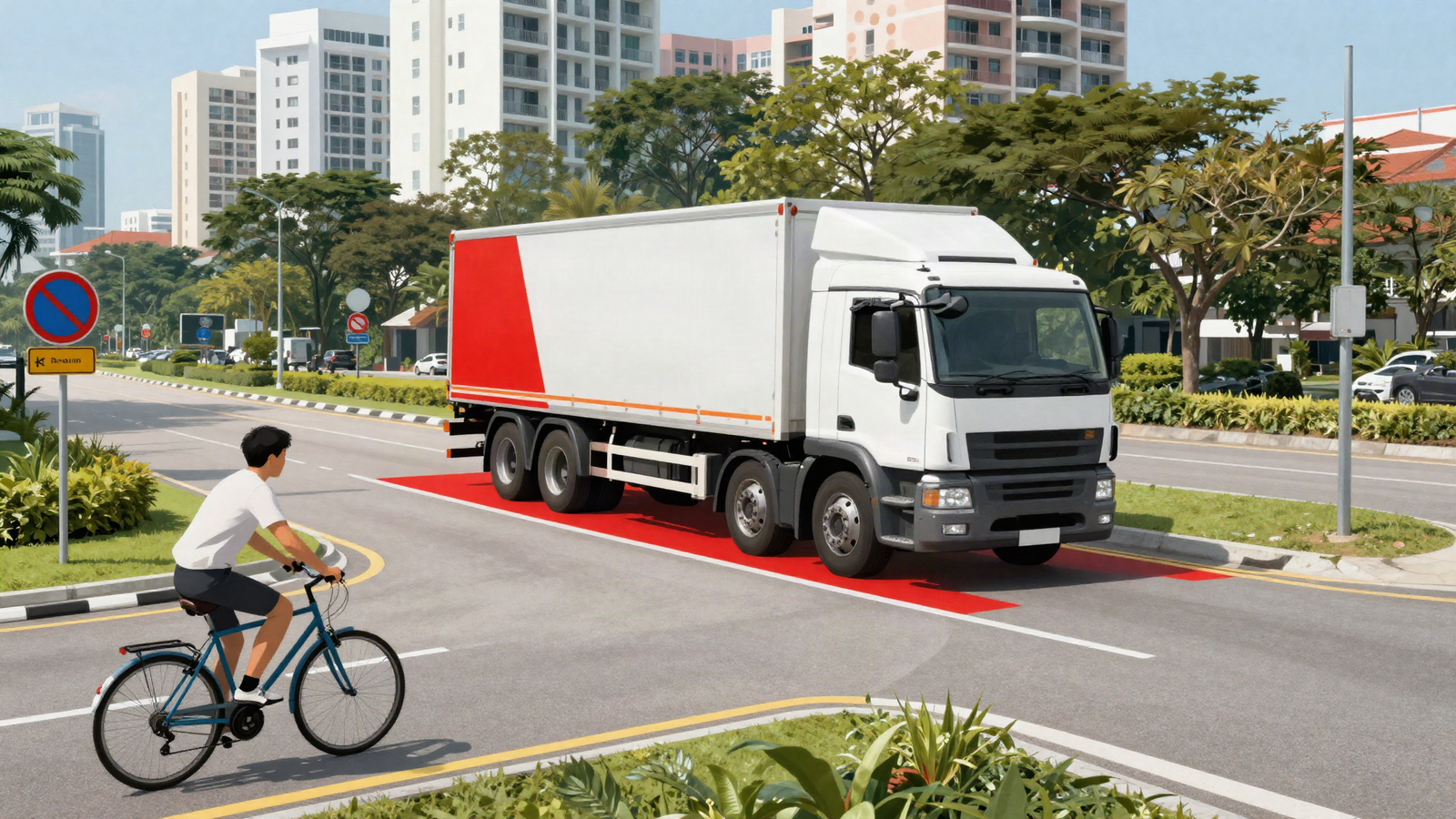
These run along both flanks of the vehicle and are worst on the side opposite the driver — for a right-hand-drive vehicle in Singapore, that’s the left side. A cyclist or motorcyclist riding alongside a lorry, in the driver’s low left periphery, can be fully hidden for the length of the vehicle. This is why filtering up the left of a stationary or slow-moving heavy vehicle is one of the highest-risk moves a cyclist or rider can make, and why so much LTA and Traffic Police guidance is aimed at both sides of that interaction.
The turning sweep is where blind zones become most dangerous. Because a heavy vehicle’s rear wheels track a tighter arc than its front wheels, the back of the vehicle swings inward during a turn — a pedestrian or cyclist positioned to the driver’s inside during the turn can be caught by the rear body or trailer even after the cab has already cleared them. This is a well-established principle of heavy-vehicle dynamics, not a Singapore-specific statistic, but it’s exactly why LTA’s guidance tells drivers to use a wider turning radius and give cyclists room to clear the junction before turning through it.
Where This Plays Out on Singapore Roads
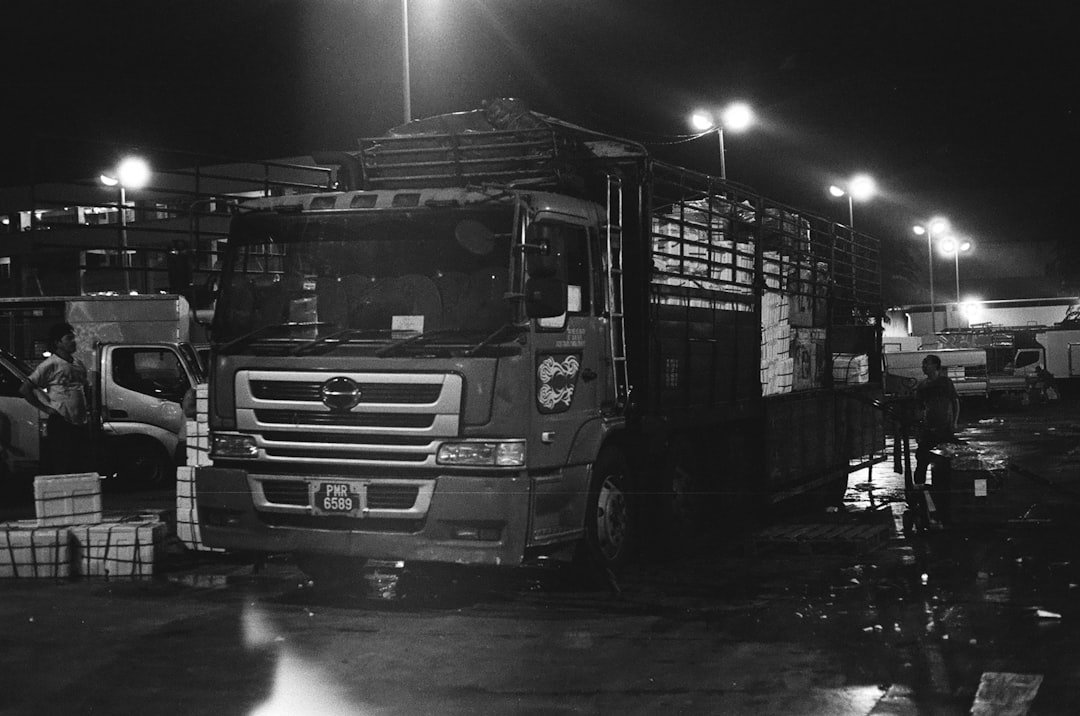
Singapore’s road network compresses these risks into a small footprint. A handful of scenarios come up repeatedly for commercial fleets operating here.
Left and right turns across pedestrian crossings and cycling paths
Junctions with a pedestrian crossing or a marked cycling path running parallel to the turn are the classic conflict point. A driver checks the crossing, sees it clear, begins the turn — and by the time the vehicle’s rear swings through, a pedestrian who stepped off the kerb a second later, or a cyclist who filtered up while the vehicle was moving, is in the vehicle’s path and in a zone the driver can no longer see from the cab. LTA’s road safety guidance specifically addresses this by asking motorists to signal turns early (at least 50m before a junction for a right turn), to use a wider turning radius so following or crossing traffic has room, and — where multiple lanes or cyclists are present — to let cyclists clear or lane-change before overtaking rather than turning across them.
Reversing into loading bays
Loading bays in industrial estates, shopping mall service areas, and HDB town centres are tight, often shared with pedestrians walking to and from parked cars, and rarely designed with heavy-vehicle sightlines in mind. Reversing is the point where the rear blind zone is at its most dangerous, because the vehicle is moving into space the driver cannot verify is empty except through mirrors or a camera — and neither shows everything, especially a person crouched low or a pallet trolley left just out of frame.
Narrow estate roads and multi-storey carpark ramps
Older HDB estates and older commercial buildings weren’t built with today’s larger commercial vehicles in mind. Narrow lanes, tight ramp turns, and parked cars encroaching on the carriageway all shrink the margin a driver has to correct for a blind spot they didn’t clear in time. A wide turn taken too tight, or too wide, compounds the risk — swinging the tail of the vehicle into a parked car, a railing, or worse, a pedestrian on the opposite kerb.
What Singapore’s Rules Actually Say
It helps to separate what’s a specific rule from what’s general good practice, because fleets are held to both, and insurers and courts treat them differently.
A specific regulatory requirement: LTA requires heavy goods vehicles and very heavy goods vehicles with a maximum laden weight above 12,000kg, registered from 1 April 2015, to be fitted with mirrors or devices — such as a Camera Monitor System — that cover the vehicle’s blind spot areas, in addition to standard rear-view mirrors. The stated purpose is to help drivers detect pedestrians, cyclists, motorcyclists and other motorists in their blind spots, particularly when the vehicle turns at a junction or changes lanes. Vehicles registered before that date have the option of a Fresnel lens fitted to the passenger-side window as an alternative. This is a hard requirement for vehicles above the weight threshold — not a recommendation — and fleets running MLW-12,000kg-plus vehicles should confirm every unit in the fleet, including older ones, is compliant.
General road-sharing guidance from LTA and Traffic Police applies to every driver, heavy vehicle or not, but carries more weight for vehicles with larger blind zones. Traffic Police’s RoadSense guidance for drivers tells motorists to always check their blind spots, avoid changing lanes at bends, keep a safe following distance, and watch for vulnerable road users such as cyclists, power-assisted bicycle users, children and elderly pedestrians who may step into the road unexpectedly. LTA’s road safety guide adds turn-specific detail: signal early, use a wider turning radius when multiple turning lanes are involved, allow cyclists sufficient space rather than squeezing past them, and — at a junction where cyclists are stopped — stop behind them rather than alongside.
Traffic Police also runs a Blindspot Stickers initiative specifically for heavy vehicles — warning decals placed on the vehicle itself to alert pedestrians and other road users to the “danger zones” around it. It’s a road-sharing awareness measure aimed at both sides of the interaction: it doesn’t replace a driver’s own mirror discipline, but it’s a useful, low-cost addition for any fleet vehicle that spends time near footpaths, crossings, or loading areas with foot traffic.
None of this shifts legal responsibility onto the pedestrian or cyclist for being in a blind spot. The rules above are guidance for drivers and vehicle equipment requirements — the driver is still expected to check, signal, and give way appropriately. Treat “the vehicle has blind-spot mirrors” and “the driver is trained to use them” as two separate boxes that both need ticking, not one substituting for the other.
Fleet-Level Mitigations That Actually Reduce Risk
Equipment: mirrors, cameras, and sensors
Start with compliance — confirm every heavy vehicle above the 12,000kg MLW threshold has LTA-compliant blind-spot mirrors or a camera monitor system fitted, including older vehicles that may still be running on a Fresnel lens. Beyond the minimum, a 360-degree camera system, reversing camera with an audible proximity alert, and ultrasonic blind-spot sensors on the nearside are all widely used fleet-safety measures — not because any one is mandated beyond the MLW threshold, but because they close the gap between what a mirror shows and what a driver actually needs to see. Camera housings and sensor brackets take a beating in Singapore’s heat and rain; they need to be on the same preventive maintenance schedule as brakes and tyres, not an afterthought.
Driver training: the wide-turn habit and mirror-check discipline
Equipment doesn’t help a driver who doesn’t check it. Training should cover, specifically: taking the turn wide enough that the rear of the vehicle doesn’t cut across the inside lane or path; a deliberate mirror-and-camera check sequence before every turn and lane change, not only before reversing; and a habit of covering the brake — not necessarily braking — when approaching a crossing or junction with pedestrians or cyclists nearby, so reaction time isn’t lost to the extra half-second of moving a foot. New drivers and drivers moving between vehicle classes (a driver used to a 3.5-tonne van moving up to a 16-tonne rigid, for example) need this training refreshed specifically for the new vehicle’s blind zones, because they are not the same shape or size as the last one.
Reversing and loading-bay protocols
A camera reduces risk during reversing; it doesn’t eliminate it. Fleet policy should require a spotter for any reversing manoeuvre into a loading bay, dock, or tight yard where pedestrians could plausibly be present — a second person standing where they can see both the driver and the space behind the vehicle, with an agreed hand signal or radio check before the vehicle moves. Where a spotter genuinely isn’t practical, a documented “get out and look” step before reversing, plus a hard rule against reversing at all when foot traffic is heavy, is the fallback — not a nice-to-have.
The Liability Angle
A blind-spot or turning collision involving a company vehicle rarely gets treated by insurers, or by a court, as a one-off driver error. The questions that follow are about the fleet: was the vehicle fitted with the required mirrors or camera system, was the driver trained on this specific vehicle’s blind zones, was there a reversing protocol and was it followed, and does the company have a record of any of that training happening at all. Gaps in those answers turn a single incident into a finding of systemic negligence — which affects claims outcomes, no-claim discount standing, and premium renewal terms well beyond the cost of the one accident. Our companion piece on commercial vehicle accident statistics in Singapore breaks down how heavy-vehicle incidents compare to the rest of the fleet accident picture, and our guide to commercial vehicle insurance in Singapore covers how insurers price this kind of exposure. If your fleet’s driver conduct and licensing records aren’t in order more generally, our overview of driver compliance requirements in Singapore is a useful checklist to run through alongside this one.
FAQ
Are blind-spot mirrors or cameras compulsory on all commercial vehicles in Singapore?
Only above a specific weight threshold. LTA requires heavy goods vehicles and very heavy goods vehicles with a maximum laden weight over 12,000kg, registered from 1 April 2015, to carry additional blind-spot mirrors or a camera monitor system on top of standard rear-view mirrors. Vehicles registered earlier have a Fresnel-lens alternative. Lighter commercial vehicles — vans and light lorries under that threshold — aren’t covered by this specific rule, though fitting blind-spot aids to them is still good fleet-safety practice.
Whose fault is it if a cyclist is hit while riding in a lorry’s blind spot?
Fault is determined case by case based on the specific circumstances, including whether the driver checked mirrors and signalled appropriately, and whether the cyclist’s positioning was itself unsafe. Being in a driver’s blind spot doesn’t automatically clear the driver, and doesn’t automatically fault the cyclist either — the standard guidance from Traffic Police and LTA is that drivers must actively check for and give space to vulnerable road users, precisely because blind spots exist. Fleets should treat every such incident as a serious one regardless of how liability is eventually apportioned.
What’s the single highest-risk manoeuvre for blind-spot incidents?
Turning at a junction where a pedestrian crossing or cycling path runs alongside the turn. The vehicle’s rear sweeps through a wider arc than the driver’s view from the cab suggests, which is why LTA’s guidance specifically calls for a wider turning radius and for motorists to let cyclists clear the area before turning through it. Reversing into a loading bay is a close second, for the opposite reason — it’s low-speed but relies entirely on indirect vision.
Do we need a spotter for every reversing manoeuvre?
As a fleet-safety best practice — not a specific Singapore legal requirement — yes, wherever pedestrians could plausibly be present: loading bays, yards, and any area with foot traffic. Where a spotter isn’t practical, a documented “get out and look” check before reversing is the minimum fallback, and reversing should be avoided altogether when foot traffic is heavy.
How often should blind-spot and turning training be refreshed?
At minimum, whenever a driver moves to a different vehicle class or a vehicle with a different body configuration, since blind zones change with the vehicle. Beyond that, an annual refresher alongside other defensive-driving training is reasonable practice for any fleet running heavy vehicles regularly in Singapore’s dense urban environment.
Does having blind-spot cameras reduce our insurance premiums?
It can factor into how an insurer assesses your fleet’s risk profile, alongside driver training records and claims history, but the effect varies by insurer and isn’t guaranteed or standardised. See our guide to commercial vehicle insurance in Singapore for how insurers generally approach fleet risk pricing.
Author: Keith Kwai, editor and publisher of SGFleetGuide, with 25 years experience in B2B and B2C companies. More about the author.
Last updated: 11 September 2026
Sources: Singapore Police Force, Road Safety Tips for Heavy Vehicle Drivers; Singapore Police Force, Road Safety Tips for Drivers; Land Transport Authority, LTA Road Safety Guide; Land Transport Authority, OneMotoring — Commercial Vehicles (blind spot mirror/camera requirements).