Singapore’s 2030 ICE Vehicle Phase-Out: What It Actually Means for Commercial Fleets
Singapore’s official 2030 target — “all new registrations of cars and taxis must be of cleaner-energy models” — is written specifically for cars and taxis. There is currently no equivalent registration mandate or ban date published for goods vehicles, vans, trucks, or private/company buses. Commercial vehicle electrification is instead being driven through time-limited incentive schemes (CVES, EEAI, HVZES) and a broader, non-binding 2040 vision for the entire vehicle population to run on cleaner energy. For fleet managers, that means no regulatory cliff-edge in 2030 for your goods vehicles today — but the financial incentives making early EV conversion attractive have their own, earlier deadlines, and those are worth planning around regardless of what happens to the mandate.
Key Takeaways
- LTA’s 2030 target is explicitly scoped to cars and taxis — the phrase used across multiple official LTA and Singapore Green Plan 2030 pages is “all new registrations of cars and taxis,” not “all vehicles” or “all commercial vehicles.”
- New diesel car and taxi registrations already stopped on 1 January 2025 — this earlier, harder deadline is also car/taxi-specific and does not apply to goods vehicles.
- Singapore’s broader 2040 vision — “all vehicles to run on cleaner energy” — is population-wide and directionally includes commercial vehicles, but it is a stated aspiration, not a registration mandate with penalties.
- Public buses are the one commercial-adjacent category with a concrete interim target: half the public bus fleet electric by 2030, all diesel buses replaced by 2040. This applies to the LTA-procured public bus fleet (SBS Transit, SMRT, etc.), not necessarily privately owned company or charter buses under COE Category C.
- No dedicated LTA page or press release sets a registration deadline specifically for goods vehicles (vans, lorries, HGVs). The transition path for goods vehicles currently runs through CVES, EEAI, and HVZES incentives, not a ban.
- Even without a mandate, the money is time-limited: EEAI ends 31 December 2026, CVES ends 31 March 2027, HVZES ends 31 December 2028 — all with no announced replacement scheme as of this update. A fleet manager waiting for a 2030 deadline that doesn’t (yet) exist for goods vehicles risks missing incentive windows that very much do.
Table of Contents
- What the 2030 Target Actually Says
- Cars and Taxis vs. Commercial Vehicles: The Gap
- How Commercial Vehicle Transition Is Actually Being Driven
- The 2040 Vision and Where Buses Fit
- Timeline at a Glance
- What This Means for Fleet Replacement Planning
- COE Renewal Cycles and the Long Game
- FAQ
What the 2030 Target Actually Says
The “2030” figure that shows up in Singapore Green Plan materials, news coverage, and this site’s own homepage quick stats traces back to one specific piece of LTA policy language, repeated near-identically across LTA’s vehicle registration pages and the Singapore Green Plan 2030 site: “From 2030, all new registrations of cars and taxis must be of cleaner-energy models.” Cleaner-energy models are defined as electric, hybrid, or hydrogen fuel-cell vehicles.
That’s the whole target, as officially stated. It sits alongside an earlier, already-active milestone: new diesel car and taxi registrations stopped on 1 January 2025, with diesel-electric hybrids specifically carved out as still permitted. Vehicles registered before that date can still renew their COE and keep running — the 2025 rule only stops new registrations going forward, same as the 2030 rule will.
Both of those dates — 2025 and 2030 — are written for cars and taxis. Not “vehicles.” Not “commercial vehicles.” Cars and taxis.
The homepage “2030 — all new vehicle registrations to be cleaner-energy models” framing you’ll see referenced around this topic is a simplification of a narrower official target. LTA’s own wording scopes the 2030 registration requirement to cars and taxis specifically. If you manage a fleet of goods vehicles or buses, don’t assume the 2030 date applies to your vehicle class the same way it applies to a company car — it currently doesn’t, per the primary sources checked for this article.
Cars and Taxis vs. Commercial Vehicles: The Gap
This is the detail that gets lost when the “2030 target” gets summarised in a single headline stat, and it matters directly to anyone running vans, lorries, or trucks rather than a passenger car fleet.
Every primary source checked for this article — LTA’s standard registration page, LTA’s EV transition page, the July 2024 diesel car/taxi announcement, the Singapore Green Plan 2030 targets page, and NCCS’s transport mitigation page — uses “cars and taxis” when stating the 2030 new-registration requirement. None of them extends that specific requirement to goods vehicles, buses, or other commercial vehicle classes. None of them, either, explicitly states that goods vehicles are excluded — the target simply isn’t written to cover them in the first place.
That’s a meaningfully different situation from “commercial vehicles are exempt.” It’s closer to: the 2030 mandate hasn’t been extended to commercial vehicles as policy, at least not yet, and not in any of the primary sources this article could locate. A future announcement could change that — Singapore’s diesel car ban itself was announced in 2021 for a 2025 start, giving industry roughly four years’ notice, so a similar lead-time pattern for goods vehicles, if it comes, likely wouldn’t arrive as a surprise next-year deadline.
For a fleet manager, the practical upshot today: you can still register a new diesel goods vehicle in Singapore after 2030 under currently published rules. That is not the same as saying you should plan your fleet around diesel indefinitely — see the incentive-window section below.
How Commercial Vehicle Transition Is Actually Being Driven

Rather than a registration ban, Singapore is managing the commercial vehicle transition through a stack of incentive and disincentive schemes layered by weight class — the same three schemes this site covers in detail elsewhere:
- Commercial Vehicle Emissions Scheme (CVES) — light commercial vehicles up to 3,500kg MLW, registered 1 April 2025 to 31 March 2027. Low-emissions vehicles get an incentive of up to $15,000; high-emissions vehicles (mainly diesel) face a surcharge of up to $20,000. It’s a financial nudge on the same registration event, not a prohibition.
- EV Early Adoption Incentive (EEAI) — applies to cars and taxis only, not goods vehicles: a 45%-off-ARF discount, capped at $7,500, for electric cars and taxis registered by 31 December 2026, after which the scheme currently ends with no announced successor.
- Heavy Vehicle Zero Emissions Scheme (HVZES) — zero-tailpipe heavy goods vehicles and buses above 3,500kg, registered 1 January 2026 to 31 December 2028, with incentives that vary by weight band. Update: LTA cut the incentive for lighter heavy vehicles (3,500–7,000kg) from $40,000 to $15,000, effective for COEs obtained from the first September 2026 bidding exercise onwards; the $40,000 rate continues for vehicles above 7,000kg and for vehicles on existing COEs. The scheme’s 31 December 2028 end date is unchanged.
- Early Turnover Scheme (ETS) — encouraged early retirement of older, higher-emissions commercial vehicles; the light-vehicle leg ended 31 March 2025 and the heavy-vehicle leg was extended to 31 December 2025 before ceasing.
We cover the mechanics, eligibility, and current rates of CVES, EEAI, and HVZES in full in Electric Commercial Vehicles in Singapore: 2026 Complete Guide and Singapore EV Grants for Commercial Vehicles: What You Can Claim — this article won’t re-litigate those numbers. What’s relevant here is the structural point: every one of these schemes has a fixed expiry date, and none of them is paired with a corresponding ban that forces the switch. The incentive expires; the option to keep buying diesel doesn’t (yet).
“No mandate” is not the same as “no urgency.” EEAI closes 31 December 2026, CVES closes 31 March 2027, and HVZES closes 31 December 2028 — all years before 2030. If your fleet replacement plan is quietly waiting for a 2030 deadline that, per current published policy, doesn’t actually bind goods vehicles, you may be planning around the wrong date entirely while the incentives that do have hard deadlines run out underneath you.
The 2040 Vision and Where Buses Fit
Layered above the 2030 car/taxi target is a longer-horizon, population-wide statement: Singapore aims to have all vehicles run on cleaner energy by 2040. This is the language used by NCCS (National Climate Change Secretariat) and LTA’s own EV pages, and it’s explicitly framed as covering the whole vehicle population — not just cars.
Unlike the 2030 car/taxi target, the 2040 vision doesn’t come attached to a specific registration-cutoff mechanism for goods vehicles in any source reviewed for this article. It reads as a destination, not a regulation — the kind of statement that sets direction for future policy (CVES, HVZES, and further schemes are arguably the implementation of that direction) rather than a rule with a compliance date attached today.
The one exception with real teeth is public buses: LTA has a stated target of half the public bus fleet running on electricity by 2030, with all diesel buses replaced by 2040. That target applies to the publicly procured bus fleet operated by SBS Transit, SMRT, and other public transport operators under LTA contracts — it is not automatically the same as a rule for privately owned company shuttle buses or charter buses, which sit in COE Category C alongside goods vehicles and follow the incentive-driven path described above, not the public bus procurement target. If your fleet includes company buses, don’t assume the public bus electrification target applies to your vehicles directly — check your specific operating context rather than borrowing the public-transport number.
Timeline at a Glance
| Date | Milestone | Applies To |
|---|---|---|
| 1 Jan 2025 | New diesel registrations stop | Cars and taxis only |
| 1 Jan 2026 – 31 Dec 2026 | EEAI (45% off ARF, capped $7,500) window | Cars and taxis only — not goods vehicles |
| 1 Apr 2025 – 31 Mar 2027 | CVES incentive/surcharge window | Light commercial vehicles ≤3,500kg |
| 1 Jan 2026 – 31 Dec 2028 | HVZES incentive window | Heavy goods vehicles & buses >3,500kg |
| 2030 | All new registrations must be cleaner-energy | Cars and taxis only — no equivalent published deadline for goods vehicles |
| 2030 | Public bus fleet target: 50% electric | LTA-procured public bus fleet |
| 2040 | Vision: all vehicles run on cleaner energy | Whole vehicle population (non-binding vision, not a registration mandate) |
| 2040 | All diesel buses replaced | LTA-procured public bus fleet |
What This Means for Fleet Replacement Planning
Three practical conclusions follow from the research above, and all three matter more than the headline “2030” number itself:
First, there is no regulatory cliff-edge for your goods vehicles in 2030. Unlike a company car fleet, which genuinely cannot register a new diesel vehicle from 2030 onward, a goods vehicle or truck fleet faces no equivalent published deadline. You are not legally forced to have replaced your diesel vans and lorries by a specific date — as things currently stand.
Second, that doesn’t mean the ground isn’t shifting under diesel anyway. The incentive schemes above are explicitly designed to make cleaner-energy commercial vehicles cheaper at registration and diesel ones relatively more expensive (via CVES’s surcharge band). As the passenger car market moves further toward EVs post-2030, expect knock-on effects on diesel fuel infrastructure, servicing capacity, and eventually resale markets for commercial diesel vehicles too — even without a formal ban forcing the issue.
Third, plan against the incentive deadlines, not the absent mandate. If part of your fleet renewal decision over the next two to three years is being deferred on the assumption that “2030 is when this becomes mandatory anyway, so why rush” — that assumption doesn’t hold for goods vehicles under current policy. The actual deadlines that affect your budget arrive in 2026, 2027, and 2028, well ahead of 2030, and they get you real money now rather than compliance later.
Build your fleet replacement roadmap around the incentive expiry dates (EEAI Dec 2026, CVES Mar 2027, HVZES Dec 2028), not the 2030 headline figure. If a vehicle in your fleet is due for replacement in the next three years anyway, that replacement decision is happening inside a window where the incentives are real and the mandate isn’t — which is the more favourable order for your budget than the reverse.
COE Renewal Cycles and the Long Game
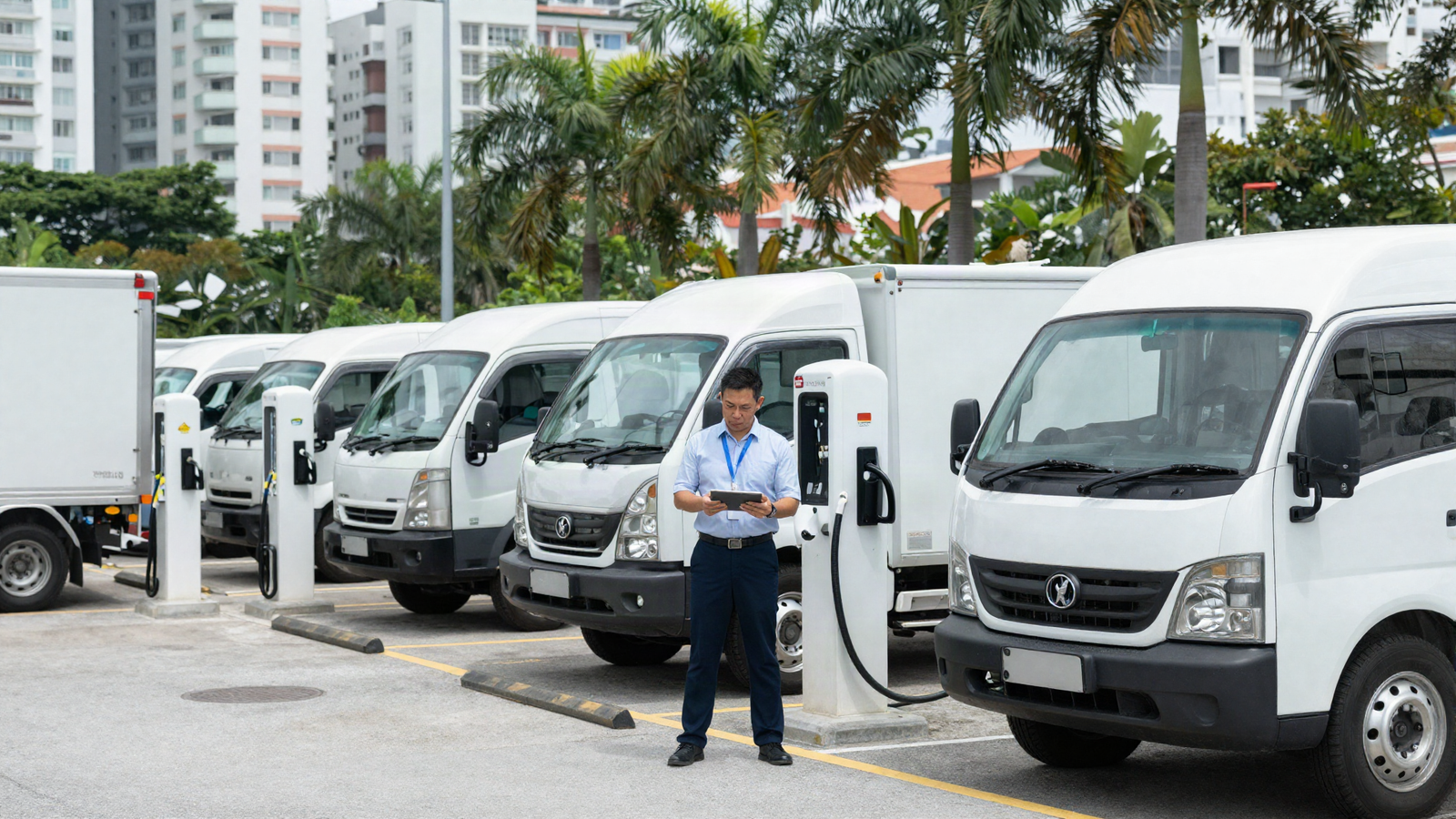
Goods vehicles register under COE Category C, which runs for 10 years with no PARF rebate at end of life — full detail in our COE Category C guide. That 10-year cycle is worth overlaying on the dates above:
A goods vehicle registered in 2026 hits its first COE renewal decision around 2036 — six years past the car/taxi 2030 cutover and getting close to the 2040 whole-population vision year. By then, the EV commercial vehicle market, depot charging infrastructure, and specialist servicing capacity will very likely be considerably more mature than today, and a diesel vehicle’s resale and servicing position may have weakened regardless of whether a formal ban ever arrives for goods vehicles specifically.
A goods vehicle registered around 2020, renewing its COE now in or around 2030, sits at a genuinely interesting decision point: renew for another 10 years on the current vehicle (taking it to roughly 2040, right at Singapore’s stated whole-population target year), or use the renewal moment to replace with a cleaner-energy vehicle while some version of the current incentive landscape may still exist. Neither choice is obviously wrong — but making it with the 2030 car/taxi target correctly understood as not your regulatory deadline, and the incentive windows correctly understood as genuinely your deadline, should change which option looks better on the numbers.
FAQ
Does Singapore’s 2030 target ban diesel trucks and vans?
No. LTA’s 2030 target, as officially worded, applies to new car and taxi registrations only. There is currently no published 2030 (or other) registration ban specifically for goods vehicles, trucks, or vans.
What is Singapore’s actual 2030 vehicle policy?
From 2030, all new car and taxi registrations must be cleaner-energy models — electric, hybrid, or hydrogen fuel-cell. This follows an earlier rule that stopped new diesel car and taxi registrations from 1 January 2025.
When do commercial vehicles have to go electric in Singapore?
There is no fixed mandatory date currently published for commercial vehicles as a whole. The transition is being driven through incentive schemes — CVES, EEAI, and HVZES — rather than a registration ban, alongside a broader non-binding 2040 vision for all vehicles to run on cleaner energy.
Is there a diesel ban for goods vehicles in Singapore?
Not as of this update. The diesel registration ban that took effect 1 January 2025 applies to cars and taxis. No equivalent ban date for goods vehicles was found in LTA, NCCS, or Singapore Green Plan 2030 sources reviewed for this article.
What happens to my commercial vehicle’s COE if I don’t switch to an EV by 2030?
Nothing changes automatically at COE renewal because of the 2030 date — that target doesn’t apply to goods vehicles. Your COE Category C renewal is governed by its own 10-year cycle and current market premium, not by the car/taxi cleaner-energy mandate.
What’s the difference between the 2030 target and the 2040 vision?
The 2030 target is a specific, worded registration requirement for cars and taxis. The 2040 vision — all vehicles running on cleaner energy — is a broader, population-wide aspiration without an attached registration mandate found in current published policy, except for the public bus fleet, which has its own concrete 2030 (50% electric) and 2040 (all diesel buses replaced) targets.
Do commercial vehicle incentives disappear after 2030?
They disappear well before 2030. EEAI ends 31 December 2026, CVES ends 31 March 2027, and HVZES ends 31 December 2028 — all with no announced replacement as of this update. Don’t confuse the 2030 headline date with when the money runs out.
Author: Keith Kwai, editor and publisher of SGFleetGuide, with 25 years experience in B2B and B2C companies. More about the author.
Last updated: 14 September 2026
Sources: LTA — Standard Registration | LTA — Transitioning to EVs | LTA — Registration of Diesel Car and Taxi to Cease on 1 January 2025 | LTA/NEA — CVES and ETS Extended | NCCS — Transport Mitigation Efforts | Singapore Green Plan 2030 — Our Targets